111 (if it could feasibly be allocated) would be the best three-digit code. You would spend the least amount of time rewinding, fingering, and returning. The minimum time per symbol would be 0.1s for the single pulse, ~0.3 seconds for the pause (that section on the dial between the backstop and the 1 digit hole) and about 0.1-0.2s for the finger and wind (reduced due to Fitts's law, and easier for the blind since it is the first hole from the backstop rather than the second). These factors combined could cut the dial time easily in half.
Numbers with widely separated digits such as 911 in the US or 119 in Japan are less likely to be accidentally dialed than numbers with similar or identical digits such as 999 or 112. As the article notes:
"However, around 35 per cent of calls do not involve actual requests for help, with the majority of these made by children playing with home phones or people accidentally dialling 999 or the European emergency number 112, often from a mobile handset in a pocket or handbag."
Though phones which map the emergency number to speed dial may negate the advantage.
Accidental calls waste time and potentially divert resources from real emergencies.
At rest the rotary dial was at say null. As soon as you moved it over a number and then released it, that was the number that was dialled. 0 and 1 were first (obvs). When you hit the backstop (a small metal shim) then you had hit nine. It isn't as bad an interface as it might sound. You would get feedback via a series of clicks as the dial returned to null and also via force (springs etc).
There really was a good reason for picking 999 originally and the world has moved on since but I still assert that 999 is a far better number (or nowadays: a symbol) for invoking an emergency call than any other number.
I too used rotary phones - I'm 28 (if it makes a difference) and I grew up in a former Soviet republic. The phone had a dial with 10 holes in it: 1-9 followed by 0 (just like on a modern phone keypad, by the way). You stick your finger in a hole over the digit and rotate clockwise until the the stop. Then, take the finger out and wait for it to rotate back to the original position. Then you dial the next digit.
I'm not sure what to tell you to do to fix this problem, but I thought you might want to know. I think the site tries to trick you into thinking everyone can see your comments when they're actually made dead. So you might never know.
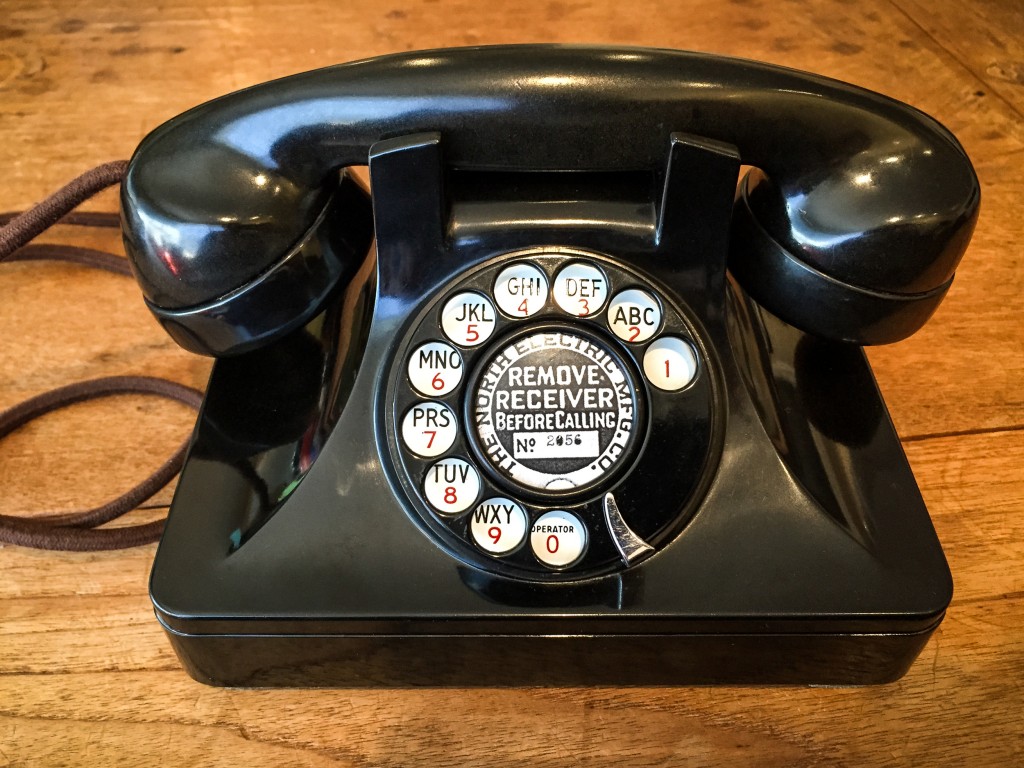


What did yours look like?
Unless I'm misunderstanding what you are saying, which is entirely possible.
I suspect 911 was chosen similarly.
https://en.wikipedia.org/wiki/Rotary_dial
That article has a UK, a New Zealand, and a Swedish phone, and you're right, all different layouts.
> The Australian letter-to-number mapping was A=1, B=2, F=3, J=4, L=5, M=6, U=7, W=8, X=9, Y=0
wat?
> In the United Kingdom the letter "O" was combined with the digit "0" rather than "6".
nooo...
> In Norway, the North American system with the number '1' corresponding to one pulse was used, except for the capital, Oslo, which used the same "inverse" system as in New Zealand.
holy crap
> the United Kingdom selected 999 due to the ease of converting call office dials to make free calls. "0" for the Operator was already free, and the cam that removed the shunt on the line when the dial was rotated to the "0" position could be altered to include the adjacent digit "9" (and "8" if required) so that calls to "0" and "999" could be made without inserting coins.
And there we have the explanation for GPs assertation that "999" was the best number, it was instead a purely technical limitation in the mechanical construction of pay phones.
When I was a lad you put your finger into the bottom left hole of a rotary dial and moved the dial clockwise until it was over the chosen number. You then released your finger and allowed the dial to roll back to null. You then dialled the next number etc
You did not press keys. That is why 999 was chosen. Telephones with rotary dials had obvious clues to where the home "hole" was - where you would dial from - and you would hit the backstop when you hit nine when you rotated the dial.
It's not rocket science 8)
The whole point of 999 was that a nine was the only number you could guarantee to accurately dial blind on a rotary input device with only your sense of touch and a little knowledge about the device itself available to you.
I'm also not too sure why any other number would be preferable. 999 really stands out whereas all the other emergency numbers across the world do not. I'll accept that because I'm a Brit that I have been conditioned to 999 being THE emergency number might bias me somewhat but I think my point still stands: 999 is far more obvious than any other emergency number.
I do a lot of (modern ie VoIP) telephony work and can only think that the 9 for an outside line plus rubbish dial plans and crap hardware and programming meant that 999 might not work for some systems. I've also explored the "not British" criteria for the number ... 8)
Can anyone explain why 999 is not the best emergency number ever chosen?