When tires are tested, apparently the manufacturers are asked to send in the tires to be used in the tests. Why on earth would a tire testing entity do that, unless they are receiving bribes from the tire manufacturers? [1]
[1]: http://www.autoblog.com/2016/02/26/nokian-tire-test-cheat-re...
Because the law on how regulators work was written by the auto lobby. (At least, that's how it is in the EU. Don't know about the US.)
No, that was a result of the Clean Air Act Amendments of 1990 for the reduction of acid rain. Though it was targeted towards industrial emissions of SO2 & NOx, but stricter regulation for vehicles were an additional effect.
>specifically disadvantaging European diesel cars
That's a weird argument given that diesel passenger vehicles in the US are held to the same standard as gasoline ones, but to a separate standard from their petrol counterparts in the EU. I mean, one could argue the opposite, that an EU emissions policy favorable to diesels amounted to an equivalent 13-16% import tariff. [1] Several domestic rather than just foreign diesel engine manufacturers were also penalized for using defeat devices in 1998.[2]
> (which are much cleaner overall)
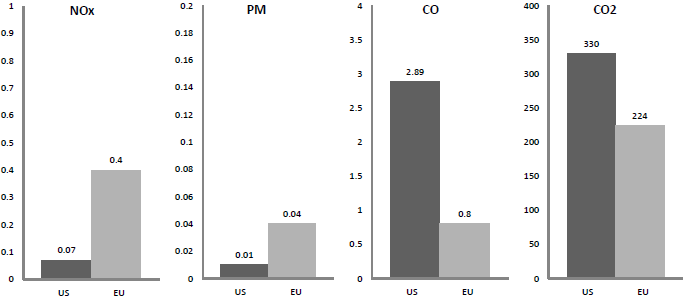
That's quite arguable, trading lower CO2 & CO for increased NOx & PM.
[1]: http://www.eugeniomiravete.com/papers/MMT-Diesel.pdf
[2]: http://articles.chicagotribune.com/1998-10-23/news/981023011...
Surely car manufacturers didn't have a say, which is why US and EU emission standards look like this https://longtailpipe.com/wp-content/uploads/2015/10/us-europ... .
>same standard as gasoline ones
Well duh, let's keep diesel cars to petrol standards so that their benefits don't matter and their disadvantages are prohibitive!
As per the source of the image says, "On the other hand, American regulators are focused on smog and health impacts of air pollution." Which the graphic you provided well indicates.
Look, California was probably the first governmental entity to regulate tailpipe emissions. Such so that it's written in the Clean Air Act by name to run its own regulatory scheme to enact stricter regulation(with federal waivers, but that's another issue). The reason being, that LA's unique geography makes smog worse. Heck, in the 1940s, they had an episode severe enough they thought they were under chemical attack by the Japanese. As such, CARB's emission standards were focused on reducing the more directly harmful pollutants like hydrocarbons, ozone, NOx & PM. So, given California's influence on the original 1970 Clean Air Act and the 1988 California Clean Air Act's influence on the subsequent amendment in 1990, I don't see how that graphic would support your argument. I mean, had they such hypothetical power, they could have also blocked the banning of leaded gasoline that was in the same amendment.
>Well duh, let's keep diesel cars to petrol standards so that their benefits don't matter and their disadvantages are prohibitive!
Emissions vs fuel economy. You're being facetious, but if that argument was true, why bother importing diesel passenger vehicles into the states? They didn't even start reintroducing diesels in America until they thought they could harmonize emissions from Euro 5 with Tier II Bin 5.
And there could be an appeals process whereas when a car fails it can be tested again, and the tests monitored by a 3rd party, etc.
This can become a privacy issue though. Suddenly, you're able to associate licenses with a set of persons with some probability. And you're able to collect side channel information about the vehicle being in motion, and the speed of the vehicle. And who knows what more you can read from the sensors of a modern vehicle. I know of a couple of vehicles with GPS sensors.
Overall, this discussion is very interesting to read, because this is the discussion about unit testing to a dot. We are unit-testing cars with a mock road - and unit testing fails with malicious and/or stupid workers building the unit. Every set of unit tests can be satisfied by a lookup table - this is happening right now in cars.
So now, the question is: Which of the bigger system control tools do we use. integration tests, so, taking cars on a race track? Property based tests - randomize the length of the test, define ranges of acceptable pollution. Live system monitoring? Maybe a pipeline of tests?
a piece of code which purpose is specifically defeating the testing cycle instead, run directly afoul of the regulations, no arguing against multibillionaire company needed.
I don't understand this from a regulator's point of view: as a regulator, all you have to do is test for symptoms. You don't have to explain root causes. You drive the vehicle in conditions as close as possible to real ones, measure emissions, and decide whether or not they're above the norms.
Why would regulators do this in a lab? It's like health inspections that would ask restaurants to send food to be tested, instead of showing up anytime, unannounced.
Regulators should pick up real cars from real owners and test them on the road, at regular intervals.
Or, modern technology should allow to test a car all the time and report emissions and fuel efficiency, etc. during its lifetime.
People cheat, and if cheating is easy they cheat more. The one thing a regulator cannot do is trust the industry.