I came at this way back in the epaper epoch by getting an Illiad2 from IRex Technologies (a large epaper device with a watcom digitizer), I've since gone through an iPad, iPad Pro, and currently use a Surface Pro 4 for this function.
The essential bits are exactly smooth drawing on it and for wide market penetration low cost. I have been really impressed with Microsoft's ASIC which makes drawing on Surface almost lag free.
Sony on the other hand has a history of weak business models, I was amused by their selling of the books made available by the Gutenberg project for their original e-book (as an example).
The product I would find really interesting (and would buy at least one of :-) Would be an e-paper tablet that I could draw on at a reasonable PPI (200+) that was US standard paper drawing area, built in wireless network and presented to my computer as a 'printer' on the network. I would use it by printing to it from my phone or my laptop and I would use it to review things and write notes on them (sort of like Drawboard PDF) and then either push the annotated prints into an archive or delete them once I was done with them.
I don't think it's quite US Standard Paper (I don't have mine with me at the moment to check), but it is quite a decent size.
It takes only a moment to save what you've written, and clearing the screen takes a split second. You do have to use a special stylus it comes with to write to the device though, other strokes won't be saved. The battery life is supposed to be ~7 days of run time, if you were writing continuously. It is quite slim, and very light weight.
From what I've read, the PDFs store your pen strokes. They claim this is optimal for OCR, but I've never tested that claim.
If you compare what you can do with that vs a Surface Pro 4 pencil and Drawboard PDF the contrast is fairly startling (and expected given order of magnitude difference in price).
I asked the inventor of the Boogieboard at Makerfaire if they had ever considered making a large whiteboard sized one (that would be pretty useful in my lab). He said they would consider it but there were technical issues with the surface area vs the erase mechanism (something like generating a very strong electric field across a very large area like that).
I would use it by printing to it from my phone or my laptop and I would use it to review things and write notes on them
Very interesting. This is a workflow I could get behind of.
I personally can't stand the idea of using that much paper, but I dig the future-y idea of printing to a read/markup slate, and automatically posting the markup to phabricator.
I imagine legal and other business functions that are review heavy could similarly benefit.
That's why I like to print code in an ultra-small font with 4 pages per sheet, duplex.
Right now I do something similar (but more cumbersome) with my iPad Pro: I print to PDF, save the PDF in iCloud Drive, and then open it in Preview on the iPad, which lets me annotate it with the Pencil.
What I really wish I could find is some way to do the same for e-books. Amazon, if you're listening, it'd be a game changer if you could support this in the Kindle app.
DPT-S1 even with its limitations (PDF only, so Calibre is extra helpful) it feels amazing to read on it.
It is a combination of hardware (lighter than 9 inch iPad, amazing screen, battery lasts a month) and quite decent software tailored for PDF reading and note taking.
I read on multiple devices, iPad Air, Kobo H20, Kindle DX and others.
Out of all devices DPT-S1 is by far my favorite for consuming text and gray scale images.
I thought of ordering a dev kit for the 13.3 inch screen but Sony really did do a good job on this that no single developer could hope to come close.
BOM for DPTS1 is probably around $200, so I envision a future where digital paper could reach mass adoption and cost less than $100.
For some reason no company feels compelled to push for this mass adoption.
Jumping into almost SF realm I'd say what we need is a 400 pages A5/A4/A3 standard book. With blank pages. Those pages are made from a material that feels like paper so the book folds, is lightweight and can be flipped through. There's a switch (or a knob or whatever) on the back cover and when pressed the back cover screen allows you to select which books you want to load. Then e-superink © displays the content on all the page at once. And now you have the exact same experience you have with real books (flipping through, knowing more or less « where » you are in the story). Except the back cover can launch a search bar. Oh, and you can write on pages and it's recorded in the software which displays it again when rendering pages.
Back to reality and to some of the geek things of the early 2000's: IBM had some kind of foldable screens in the demo department. I remember some video or concepts and you could see a guy reading his newspaper on his folded screen. Attach 8 of them together in a binder and you got some kind of physical computer interface that you can easily skim, read and pass around.
edit: Dug out a 2000 wired article about that very subject https://www.wired.com/2000/08/epapers/
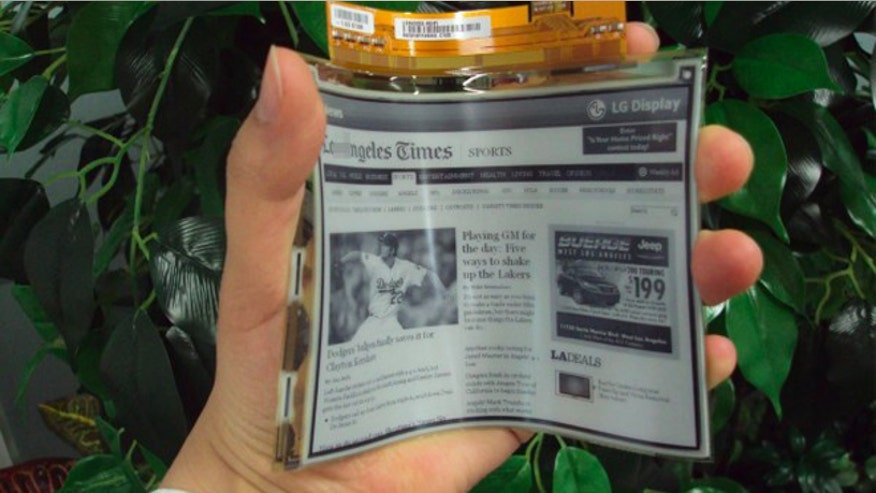
edit flexible screen picture: http://a57.foxnews.com/global.fncstatic.com/static/managed/i... and http://www.computerworld.com/article/2507175/emerging-techno...
But ... what exactly does it solve? Fundamentally all it provides is a way to mechanically flip through the pages of a digital book. It doesn't replicate a real paper book, in terms of feel, smell, or nostalgia.
Ignoring nostalgia, is the ability to mechanically flip through a book important? Is that the ideal way to traverse a large volume of text? I doubt it. It's unlikely that, when humanity designed paper books they stumbled on the ideal way to handle a large volume of text.
When I'm reading things on my computer, whether they're articles or books, I never really think "man I wish I could flip through this text like a book." PgDn handles that just fine.
What I usually long for is a more portable form factor, which tablets solve, and more space. Side-by-side pages is great, not just for reading, but also for looking at different sections of the book at the same time. Again, a tablet _could_ solve that. If they made e-ink tablets larger ...
Heavy readers and researchers I'm sure will argue about bookmarking and notes. That's not unique to physical volumes; tablets can handle that. And again, probably better. Maybe we don't have the right UIs for them yet. But I guarantee we eventually will.
Basically, I don't think having a bunch of e-ink pages is what we need. We just need the readers to be bigger, faster response time, color, physically flexible, and have better UIs.
Of course, none of that addresses the nostalgia factor. But I don't think people are going to have such a strong desire for old fashioned books once we have e-ink readers that are fundamentally easier to use than physical books.
Nostalgia is always a shrinking market. Imagine someone who really wanted to access Google using the Dewey Decimal System. At least the amount of content in books remains about the same as it always has.
But I'm honestly kind of amazed that something like this isn't already widely available at a reasonable price... I don't feel like my needs are that atypical and it's just the dream product to me.
Edit: Curse you autocorrect!
The Mobileread discussion linked from there is >60 pages of discussion including staff from the company, and there's discussion of a Boox Max 2 coming out later this year that will have the higher-resolution screen, touch instead of pen, an updated (but still slow) processor, possibly a bump in Android version (still ancient, jumping from 4.0.4 to 4.4 perhaps?). Doing a little digging, the processor change may not be a processing power increase but a power consumption decrease (i.MX6 to i.MX7). Note that all of this is unofficial and that it doesn't seem like the details have been finalized.
I'll also note that (without reading the whole 60+ pages) I saw at least one person who'd also installed apps from the Google Play store and found that troublesome, particularly when updating the firmware in the device.
Edit: after a bit more reading on Mobileread there might also be a 10.3" version of the Boox ("Boox Note") towards the end of the year; they're taking prototypes to the Hong Kong fair to gauge interest but would likely not do mass production until October (https://www.mobileread.com/forums/showthread.php?t=285006)
When I read this post about the Sony tablet, I'm thinking the product space is getting interesting--FINALLY!!
Which is a shame because I'd love to purchase this for reading technical books.
b&h photo had one in their store to play with. Was very nice, weighed much less than I expected, but still wasn't quick. They seemed to push the note taking with a stylus feature which I didn't really care about.
The 13 inch size is amazing, but leaves the whole thing probably larger than I really wanted.
It's also nearly impossible to find a physical place where you could test it without making an appointment. There are few things I want more than a product like this to succeed. I have had a couple of Microsoft Surface products, and they are amazing. Game changing even. But nothing beats e-ink as far as being pleasant on the eyes for extended periods of times.
I've been trying to move from books to e-books, just because I don't have a lot of space to keep books anymore. For non-technical books, a Kindle suffices. But for anything even slightly technical everything falls short. Nothing comes close to the experience of physical books. The surface is the closest for me, but even that the software available for making annotations on it is lackluster, and just staring at a screen too long is not pleasant. This sort of large e-ink tablets I hope are the solution, but their popularity being so lackluster, makes me think that those that have spent the money aren't quite happy with it.
I wish more products like this keep coming out until one sticks.