1. Storage. As a family with little kids, the car is a mobile storage for diapers, toys, and other stuff. This was the main reason, why we got our own car. We used car sharing before.
2. Customization. Cars are still a status symbol and for heavy commuters also living space. Car manufacturers already provide more and more options to customize.
The second reason is not that strong. I can imagine that cars lose the status symbol appeal, because economic reasons always win. Eventually, only rich people own their cars.
The first reason is difficult. My prediction would be that many people will switch to car sharing. It is already happening even without autonomous cars. Families with little kids still want their own cars. Effectively, it becomes more expensive to have kids due to autonomous cars, relatively.
That said, I don't think self-driving taxis will completely replace car ownership, at least in the medium term.
(Cheap robotic guaranteed theft-free car valeting might change this, I grant you)
1. Some people will used shared ride services, so the shared car rarely needs to park.
2. Cars will be able to much more densely park. Autonomous cars that can communicate with each other can pack themselves in on the side of the street bumper to bumper. In parking lots with rows, spaces can be much narrower since people don't need to open the doors, the car can just pull forward itself. Even the rows between cars can be filled up. You see this at the facebook campus now because they don't have enough parking, but it takes an army of valets to move all the cars around.
3. People will own and drive smaller cars on average. Even for people who do own a car, the ability to have a larger vehicle available on demand will tend to make them buy smaller cars.
4. Even when it's hard to find parking in an area, the car can drive itself to areas where parking is less scarce.
Overall my guess is that all of these are going to effectively increase the amount of parking available by 4-5x. Parking simply won't be a problem anymore, unless of course this induces demand, we build higher, and without parking garages...
I don't feel comfortable renting out my car to strangers while it's not being used. I'm afraid of it getting dirty, them not operating it properly and causing mechanical damage that won't be seen for weeks.
On the other hand, having an "on demand" car service as my only option would increase my transportation costs. My car is paid off, insurance is almost free and gas is dirt cheap in the US it might as well be free. If I had to Uber around with self driving cars my costs of getting around would skyrocket.
Are you suggesting having your own car as well? That's the only way I could see this working.
I've done some of the math on this; here are some very conservative figures.
- $50/mo for reasonable high deductible coverage.
- $100/mo gas
- $100/mo parking at the office
- $x /mo parking at home (not realized in my case)
- $80mo misc expenses (tires, wiper, diy synthetic oil change, taxes, car wash)
$330/mo pays for a lot of $5 uber pool trips.
And while our cars are paid of; The average American does not and is increasingly spending more. This adds an additional $300 to the amount I can spend on trips.
This says nothing of the current liability of driving a car. Where an accident with a > $50k car with over $100k of medical costs creates a gap in coverage for the average American.
I don't know what kind of car you drive, but my wipers cost $40, and don't get replaced every year, my oil change is ~$50, my tires cost me ~$400, but last for 60,000 miles.. At some point in my car's life, I will probably throw a few thousand dollars into repairs - but its cost of maintenance is not going to be ~1,000/year.
There's also various licensing and registration fees, which are, essentially, roadway and driving taxes. You're going to pay your share of them, regardless of who owns the vehicle you will be riding in.
These are not conservative figures, unless you're driving an M1 Abrams, or, like my partner, a 20-year-old junker...
And, of course, if you're driving 100 miles/work day, I doubt those uber trips are going to cost you $5.
UK example here. During the course of my work career I have driven 700,000 miles, which is to the moon, back to the Earth, and most of the way back to the moon again. Or about 28 laps of the equator.
I live in a semi-rural village 65 miles from my place of work (a town about an hour away from central London) and visit clients scattered around the south west of England. Several of my colleagues live 30 to 40 miles from our main site, but far enough from me that we can't car-pool. This pattern of commuting is quite common in the UK for people living outside major cities with approx 3.7m workers having a commute of two hours [1] (including trains as well as cars).
By the way, I am really bored with the M3 motorway.
[1] https://www.theguardian.com/money/2015/nov/09/million-people...
I guess it beats $25 Uber rides though
- Synthetic Oil parts cost $26 for 6 quarts + $10 for a premium filter.
- A Car Wash Once a month is $20
(I didn't list any surprises, alternator, cooling system, ac, blower, emissions, brakes, suspension, oil leaks, wheels, etc - and I can assure you that plenty of people spend over $1000 on many of those when they go to designer car shops or dealers.
I definitely forgot that I was talking within the context of trips that are your typical uber trips.
Uber and public transportation has made it extremely easy for my family to get rid of one car, but not both. Maybe if I were a light-packing 20-something single person in SF I could get away with Uber pool all the time, but for most people it's a non-starter.
- $40 for insurance
- $30 gas
- $5 (Maintenance)
$75/month on my end. If I were to UberPOOL everywhere, besides the fact that it would be inconvenient because it would take longer and I would have to share a ride, it would cost more.
You also can't just totally discount the initial cost of the vehicle like that as "free."
(1) https://www.edmunds.com/car-care/how-old-and-dangerous-are-y...
Most states have tax depreciation/deductions per mile that are considered by most to be much lower than accurate. In GA, it's $0.55/mile (real costs were estimated $1/mile at $4 gas); so, at $30/gas, you're being very "efficient" because it should be costing you at least $150/mo for that kind of mileage.
This is no easy function as it depends on your fixed costs vs. variable costs and trip lengh.
Especially for people going shot distances on rare occasions a rented car might be the better option.
I don't think anyone is suggesting it would be your only option, simply that most people would prefer it because it will be cheaper (since you're amortising the overheads of car ownership over many users).
And while owning a car might feel prudent, if taxis become cheap enough, it might not be the best investment for your money anymore.
The on demand service will have well maintained cars, where the biggest costs (depreciation and insurance) are shared between a large number of people. There's just no way¹ private cars will be cheaper.
1 - Ok, there's government intervention and monopolies. Given a competitive market, there's no way.
With level 5; this doesn't happen.
It astounds me how naive and over-optimistic we are seeing enthusiasts of self-driving cars behave. The industry is in its infancy, but people talk about it like our roads have been exclusively filled with them for decades, and all challenges and bugs have been conquered. Surely every person who talks about these cars like it's a solved domain can't all be prospecting, bandwagon investors.
I can't get a bug free desktop OS after 40 years of development, what chance a fully automated vehicle?
Level 5 is a fantasy world as it is, let's not pretend it can do even more than is described.
An example of an unintended consequence of fully autonomous vehicles would be what might happen to where people want to live and hence the structure of communities and property values.
Just mentioning it as a bit of "expectation management" for what the article is about, since there's overlap between consequences one doesn't anticipate and consequences that are unintentional, but it's not quite the same thing.
- still shake on bumps,
- make reading uncomfortable for many,
- not be quiet,
- be too small to stand up and stretch
- not have a toilet so you still have to stop somewhere
- not make eating on a run any easier.
It is certainly more comfortable than driving for few hours so it can extend commutes, but not by that much.
You can't expect to be able to sleep comfortably in a moving car. It will be like trying to sleep while someone tries to wake you up - noise and constant erratic movement. Even if you can get over it, to maintain safety you will have to be strapped to the bed and make sure that nothing heavy (even your phone) would struck you in case of an accident.
I once had a great idea - a car that would drive backwards with complicated display system to show a road in the direction you are actually driving. The idea was that it would be safer than seat-belts. But there is a reason why seats (even passenger seats) in a car are front facing. In case of an accident everything will try to maintain it's momentum. If you would have a coffee or a phone in your hand it will struck you in your face.
That's a problem that makes sleeping in comfortable bed inside a car dangerous. You can't get around it for foreseeable future.
I think not having to deal with parking will be one of the major benefits of self driving cars. It gets even better if you just rent a car for a couple of minutes instead of owning it.
Hopefully it'll be like a taxi at a much lower cost.
Creeping to the next free parking spot while scanning online availability data could easily be the one task where robotic cars would be consistently safer than drivers.
I think self-driving cars and the ever cheaper cost of electricity will fundamentally change everything.
A huge problem remains though : how do you avoid having dirty/smelly/broken cars all the time when everybody is sharing cars ? People are usually way more cautious with there own stuff than with others'.
The city bike-sharing systems around the world usually chose «indestructible» bikes to deal with this problem, but as a result you get a really heavy and uncomfortable bike and I don't think you could do this for cars anyway: no matter how robust is your car, spilled drinks or food on the seats are still a pain … This kind of system definitely needs a way to avoid the tragedy of the commons.
Elinor Ostrom[1] showed that there are mechanisms to regulate this efficiently, but you need to actively deploy them and it's better not be an afterthought.
If you do nothing and let people be toxic human beings, you'll end up with shared cars in worst shape than public transport (because in public transport you have a kind of social pressure that limits the bad behaviors)
Owning a self-driving car may be cheaper and therfore move viable if they are safe (a few sensors instead of expensive construction and safety technology).
Self-driving cars could be cheaper if they turn out to be domesticated nodes in a network instead of status symbols.
I wouldn't completely rule out car ownership just yet...
That's a little futuristic, but sensors and software could potentially be good and cheap to get things safe.
Talk about superficial thinking.
Half the time I get in the car it's for a spur-of-the-moment run to the store.
And while the bus stops 300 ft from my house I've never ridden it.
I don't want my car off earning money when I need it for something important like running up to Home Depot so I can finish whatever project I'm working on.
"The ideal state of a resource is idle and ready for work."
People owning cars like today that drive and park themselves, after that maybe people are willing to rent out those cars when they don't need it. Many people probably would not do this all the time because they don't want to risk the car not being present when they actually need it in some cases.
Only after that and only if enough of self driving cars are available at all times, would people really stop buying their own cars.
Your idea of the drive-thru for self driving cars will also take some time to actually happen, self driving will not happen from 0 to 100 with all possibilities a reality from the beginning.
And why would that bother you to the point of having to stop reading? Because if it causes rejection on an emotional level, I'm more inclined to think the discomfort is a consequence of it challenging your worldview. Which is likely one of driverless cars being the magical technological cure for all transportation problems. Especially since your suggestions, at least when formulated as briefly as this, are demonstrating quite a bit of superficial thinking in themselves:
> So instead of worrying about parking, you order a car, and it picks you up, and then you get dropped off. It drives off and services other customers. Then, when it comes time to get driven home, you order another car that comes and picks you up.
A the car is being shared without supervision, and somehow this will all magically go right, because vandalism doesn't exist in public spaces right now while we still have human supervision either, right? As Nathan Pyle once wrote about NYC public transport: "Beware the empty train car, it is empty for a reason."
http://also.kottke.org/misc/images/nyc-tips-etiquette.jpg
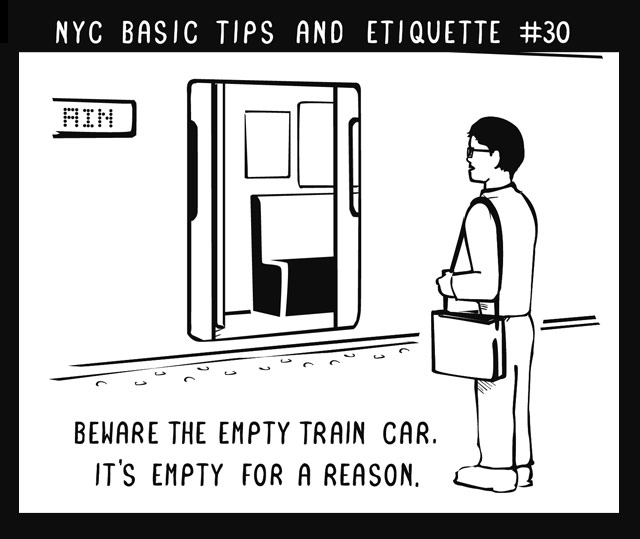
I mean, come on, the tragedy of the commons is ancient and well-established economic theory by now:
https://en.wikipedia.org/wiki/Tragedy_of_the_commons
> You only pay for the car while it's driving you, not while it's sitting there doing nothing.
Except that in the scenario you suggested cars are never "doing nothing," they are constantly driving around. Even if they have no customers. You suggested we wouldn't bother with parking, remember? So we'll get into a scenario where swarms of empty driverless cars are clogging up the road waiting for customers.
And this can realistically happen if we don't pre-emptively regulate this, because we'd have competing different companies with swarms of cars who don't want to share their parking infrastructure for "resting" cars, so they'll use the shared free common infrastructure (the road). Tragedy of the commons again.
> And why would you go to Starbucks to pick up your own coffee? Why not send a self-driving car through the special self-driving car drivethru to pick up the coffee and return it to you? It could wireless transmit the order and payment details for you, and have a special slot for the coffee or food order.
People don't bother with food delivery most of the time right now, why would the presence of driverless cars change this? More importantly, why would sending an entire car for a coffee be a good thing? What you describe is a form of Jevon's Paradox, where increases efficiency (or in this case, convenience abstracting away (externalising) the real cost from the user) actually creates more wasteful use of a resource
https://en.wikipedia.org/wiki/Jevons_paradox
But don't take my word for it, how about Mark Hallenbeck, who is the Director of the Washington State Transportation Center (TRAC)?
http://humantransit.org/2015/11/self-driving-cars-a-coming-c...
Or this Elseview publication on how automation likely increases reliance on cars, creating more traffic and energy consumption:
http://www.sciencedirect.com/science/article/pii/S0965856415...
> Seriously, the article is really superficial thinking when it comes to self-driving cars.
This isn't an argument. You're just asserting that we shouldn't even bother reading it. You are basically shutting down opposing voices before they are being heard, because they go against your own preferred line of thinking. And I have serious issues with this attitude, since we have more than enough of that in [current year] as is.
If you're going to think completely autonomous self-driving cars, why the hell would you bother with things like parking? Why would I even bother "owning" a car? What the more reasonable approach is time-sharing of multiple vehicles, like Uber.
So instead of worrying about parking, you order a car, and it picks you up, and then you get dropped off. It drives off and services other customers. Then, when it comes time to get driven home, you order another car that comes and picks you up. You only pay for the car while it's driving you, not while it's sitting there doing nothing.
Or, if you did own the car, when you are not using it, it could go off and service other people and earn you money, and then return to pick you up.
And why would you go to Starbucks to pick up your own coffee? Why not send a self-driving car through the special self-driving car drivethru to pick up the coffee and return it to you? It could wireless transmit the order and payment details for you, and have a special slot for the coffee or food order.
Seriously, the article is really superficial thinking when it comes to self-driving cars.