The usual response I think is that the timescales and distances involved are simply still too big / spread out that we're still searching for the metaphorical needle in the haystack.
I don't think we have enough information to tune the values in the Drake equation to make meaningful predictions. We'd need observations to do that, but the observations are, as you point out, difficult enough that we don't know if they're absent or we just can't see them yet.
UPDATE We have had computers for less than a 100 years, and with i2p we hav already created a technoligy that would hide us from other aliens
Its also worth mentioning that FTL travel probably isn't in the cards and even if we consider exploratory advanced civilizations working for billions of years, they most likely would not get far by the time they hit their extinction event anyway. Even an incredible case of E.T. exploring an entire galaxy would be an achievement without peer, but ultimately would leave 2 trillion other galaxies unexplored. Even that would be a stretch considering a galaxy is 100,000 long/wide and in 3 dimensions. Even if you could have a practical 1/10th lightspeed ship, you're looking at 1bn years right there. The universe is only 13bn years old so this civilization could explore maybe 3 or 4 galaxies at most considering inter-galaxy distances.
Another possibility is that we've simply explored in the wrong directions.
    ___________________________________________
    |                               Us --> Exploring this direction
    |
    |     [Millions of lightyears of space between Us and Them]
    |
    |             Them
    |                 |
    |                 |
    |                 |
    |                 v
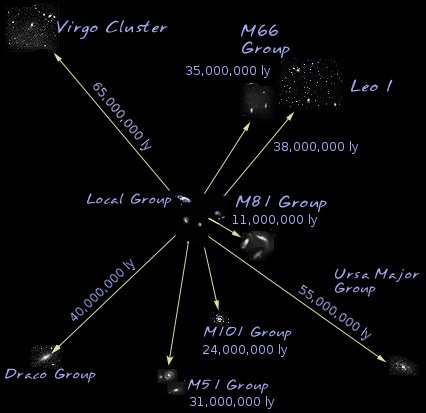
| Exploring this directionThe observable universe has an estimated diameter of 93 billion light-years. A few million years might be enough to explore nearby galaxies. For example, to explore just our Local Supercluster you would need approximately 65,000,000 years [0]. Travelling at the speed of light.
E: Virgo is further than Ursa Major. Updated 55,000,000-->65,000,000.
E2: I always refer people to this video in regards to aliens, space, and time. I forgot to in this post, so here it is now: https://www.youtube.com/watch?v=HPl10L40pBM
[0] https://upload.wikimedia.org/wikipedia/commons/e/e2/Local_su...
What about the people who ride on ships from Southport to the Americas to plant crops or cotton?
But most expansion beyond the solar system would be inter-generational anyway, so it's more like people who are born on a spaceship and told by their parents they're a pioneer to an uninhabited world, and can't turn around.
The explanation I have heard repeatedly goes something like:
"This equation shows that there should be [massive number] of alien civilizations in the universe. But where are they?"
This seems to assume that, given the density of civilizations throughout the galaxy we can determine from [massive number], we should be able to observe other advanced civilizations. But is that true? If there was a civilization as advanced as we are somewhere in e.g. Alpha Centauri, would we be able to detect them?