So it'd be a quark-antiquark pair popping up.
The proton is the lightest Baryon (3 quark particle), there is no lighter Baryon it could decay into. The decay products have to be lighter than the original proton, by at least the mass of the virtual quark pair, to repay the energy 'borrowed' from the vacuum to create the virtual quark pair (because energy is always conserved). So the proton remains unaffected by the virtual particles popping in and out of existence around it. The virtual particles have no choice but to effectively to annihilate with one another and disappear, to pay back the energy debt.
Heavier Baryons (Sigmas, Lambdas) are indeed destabilized by virtual quark pairs, that is the mechanism by which they decay, almost instantaneously, on their own.
You could have an up-anti up quark pair that pops up close to the up quark of the proton, the up quarks could 'swap places', and then the up of the proton annihilates with the anti up of the virtual quark pair, but the the result is still a proton.
https://ned.ipac.caltech.edu/level5/Cottingham/Figures/figur...
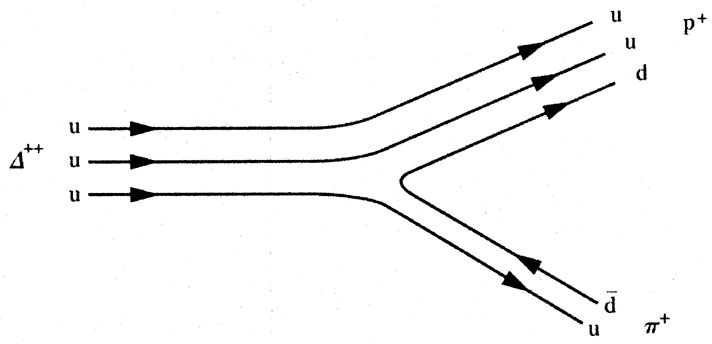
It's required that quantum interactions obey conservation laws, and any non-conserving "virtual configuration" must be short-lived, only existing to the extent it might affect interactions with "real", physically allowed configurations. There's no quantum interaction that lets a proton turn into something else while obeying conservation laws. In particular, normal interactions can't change the number of quarks in a given configuration, and the proton is the lowest energy configuration of 3 quarks. So it can't "tunnel" via a virtual configuration into some other real configuration.
Grand unified theories usually introduce additional mechanisms that can turn quarks into leptons, so proton decay is a test of those theories.