Re:Qualcomm Demos 48-Core Centriq 2400 Server SoC in Action,...
by vegabook on Saturday December 17, 2016 @04:06AM
(#13199944)
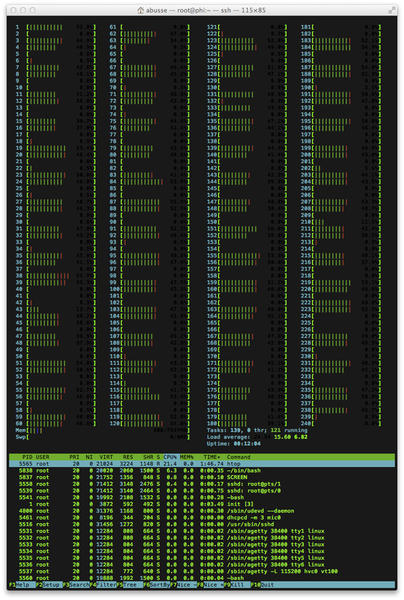
Intel is quite happy to ship CentOS Linux on its 64-core (256 hardware thread) Xeon Phi Knights landing dev boxes:
Here is Linux htop with 288 hardware threads on the higher end KL:
http://www.admin-magazine.com/var/ezflow_site/storage/images...
Re:Qualcomm Demos 48-Core Centriq 2400 Server SoC in Action,...
by jdub on Saturday December 17, 2016 @03:50AM
(#13199913)
Linux is already pretty comfy at 48+ cores (and more), probably especially so on a single socket.
Re:Qualcomm Demos 48-Core Centriq 2400 Server SoC in Action,...
by dom0 on Saturday December 17, 2016 @05:52AM
(#13200154)
> What modifications are required to be made to the linux kernel/tcp stack to take advantage of 48+ cores, in order to achieve a more linear scalability?
https://xkcd.com/619/ isn't a joke.
Linux is the default operating system of huge NUMA systems with hundreds of CPUs / thousands of cores.
Re:Qualcomm Demos 48-Core Centriq 2400 Server SoC in Action,...
by loeg on Saturday December 17, 2016 @09:51AM
(#13200898)
They have put quite a bit of work into scaling, but that doesn't mean it's perfect yet.
Re:Qualcomm Demos 48-Core Centriq 2400 Server SoC in Action,...
by baybal2 on Saturday December 17, 2016 @10:54AM
(#13201105)
Yes, if you want to run TCP/IP on it. But if you have bucks for it, it takes just a little bit more cash to get rid of packet IO altogether, and the network stack overhead along with it.
Are there any real-life experiences? Would a different TCP stack such as mTCP[1] suffice?
1. http://shader.kaist.edu/mtcp/