News for hackers. Stuff that matters.
Re:NASA just launched 8 satellites from a rocket dropped fro... by astrodust on Friday December 16, 2016 @05:10PM (#13197357)
Given how SpaceX has landed things on a drone ship, presumably they're considering launching from a rocket that's been lifted above the bulk of the atmosphere using a balloon of some sort.

You'd probably save a ton of fuel if you could launch from 40 or even 100K feet.

Re:NASA just launched 8 satellites from a rocket dropped fro... by ygra on Friday December 16, 2016 @05:55PM (#13197655)
That'd require a rather huge balloon. Rockets are quite heavy. Pegasus XL has a mass of over 18 Mg, for payload mass of just over 400 kg.

Not sure how this relates to SpaceX' drone ship landings. Falcon 9 couldn't launch from the air, as cryogenic fuels mean you have to launch rather soon after fueling. Furthermore fuel is cheap (compared to the rocket), and their mode of operation seems to work rather well (despite CRS-7 and Amos-6) with normal launch and propulsive landing.

SpaceX also has made it clear that a lot of the things they're doing, trying, and learning are designed to work in other places as well. While you can land with parachutes on Earth, you can't do so on Mars. Same holds for balloons. They just won't do it.

Re:NASA just launched 8 satellites from a rocket dropped fro... by astrodust on Friday December 16, 2016 @06:00PM (#13197690)
The thing about balloons is they're relatively cheap, and the stuff you put in them isn't expensive either. If you want to flirt with danger, hydrogen filled is one way to do it.

The drone part is mostly to do with automation, as a terrestrial platform allows a lot of hands-on work to prep the rocket for launch. A high-altitude platform would have to be automated.

Plus the way rocket physics work is the less fuel you need to punch through the atmosphere at speed, the less fuel you need overall, which reduces the weight of the rocket exponentially, as the fuel itself requires more fuel to get lifted.

Anything they can do to get to a higher altitude without paying a heavy price is worth considering. Turning a theory into a viable launch strategy is not easy, I understand, but they've shown a remarkable ability to innovate.

Re:NASA just launched 8 satellites from a rocket dropped fro... by nickik on Friday December 16, 2016 @07:57PM (#13198324)
There is a reason basically nobody ever uses a balloon, it just does not make sense. It does get you far to little for not enough. You don't save that much energy and you have way harder time starting.

You can't do deep cryo fuels and you can't do static fires in lunch conditions.

Re:NASA just launched 8 satellites from a rocket dropped fro... by outworlder on Friday December 16, 2016 @06:15PM (#13197781)
Hint: if altitude were such a problem, why don't rockets go straight up to 80km or so, and only then thrust sideways?

Rockets clear the most dense portion of the atmosphere very quickly. Building up speed is what takes time (and fuel).

Of course, the exponential nature of the rocket equation means that you'd get to save a lot of fuel. You'd still have to lift a lot of rocket though. With a balloon so big that would put the ships from the original Independence Day movie to shame.

Maybe it would be worth it on Venus.

Re:NASA just launched 8 satellites from a rocket dropped fro... by greglindahl on Friday December 16, 2016 @05:42PM (#13197559)
SpaceX was originally going to build a 4-engine Falcon for Stratolaunch, which is building a huge carrier aircraft, but later decided it was a distraction.

https://en.wikipedia.org/wiki/Stratolaunch_Systems https://en.wikipedia.org/wiki/Falcon_9_Air

Stratolaunch's latest strategy is to use Pegasus XL to launch from their plane, as many as three in a single flight. While they had flirted with a rocket that had one cryo stage, Pegasus XL and the other rocket that OrbitalATK might build for them are both all-solids.

Re:NASA just launched 8 satellites from a rocket dropped fro... by RelaxBox on Friday December 16, 2016 @05:15PM (#13197390)
Eh, not really. It's not getting to altitude that's expensive, it's speed. Orbit is blisteringly fast.
Re:NASA just launched 8 satellites from a rocket dropped fro... by AdamTReineke on Friday December 16, 2016 @05:18PM (#13197412)
It's expensive to build up speed while fighting through the lower atmosphere. Density drops pretty fast[1], so you don't need to fight it with the rocket if the launch vehicle has already paid the cost.

[1] https://upload.wikimedia.org/wikipedia/commons/d/de/Atmosphe...
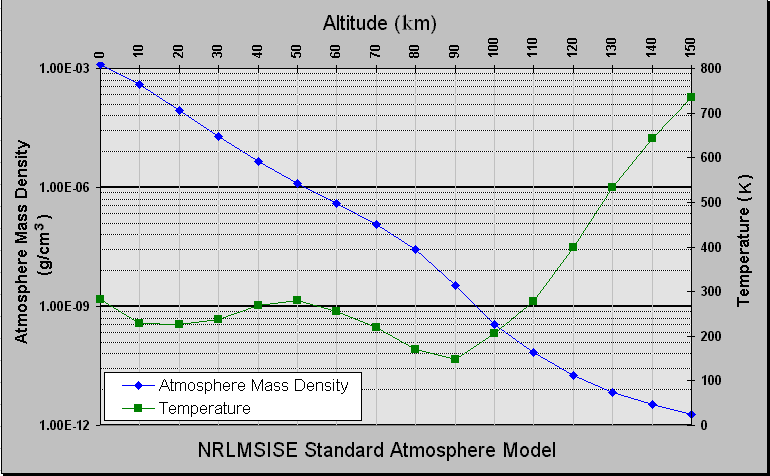
Re:NASA just launched 8 satellites from a rocket dropped fro... by patall on Friday December 16, 2016 @05:39PM (#13197543)
Why aren't space ports then at higher altitudes but mostly at sea-level like cape canaveral? At the beginning the rocket flies comparably slow, so the lower atmosphere density is not that important, its the speed that is hard.
Re:NASA just launched 8 satellites from a rocket dropped fro... by msandford on Friday December 16, 2016 @05:44PM (#13197578)
Because there aren't any places in the US where you've got 20kft mountains right next to the ocean, on the east coast. The idea is that you launch over the ocean, near the equator so that you're getting the first ~1000mph for "free" since you're launching with the earth's rotation instead of against it. Next to the ocean is for range safety. If it's over the ocean and it blows up you don't rain down parts on populated areas. If you tried launching from the top of a mountain in the Rockies and something went wrong it could theoretically rain down on DC which would definitely get your funding cut.
Re:NASA just launched 8 satellites from a rocket dropped fro... by Retric on Friday December 16, 2016 @06:29PM (#13197849)
No need for the east coast. Hawaii's highest point is 13,800 ft above sea level and much closer to the equator both significant advantages. The real advantage to Cape Canaveral is it was in the middle of nowhere with lot's of open land.
Re:NASA just launched 8 satellites from a rocket dropped fro... by astrodust on Friday December 16, 2016 @05:30PM (#13197495)
It's a lot easier to get up to speed if you don't have to deal with cutting through a heavy chunk of atmosphere on the way up. Plus, rocket designs could vary, be less concerned about aerodynamics, if they were starting from a launch platform already in very thin air.

A wider, shorter rocket might work better in thin air, for example, but that would be impractical launching from sea-level as is tradition.

Re:NASA just launched 8 satellites from a rocket dropped fro... by msandford on Friday December 16, 2016 @05:41PM (#13197553)
I have this dream that someday we'll build a SR-710 that's 10x the size and carry a BIG payload. And then putting stuff into orbit will basically be strapping your thing to a "big" upper stage (but small relative to a whole rocket stack), loading it into the cargo bay and then some fancy flying.

I know it'll never happen for a variety of reasons. But it's such a cool plane and when you think about cruising at mach 3 (2000mph+, 15% of escape velocity (http://www.sr-71.org/blackbird/sr-71/)) it seems like it could make the rocket equation for a plane-launched rocket much, much more forgiving.

Re:NASA just launched 8 satellites from a rocket dropped fro... by Scramblejams on Friday December 16, 2016 @07:02PM (#13198036)
One big reason it'll never happen: The square-cube law. https://en.wikipedia.org/wiki/Square-cube_law
Re:NASA just launched 8 satellites from a rocket dropped fro... by msandford on Friday December 16, 2016 @09:35PM (#13198826)
Well 10x doesn't necessarily mean 10x longer, it might mean something with 10x the total wing area and thus 10x the lifting capacity. Which might only be say 3x the length and 3x the width.
Re:NASA just launched 8 satellites from a rocket dropped fro... by astrodust on Friday December 16, 2016 @08:33PM (#13198569)
Physics is such a killjoy.
Re:NASA just launched 8 satellites from a rocket dropped fro... by Symmetry on Friday December 16, 2016 @06:35PM (#13197889)
With a wider, shorter rocket and lower pressure you could also use wider engine bells, for more efficient thrust.
Re:NASA just launched 8 satellites from a rocket dropped fro... by TallGuyShort on Friday December 16, 2016 @06:17PM (#13197790)
When you're dealing with LEO velocities, the difference between the speed of the aircraft they launched with (significantly <M1) and a drifting balloon is relatively negligible considering the benefit of start at the edge of the atmosphere inexpensively, I would think. Definitely a new technique that would have some hard problems, but not fundamentally infeasible, I would think.
Re:NASA just launched 8 satellites from a rocket dropped fro... by gremlinsinc on Friday December 16, 2016 @05:56PM (#13197663)
Couldn't we build a launch pad above the clouds, at 100k? I know building a space elevator is rough/difficult but if it's a lot easier/cheaper to launch from that high up, why not a permanent structure as high as you can get?
Re:NASA just launched 8 satellites from a rocket dropped fro... by greglindahl on Friday December 16, 2016 @06:05PM (#13197714)
Like most ideas, you can read about it in science fiction! Not so practical, though.

https://www.dezeen.com/2013/09/24/science-fiction-author-pro...

Re:NASA just launched 8 satellites from a rocket dropped fro... by Roritharr on Friday December 16, 2016 @05:43PM (#13197574)
I've heard of this concept lately, not sure what to think tbh. http://www.zero2infinity.space/