Outside of a regulatory framework, in modern economics, comparative advantage won't work. It will be those with the most power (derived from success or money or something else) will win. Those with the most resources wins. And yes those who can game the system will win. Otherwise you'd take the 'capital' out of capitalism. After all, who wouldn't capitalize over the stupidity of another country that let you take advantage of it?
Outside of natural resources, can you please tell me how an area on this earth can have an advantage over another area. I am befuddled by this argument for free trade, in regards to countries.
An advantage can come out of any number of things - climate, location relative to a trade route, particular local demands or preferences, or just happenstance. As you note, comparative advantage is not just about whole countries, but also about regions, companies, and individuals - so that it's not just about an "area of earth" but about the variety of things that happen in each place. Comparative advantage is an argument that trade makes people (regions, cities, etc.) better off even if they have nothing they are the best at.
And if you say "but the perfect market wouldn't have any subsidies or aids" then you are living in a fantasy world made up by economists! They don't even have to subsidise, all they need to do is make it slightly easier for house painters to do their work there than anywhere else in the World, by easing legislation and lowering taxes. They will outcompete you just by following less laws and regulations and paying less tax. Because everyone ever has agreed that laws and tax should exist, you need to explain how "perfect" markets will ever exist. Again, look into China and it's the exact same thing. They don't need subsidies, they create Special Economic Zones.
Anyway the idea that markets exist separate from governments is a fiction made up by economists. See "Debt the first 5000 years" on a description of how anthropologists have found that actually, the most common origin of a market is government intervention.
I don't think most economists have ever argued that markets exist outside frameworks of property rights and rules of trade. And while these things have often been laid out by governments, it does not necessarily mean that they always are, or always must be (where we take "government" to signify a usually-geographically-bounded entity with the monopoly of force.) Just the same, money has often been issued by governments, but does not necessarily mean that only governments can issue or create money. Markets exist wherever trade exists, and are shaped by governments - sometimes well, sometimes badly, and always within certain constraints of reality.
As pertains to the supposed advantage of government support of industry - take a closer look at China. The most dynamic sectors of the economy there - in assembly and manufacturing - have been the least directly subsidized and encouraged. The big State Owned Enterprises, in steel, concrete, and other heavy industry insulated from competition, are the most saddled with debt and are not innovative and dynamic. The main effect of their subsidy to these industries is philanthropize everybody's consumption of their products. Sucks for the Chinese taxpayer, but everyone else gets cut-price goods. And you'll note that, even after getting "pseudo-monopolies" on various economic sectors, prices in those sectors have kept falling. The "drive-out-competitors-then-raise-prices" drama never seems to appear - and it's no surprise, because these companies are competing with each other.
But the idea that free trade is "awesomely good for everyone" which is pushed or that markets can exist without governments or that a "perfect market" would have no government intervention seems to have no basis in reality, as far as I've read. Markets and governments exist in a symbiosis that can have good or bad effects, and there's increasing knowledge on how to manage the relationship so that most people in most places benefit. The arguments towards Total Free Trade with No Protectionism and Free Movement of Capital (capitalized because those are the ideas that I have qualms about) seems to ignore, in my opinion, the following things:
On No Protectionism: Masses of workers might lose their jobs and be unable to retrain, creating a huge structural unemployment problem.
On Free Capital: Quoting Jonathan Goldsmith talks about in his segment on Charlie Rose, if you allow for capital to move freely, you brake the contract between labor and capital that's been made through tremendous conflict and compromise in the West. Capital can manufacture goods outside of the country and reimport it, breaking the fundamental agreement of sharing of profits that allowed the West to become so good to live in during the 20th century.
And that is the recipe for tremendous income inequality and the destruction of local manufacturing.
On the Loss of Manufacturing: Vaclav Smil has said that "without manufacturing you have no middle-class"
Basically Free Trade with No Protectionism seems to mean the destruction the local population's wellbeing in exchange for "economic growth" that benefits very few people at the top. The pieces are there if you want to connect them.
But the primary counterargument is that attempts to restrain free trade generally a) reduce overall output and productivity b) give domestic producers a captive market and no incentive to improve c) incentivize smuggling and corruption in getting around barriers and d) cause local industry to fall behind and inevitably be overtaken in global markets even with domestic supports.
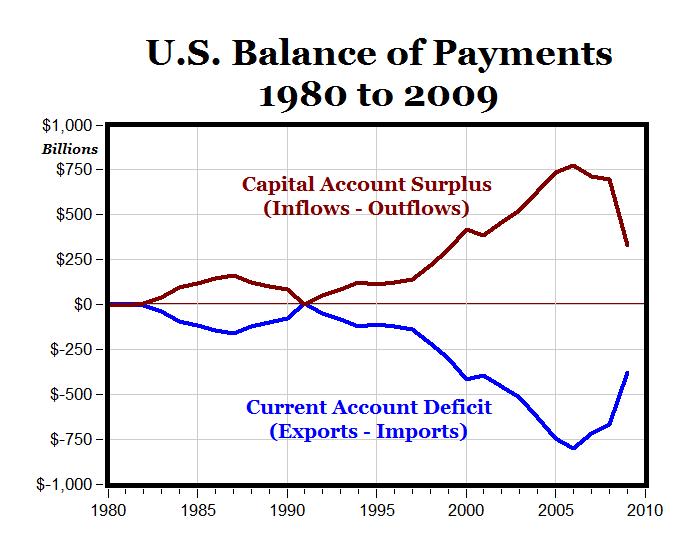
On the free movement of capital, one notes that the US, for example, has a large "trade deficit". But what does this mean? Essentially, that US consumers are net exporters of dollars in trade for foreign goods. But where do these dollars go? Well, they come to the US as part of "capital account surplus" - that is, the movement of capital investment into the US. While the immediate impression is of "industry moving overseas", the US is in fact an enormous net destination of capital investment. ( http://3.bp.blogspot.com/_otfwl2zc6Qc/TMybFmTdp1I/AAAAAAAAOm...) If they restricted the movement of capital, it would mean shutting out incoming capital investment, not keeping it from leaving.
So what happened to manufacturing? In a word: automation. The US manufacturing sector is at an all-time high in terms of value produced, but it's quite true that it employs fewer people than it did during its heyday. Manufacturing didn't decline, it's just that people don't work there like they used to. ( https://www.aei.org/wp-content/uploads/2015/10/mfg1.jpg ) This is what's felt as being "without manufacturing", but really it's just the automation of manufacturing, just like the automation of farming. This is overall a positive process, increasing productivity, but in the short-to-medium term it can be painful.

I also think the automation argument has another flaw and a very simple one. By tracking jobs that have been outsourced you are tracking old jobs in some factory that put people out of work. But what about the factories that don't get built, or the labour Forces that don't get trained to make new goods ?
By removing trade barriers and allowing capital to reimport manufactured goods you have removed the incentives to invest and maintain a workforce.
If trade barriers were still up, my guess is there would be huge training programs for people to go into certain professions that would be needed to manufacture goods locally. I.e. The IPhone is produced in China, and Steve Jobs once told Obama the reason was he couldn't find the 5 millions engineers or so he needed in America to build it.
If the trade barriers were still up that would make manufacturing in China uneconomical, then Apple would start a massive training program to train those engineers in America. Apple didn't do that program because it didn't need to, it could find them in China at a cost of 20-to-1. Compare that to Intel, a company that keeps their production in the US, which has invested in programs to train engineers in America.
If capital can move freely it will choose the cheapest available workforce, and it can't find that workforce it will train it in the cheapest possible location. It will then reimport goods manufactured with the lowest-investment workforce into the highest-profitable markets to sell it. Because free trade.
So even though automation is part of the story the destruction of trade barriers also has another effect, which is the removal of incentives for capital to invest in labour training. And that's the origin of the barista economy that people keep complaining about - businesses have no reason to invest in America anymore to manufacture their goods. They absorb the highly educated workforce paid for with a lot of public money, and they benefits from it, while reinvesting as little as possible in the economy and dodging as many taxes as they can.
Personally I think Steve Jobs was talking guff, if that's what he said. Most of the actual engineers and designers are in high-income countries - it's just the assembly and components that come from low-income places. Which is what you'd expect - the more labour-intensive a component or task is, the more you strive to minimize labour cost. And most of the cost of the iPhone is in components, research/overhead, and profit (things which mostly do not go to Chinese wage-earners!). The actual assembly is generally estimated at between 5% - 8% of the final cost, and done largely by 'semi-skilled' rote-task workers. Not the kind of jobs that pay high wages even in the US.
The idea of moving goods from the place where it's cheapest to make them (including extra investment), and moving it to the markets where it's most profitable to sell them, is indeed most of the point. It is sort of the idea of the best supply meeting the highest demand - the idea that we grow corn in a sunny field, not an arctic greenhouse, and ship it to the mill quoting the highest price. To require this to not occur is to require that the cost of making it is increased, or the demand for it is decreased.
I would argue generally that the 'barista economy' is not a case of a lack of investment in labour training, but rather a mis-investment. There are huge incentives - especially through federal and state grant and loan programs, and supports for state schools - for students to go into four-year universities and take some degree, any degree, regardless of how useful it actually is. So this results in a large amount of money being spent on a lot of "training" which never actually gets used. This takes up the time that would be spent on other, more relevant training, and causes dissatisfaction among "over-educated" people who feel that their expense of time and money was pointless. That's one of the big problems with a system that promises people lots of money for taking a degree, no matter what it is - it detaches people from the need to look at what jobs are actually available, and it suppresses other training that could have been more usefully done. It also does subsidize those companies which do use the training that has occurred, at the expense of everyone who's paid taxes and doesn't need the training that's offered. Arguably, the fact that tax money is taken off everybody and spent on bachelors of arts degrees is a disincentive to manufacturing and other industrial sectors.
Is there really that much tax money being spent on Bachelors of Arts ? That seems like a myth to me, the cost of Bachelors of Arts in America must be tiny at this point.
I'm not sure how to carry on with this, as much as it is enjoyable to talk to someone about these issues, It seems like you have all the knowledge and have decided the human costs of this calculus are acceptable. I don't agree it is, particularly not if, as we are now seeing with Trump, Le Pen and AfD in Germany, the cost of globalised capitalism includes the unraveling of democracy.
I suggest that this is true of much of the US educational/training system. The government keeps pumping more and more money into the educational system, especially via loans. But the number and size of universities are still limited by accreditation and other restrictions (especially in qualifying for those loans) so competition can't drive the price down. Indeed, the price climbs precipitously because students have ever-more amounts of money to spend (often as debt) on a limited number of spots. But you have to pursue a degree to get the money, so rather than pursue what seems best in the job market, pursue what's easier to get into and succeed in. Hence, the phenomenon of a big mis-allocation - a huge number of expensively-educated people carrying lots of debt who can't find commensurate jobs.
I think a lot of the problem is just the suddenness and visibility of a lot of it now. US unemployment is now getting quite low, but a lot of it consists of the chronically unemployed who were accustomed to a solid, long-term job. (I would disagree that purchasing power is falling for a majority - though it did during the recession.) Hence it is more visible. But can the US close itself to large sectors of trade indefinitely to maintain this workforce, especially as automation advances anyways?
It's not so much that I have "accepted the human costs" or "have all the knowledge" - but rather that I don't, and don't really imagine that somehow a system can be designed that provides all the benefits of free trade without actually instituting it. To balance and tweak tariffs and quotas and supports seems to be just as high, or higher, a claim to having all the knowledge. The trouble of Trumpian or Le Pen populists is a real one - but do we just say: whoever has the loudest, weirdest political base gets to set the economic agenda, because we're scared if they get angry? I dunno. If so, we should be honest about that - that we're avoiding free trade not because it's bad economically, but because we're worried about fierce populist backlash.
economists and experts keep telling them that they're "wrong" to blame free trade or immigration (just like the linked article). Even though most competent economists would actually say, like you said, that free trade is not beneficial to everyone everywhere.
To answer your question directly yes I think the economics of the system must include the "externality" of the discontent it generates in populations.
It seems like you're saying that although some people might lose their jobs and see their earning potential collapse, free trade is "more efficient" for some majority (+50%) of the population therefore it is good. I would say whatever benefits that come to the majority doesnt really balance out with the suffering of those left with their wellbeing destroyed. Their backlash against the system that destroyed their livelihoods is only natural.
markets are supposed to serve us, and our societal wellbeing. If they fail do that, in my view, they are a failure.
So yes people are losing purchasing power in developed economies, and from my understanding it's been that way since the 70s.
As to losing purchasing power, I would more prudently say "relative stagnation". Here's before-tax incomes, adjusted for inflation, for the top 1% and bottom 20%: (http://inequality.org/wp-content/uploads/2014/10/Figure-8-e1...) It's not that the majority have seen real declines in purchasing power in most areas, it's just that they have seen relatively less growth than the richest - but this is unsurprising in a rapidly growing, globalizing world. Inequality certainly chafes a lot of people - but it's not quite the same as declining real incomes. (You can also see how tied to asset valuations the top 1%'s incomes are - the dot-com bust and the 2008-2010 recession are quite visible.)

Edit: Here's the same sort of graph for the whole income spread: http://inequality.org/wp-content/uploads/2014/10/Figure-9-e1...

On top of that, it's making people angry, for very good reason, because if you look into behavioural economics and psychology, we have an innate sense of fairness that's being violated. And the social contract that maintains democracy includes the idea of fair work, fair rewards.
It seems like you regard this sort of outcome, of massive income inequality and stagnating wages, as inevitable, or neutral. I don't and many other people don't. They're angry about it and they're voting for Trump, or fighting for higher minimun wages, or unionizing. And historically those things (political change, collective bargaining) have in fact ended up giving higher percentage of the profits to the workers and citizens involved in the manufacturing of the products that are making so much money for capital. This is exactly what global trade is destroying, and people are getting increasingly angry.
Look, I just think you need to reconsider, globally, the psychological effect this sort of thing has on the population. Since 1973 the median wage has grown at a 0.2 percent annual rate. 0.2 percent! And the return is slowing down since 2000.
Source: https://thinkprogress.org/wages-have-been-stagnant-for-40-ye...
Yes, I understand why people are angry. People get angry about all number of thigs, more or less justifiably.
The problem is that most of the cures being proffered for this percieved unfairness will not solve the problem. To reduce the disparity between the wealthiest and the rest, are people talking about, you know, ending mortgage and property tax deductions, liberalizing the education sector, permitting more housebuilding, ending moral-hazard-generating bailouts of companies and banks? A little, but hardly. What you hear is that the "people" want tariffs (impacting the poorest, who disproportionately consume cheap imports), higher minimum wages (which slightly raise the incomes of some workers, at the expense of making youth, people with minimal educations, ex-prisoners and the disabled unemployable), and trade unionization (which benefit those in the union, but those shut out of the union scarcely at all.)
I'll also note that this era of stagnation for the developed-world middle class has also coincided with a huge growth in the incomes of most of the rest of the world - these are not totally unconnected. Sure, we can be nationalists about it, but there are big benefits to the rest of the world from globalization.
I think there are sensible ways to diminish these income disparities. But I don't really that many people advocating for them - mostly I hear the old protectionist mantras, and I just do not agree with that.
But that's not the main point that most economists are making (except the rather unusual anarcho-capitalists like Rothbard and the like.) The point is that there are property rights that are more or less in accordance with certain aspects of reality, and attempts by governments (or indeed private actors) to enforce property rights at odds with physical and informational reality is going to cause serious problems. For example, if a system of property rights says that nobody can own title to exclusive use of land or water, then I've set up a system where the inevitability of needing to physically occupy some land or water conflicts with the impossibility of acquiring stable property in it. Conversely, if a system of property rights says that the first person to speak and claim a phrase owns all rights to it forever (like some super-copyright), then it's just made normal language extremely cumbersome. The primary point of economists in the whole Menger-Hayek-Mises-Hazlitt meta-tradition is that while a government of some kind is probably inevitable, it should recognize that appropriate property rights depend on certain properties of the things themselves, and not arbitrarily defined by the government. (This is a sort of compact way of saying "property rights need to be defined differently between private goods, public goods, club goods and pool goods, due to their actual physical differences.)
Also these people are only respecting the rules they have already interiorised from living in developed economies. If you look at history, individual private property does not show up as something innate. Tribes owned areas and fought for them, but they didn't have much individual property within themselves (neither did they have barter economies).
It's true that people interiorize rules to a certain degree. And to be sure, no set of property rights should be beyond question. However, once you get up beyond a certain small society size (a few hundred people, really) you need some kind of property right to distinguish whose stuff is whose - since you'll soon start making trades between strangers and middlemen who are not bound by familial/kin ties, or reciprocal gifting arrangements, or honor systems.
The point is that you need appropriate systems of property for various things. Apologies if this is just repeating what you already know, but consider, say, clothes. They're rivalrous (only one of us can wear them at the same time) and excludable (I can easily stop you from also wearing them, and can tell when you're trying to do so.) So, it's a "private good". On the other hand, a broadcast radio station is not rivalrous (you tuning in does not prevent me from doing so) and not excludable (I can't really tell if you're tuning in, and can't stop you specifically from doing so.) Therefore it's a "public good". These are material realities that imply certain (different) property rights - and attempting to ignore that fact is likely to lead to all kinds of problems. The point of theories of private property is to try to come to grips with these realities, and to acknowledge them in the creation of property rights systems - whether mono-centrically with a government, or poly-centrically with various contracts and arbitrations. The mistake I think Graeber and others make is to sort-of assume that any arrangement of property rights that we can imagine, can be successfully imposed on material/informational reality.
I haven't read the he believes any system imaginable can be applied.
Its true many of the examples he gives were for small populations, but the principle of sharing in small tribes was reciprocity. You give something you get something back. The issue with reproducing that in bigger groups is that you can't hold people accountable anymore. But of course, maybe with modern information technology there is a way.
Anyway as I've said on my other comment (and getting back to the topic of discussion) it seems like we both know the data but arrived at different conclusions. I'm not sure how to convince you of anything other than ask you to reconsider. If current trends continue, the cost of global capitalism might end up being democracy itself.
Reciprocity is a perfectly good way to run a small economy. But note - you're still trading, in a significant sense. Accounts of who does what are kept, the relative value of items and acts are considered, and social honor and reputation are valuable goods in themselves (in a "capitalist" system as well.) One does not escape from "markets" or "property" just because some goods are social or symbolic.
I agree we've sort of ended up at different destinations. I'm aware that "global capitalism" is a strange beast - but not really any stranger than anything that's come before. It's sometimes hard, but works okay, and is probably worth keeping around on its own merits.
This was very very good and I appreciate you taking the time to write all that.
Thanks
Other countries that started off from a similar starting point (e.g Thailand) and "let the market handle it" ended up way behind.
And of course you'd expect them to develop a few large and particularly successful industries - but they developed on all fronts simultaneously, in some areas slightly faster than others.
And I mean, the most successful "Asian tigers" were Hong Kong and Singapore - with the most open, least "state chosen" economies.
Hong Kong and Singapore very much followed stated directed investment. Singapore went out of its way to court large multinationals (Philips and Shell were among the first lured over), for instance, built 90% of the housing stock in the country and even today gives out a multitude of grants to new businesses in 'key' industries.
I'm not saying that any tariffs and subsidies will halt growth, or that industrial policy will always fail. What I am asserting as the general trend is that moving towards a freer economy pretty typically helps - and moving towards a dirigiste economy usually doesn't do much good. If anything Asia should be a demonstration of this - China before and after the 1978 reform process, Vietnam before and after the 1986 Doi Moi reforms, India's 1991 Rao-Singh reforms, among others. These didn't mark an increase in state intervention/ownership, tariffs and subsidies, but rather a decrease.
Which countries are you talking about specifically?
>I'll note also that throughout most of their boom periods, both Singapore and Hong Kong had very small or no tariffs on almost all goods
They tended to suppress the value of their currency by buying treasuries, rendering their exports more competitive. This acted as an implicit subsidy on all exports.
Also, while they tended not to put tariffs in place, they did directly subsidize - the flip side of the same coin.
"Free" that was not.
>Also, that housing, the most government-controlled sector in both countries, is notably very expensive - not a particular success story.
That's a global phenomenon. After the US plunged interest rates to zero everybody else had to follow suit or watch their exports drop off a cliff.
It used to be much cheaper before that happened.
>not a particular success story.
Whether you call it a success or not it is the direct opposite of what you claimed: it is interventionist.
The housing is all excellent quality and it forced the private sector housing to be even higher quality still in order to be able to compete. I'd say it was a policy that we should probably copy.
>China before and after the 1978 reform process
China didn't fully open up after the 1978 reforms and still hasn't. The investment in the country is largely state directed even today. It's a counterpoint to your argument, not proof of it.
They also loaded up on treasuries and put in place covert and not so covert subsidies/tariffs.
>Vietnam before and after the 1986 Doi Moi reforms, India's 1991 Rao-Singh reforms, among others
Hardly great success stories. Considering that Taiwan and South Korea, for instance, started off from pretty much the same place and reached first world status.
I'm talking about countries across the world in Africa and South America, as well as in Asia such as Indonesia, and the countries I mentioned before their reforms - India and China. These policies (acquire key heavy industry, support exports, replace imports with domestic production, have government plan the economy) were extremely common - almost ubiquitous - all over the postwar world, especially before the 1990s, yet didn't deliver high rates of growth to most of the countries where they were tried. So what was the spark of growth?
> They tended to suppress the value of their currency by buying treasuries, rendering their exports more competitive. This acted as an implicit subsidy on all exports. Also, while they tended not to put tariffs in place, they did directly subsidize - the flip side of the same coin.
Sure, you can suppress the value of your currency - that just makes imports more expensive and suppresses domestic consumption. Which has a negative impact on real domestic incomes. It's a costly "trick".
And export subsidies are different from tariffs - they do not directly make domestic production, for domestic consumption, more competitive against imports. So if I had to pick a "least-bad" option between a tariff and an equivalent export subsidy, I'd pick the latter, since it at least exposes domestic producers to foreign competition, and therefore doesn't drive up domestic prices. (Though it does subsidize foreigners. Ah well.)
Again, I'll note that the countries which did this the least did as well, and usually better, than the countries which did it more. It's about magnitudes.
> Whether you call it a success or not it is the direct opposite of what you claimed: it is interventionist.
Sure, it's highly interventionist. So going by your rubric, you'd expect it to outperform the rest of the economy in price or quality. But it generally doesn't - and housing in more liberalized housing markets, like in Japan and South Korea (even in the megacities!) is more affordable compared to incomes, taking quality into account.
> China didn't fully open up after the 1978 reforms and still hasn't. The investment in the country is largely state directed even today. It's a counterpoint to your argument, not proof of it.
China didn't fully open up, that's true. But it did open up massively compared to before, and this succeeded in boosting growth considerably. I don't see how a country going from, say, 90% state directed investment to, let's say, 50% state directed investment, and succeeding, is an argument in favour of interventionism. Did they engage in tariff/subsidy measures? Sure, but those barriers to trade were even stronger during the pre-reform Maoist era.
> Hardly great success stories. Considering that Taiwan and South Korea, for instance, started off from pretty much the same place and reached first world status.
Well, note the chronology. Taiwan and South Korea had completed most of the same reforms (considerable liberalization of trade, ownership, investment) in the 1950s and 1960s! So they had a 25-35 year "head start". Also, in the era immediately after these reforms, growth in India and Vietnam roughly doubled compared to their pre-reform eras. And they've kept or expanded these reform policies and continued to see strong growth.
As far as I can tell from your examples, you're arguing for roughly a Ha-Joon Chang-ist position - that whatever intervention exists in a country, no matter how much reduced from its previous level, is to credit for its growth - and no matter how much liberalization has occurred, even when a sudden liberalization coincided with a sharp takeoff in growth, liberalization can apparently not be credited with that growth. And I do not think you are so absolutist - but neither am I.
I'm not arguing that intervention leads to increased growth 0% of the time, just as I'm not arguing that liberalization leads to increased growth 100% of the time. I'm only saying that, in most places, especially pre-1990, there was/is too much intervention and not enough liberalization. And I think that people arguing for some sort of neo-mercantilist Trumponomics have at least as high a burden of proof to explain why, when moves towards liberalization usually coincide with increased growth and moves away usually coincide with low or reduced growth, that somehow this is an argument for moar government economic planning. It's like arguing that because I can still drive fine with one beer in me, then three or four more won't hurt. Anyways. I think I've made my point as long-windedly as I need to here - I'm not taking an absolutist position, just an "it tends to be this way, generally" one - which is only sensible in a fuzzy realm like macroeconomics.
I know the standard answer to this one: they don't, but they allow the free market to handle it. Industries which have an advantage in that country will flourish, those that don't will go bankrupt.