https://www.youtube.com/watch?v=zk3ruapRQZk
Of course, reality and practicality can change the implementation or feasibility of an idea, but the mere concept of restricted trade being more economically efficient is non-sensical to me.
As an example, if restricting trade were positive, would you say that it would be a good policy to restrict trade between states in the US? And then withing cities? I like one of MF's arguments that restricted trade is what you do to your enemies in war, or to yourself in peace.
What does happen is that the profits of such movement are globalized, so even though at world-level its more efficient, there could be locals that dont profit from it. Free trade increases economic efficiency, but it represents different people, and it doesnt distribute that wealth in a controlled manner. Bear in mind that world-wide poverty has decreased at an unprecedented pace and theres little doubt that it was globalization that catalyzed that.
I also relate this to what Varoufakis speaks about with Greece and Germany: Greece will never have trade surplus because it's not a productive country like Germany, and reducing taxes and salaries don't necesarily fix the problem: but Germany investing in Greece in products and services that serve Germans can compensate the deficit and maintain economic efficiencies.
That is, what I think the failed promise of free trade is that the gains of globalization did not benefit a huge part of the population, but if some of that did then the situation would stabilize.
If everyone is free trade, and nobody tries to cheat, then free trade is better for everyone.
However, when you add in state actors, taxation, arbitrage, high speed trading, and many other real world issues, then non-free trade can be more efficient if it distributes economic output better.
This is really simple if you stop and look at the individual pieces: if you have free trade, but your trading partner uses the money they get from taxation to subsidize weak parts of their economy that you would normally have an advantage in, then you're going to lose that advantage when businesses in that area go bankrupt as they can no longer compete. Your trading partner can then move the subsidy to other businesses and repeat the process until they have destroyed all of your local business.
Free trade doesn't work if others are cheating and you're doing nothing to stop them. There are many other cases besides subsidies where free trade can be easily abused by actors in your own country as well - such as moving their tax debt to other countries while continuing to operate in your country. Free trade is a two way street that has to be managed to prevent selfish actions. Not to say that free trade isn't still the best option, but you have to make sure both partners in the free trade agreement are working to the benefit of both partners.
EDIT: Ah, I'm from South Africa so I forgot it's the USA election and this website is liberal, which means you'll all lose your regular sense and downvote this post because it appears to support Trump or something. Carry on then, I'll be back in a few weeks when you guys have calmed down!
I think this is one of those fearful arguments that doesnt really represent reality.
In argentina we export a lot to Brasil, and one thing we export is cars. Lets suppose that Brasil takes a protective policy and then uses heavy subsidizing to make car factories and then outcompete argentinian automotors, lets say the subsidy is so large that cars in Brazil cost half in every single aspect, in every niche and ever smaller car element(something impossible to cover in reality).
Yes, the car industry in argentina is toast, but now argentinians can get cars at half the price thanks to the generosity of the brazilian taxpayer. The argentinians have become enormously wealthier by such a measure at large.
Not only that but now argentinians as a whole have half a car extra in money to spend in other services and products, which means that a bunch of other industries will grow! Argentinians would become much richer.
Lets say that Brasil loved that result (i dont know why, because they hemorraged money like hell) and repeat that with every single product argentina builds. IF every single product in argentina ,imported from brasil costed half, and it effectly replaces everything, it really means that Brasil is now giving argentina half the PBI of Argentina in subsidy. That is so unreasonable that it will never happen.
Theres another thought around this topic: that you can destroy an industry, and then increase your profits later on as a sort of monopoly power to recoupe the initial investment. IT would never happen that way: the moment prices rise up, investors would flock again to the argentinian automotive industry and take those profits away.
What is clear is that brasil would be using its tax payers to give products to other countries!
Temporarily they do. Once the Argentinian car industry is gone, however, they can safely jack up prices again knowing that bringing it back will be very, very hard. That money will leak out of the country, driving down the Argentine peso, making Argentines poorer overall.
>Theres another thought around this topic: that you can destroy an industry, and then increase your profits later on as a sort of monopoly power to recoupe the initial investment. IT would never happen that way: the moment prices rise up, investors would flock again to the argentinian automotive industry and take those profits away.
The flagrant gaping hole in your argument is the presumption that you can build a car industry overnight. It takes decades and requires a lot of investment. The Japanese government threw a not insignificant portion of its GDP at its car industry before it even started showing promise.
I dont think you will find a subsidy that ended up being a net monetary gain for the tax payers, let alone a good investment option.
To add as well, the free subsidy is definitely a short term thing. If you look at it as an 'education fee' for the subsidized business, it's not really that unexpected. Eg, a student may be paid nothing while he works as an intern and learns skills, but he does it anyway because once he has done so he can earn far more for the rest of his life. Same with subsides.
Also another way to look at it: the people buying the cars for less could probably already afford the cars. So instead of that money going to new workers in your own country, they're going to those in other countries. So the rich benefit in paying cheaper prices, but the poor who needed that income more than they needed a cheaper car suffer. In properly working free trade, this would be a two way street of comparative advantage, but because of numerous 'cheats' it's no longer a two way street.
...is precisely the justification the British made for exporting food from Ireland during the potato famine.
Well, they didn't exactly claim it was better for everybody but they claimed that it was a good pretext for letting the Irish starve while Ireland exported food.
Those profits were not used to feed the starving, either. They largely went to rich landowners.
Amazing that even today people defend this.
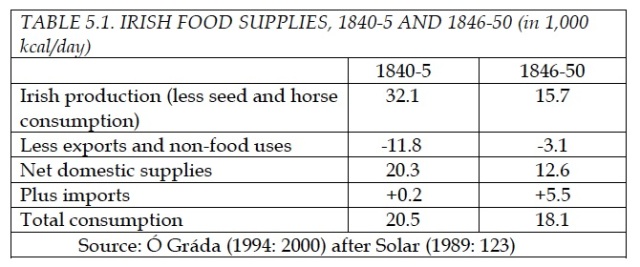

As you can see, domestic Irish production of all foods, in calories, just about halved. Food production absolutely cratered, due to weather and blight. They eminently were not able to farm "all the rye and corn they needed", and such imports were also in shorter supply than usual, because famine/scarcity conditions were occurring all across Europe (helping to spark the 1848 Revolutions, notably.) But these imports still had to be paid for somehow, and in an era of largely subsistence farming and thus small savings, this had to be paid for in large part by exports - of what? Of highest-value agricultural goods. You see from the graph that Ireland, during the depths of the famine, was a net importer of every grain except oats, where their exports had also fallen from normal levels. And, you see from the chart that, in total calories, Ireland had gone from being a net exporter to a net importer - bringing in over one-quarter of their total food supply in the Famine years, and going from typically exporting around 240,000 tons of grain a year, to importing up to 750,000 tons. Stopping exports from Ireland would have meant more dairy, oats, meat in Ireland, true - and less of the cheap imported grains that people really needed. It's true that the landowners were part of the overall problem, but no export limits would have caused new food supply to spring into existence or be imported.
I think it's just that people get caught up in tribal thinking very easily, and while the commentators on this site would usually be interested in discussion on the comparative advantages and disadvantages of free trade, Trump's message on protectionism have driven some people into a corner of having to be anti-protectionism to remain true to their 'tribe'. It's pretty unfortunate how quickly we as humans can fall into a trap like that: "I hate person X, person X believes Y, therefore I don't support Y".
It's not just globally more efficient, usually each country benefits (although I wouldn't want to over commit by saying each country always benefits). But the gains from trade are often not distributed evenly within a country, for example manufacturing employees might lose their jobs while the owners have higher profit margins and/or consumers benefit from lower prices. Furthermore, diffuse gains such as lower prices are felt less than acute costs like losing a job.
Time and transition costs are also very important. In some cases transition costs may be very high, e.g. a whole generation of miners might not be able to transition to other types of work such as software development. In the long run the economy as a whole should benefit, but those miners are unlikely to be convinced.
Any idea what MF thought about migration?
The main difference between goods/services and people is that goods don't have rights, but people do. So if people are obligated to pay for the 'positive rights' of people - the "right to food", "right to shelter", and so on, then migration imposes genuine costs. (Of course, this is different from 'negative rights' - the "right to free speech", the "right to freedom of association", and so on.)
The problem is unrestricted trade without a surplus-recycling mechanism. https://yanisvaroufakis.eu/2011/02/09/what-is-a-surplus-recy...
https://www.youtube.com/watch?v=wwmOkaKh3-s
Free Trade is not always good, and he correctly predicts that the global movement of capital will disrupt the current agreement between capital and labor that served the West so well. Donald Trump is wrong on many issues, but this is not one of them as far as I can tell. There a religiosity to the argument that free trade is "always good", even though high performing Asian economies are somewhat protective.
Economics at its current understanding is almost like a religion of capitalism. It has little to do with actual economic behaviour and has very little predictive power. That's why we keep having crises. Look into the work of anthropologists and behavioural economists to see the reality of how humans actually behave and what that means for "classical economics". Basically, most of it is bunk, all the way down to Adam Smith.
One of the best references I've read on this so far is
"Debt the first 5000 years"
"How Asia Works"
On behavioural economics, there's studies coming out all the time. The evidence is piling up that little of what economists have said makes sense. They've deducted general guidelines that sort of work at the macro scale, but their fundamentals are mostly wrong.
I'm increasingly growing into the opinion that capitalism fails to engineer any new "real" growth after physical needs are met for the majority of the population and this is true of any developed economy. Developed economies by nature stagnate. And when you look into post-physical-needs-are-met growth you mostly see financial services that might not be any net-benefit to society. Again I am still studying the topic so not sure. But it's the impression I get.
If you look at Japanese society it's clearly hit that stage. Physical needs, basic human needs for food and shelter, have been met. Therefore capitalism has for the most part stopped functioning. Most developed economies reach that stage. The issue is we're not satisfied and we keep asking for more and more "growth", even though capitalism might not be able to deliver it.
It might've worked before, but without physical needs capitalism stops functioning effectively, maybe at all. I've written about it here: http://www.rafaelkino.com/essays/capitalismisfailing.html
Information theory is where its most important principles come from: competitive advantage, supply and demand, gains of trade, reversion to mean, diminishing returns, etc.
History is the other half of economics: using information theory, psychology, and unreliable data, explain why and how a given scenario unfolded.
If you don't have a strong grasp of either of those but read Atlas Shrugged and call yourself an economist, you might be Paul Ryan.
I'm basically going with what the experts seem to say. If I was living in the Soviet Union I'm sure I'd be parroting the views of a different set of experts and saying completely different things with exactly the same conviction.