And no, it hasn't been all 'right-wing' intervention, though I'd certainly agree that there has been a lot of that.
There's been a ton of new 'left-wing' intervention in the form of growing welfare programs and authoritarian prohibitions on free association a la affirmative action, anti-private-discrimination laws, etc.
It is, a big corporation should not be served a bread buttered on both sides. Tax break is a form of risk mitigation. Corporations are supposed to be awarded tax break to allow them to take risks and move us forward. Does it really happen?[1].
I am not sure why a big group whose over all interest is to preserve status quo should be allowed tax break and keep on earning billions in return. Why they should not be allowed to die if they are can't compete?
[1] https://www.ted.com/talks/mariana_mazzucato_government_inves...
With clay, you start with nothing and fill up the space until you get the shape you desire. With marble, you start with a slab and cut out the bits until all that is left is the statue you desire.
You're claiming that only one of these two things is sculpting, and the other is not.
This is rich coming from someone equating financial intervention with violence.
Way to go with the straw man arguments too.
Orwell on socialists:
>The first thing that must strike any outside observer is that Socialism, in its developed form is a theory confined entirely to the middle classes. The typical Socialist is not, as tremulous old ladies imagine, a ferocious-looking working man with greasy overalls and a raucous voice. He is either a youthful snob-Bolshevik who in five years’ time will quite probably have made a wealthy marriage and been converted to Roman Catholicism; or, still more typically, a prim little man with a white-collar job, usually a secret teetotaller and often with vegetarian leanings, with a history of Nonconformity behind him, and, above all, with a social position which he has no intention of forfeiting.
Orwell was wrong about the market. There is nothing authoritarian about voluntary interactions between consenting adults, even if said interactions involve the exchange of (god forbid!) currency.
I would laugh if the ridiculous lengths you're going to in order to euphemize violence and imprisonment wasn't so fucking terrifying.
Also love the revisionist history that welfare has in any way grown. It hasn't, in fact it's been scaled back dramatically since the 90s, and the consequences have been horrendous: http://www.demos.org/blog/2/12/16/welfare-reform-was-quite-b...
Regarding welfare, I was being vague, so let me clarify: social welfare spending has increased substantially over the last 40 years in the US:
http://fivethirtyeight.blogs.nytimes.com/2013/01/16/what-is-...
In Western countries in general, social welfare spending is substantially higher now, as a percentage of GDP, than it was before the 1970s. Social democracy on the scale we have today is a relatively recent phenomenon.
Regarding your claim that welfare reform has had "horrendous" consequences, it is overly narrow and simply assumes no broader and longer-term negative consequences from compulsory income redistribution.
Love the calls for civility from the person proposing that anti-discrimination laws were bad. Also "the free baby market" isn't really a leap from any of these hardcore libertarian views.
> In Western countries in general, social welfare spending is substantially higher now, as a percentage of GDP, than it was before the 1970s. Social democracy on the scale we have today is a relatively recent phenomenon.
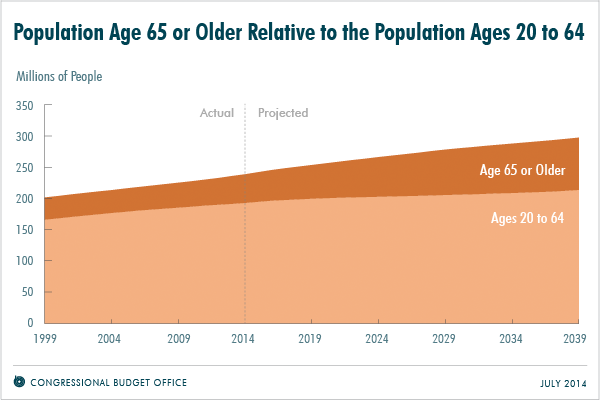
This has absolutely nothing to do with program expansion, it has to do with an aging population. It's an increased percentage of GDP because the population is skewing older: https://www.cbo.gov/sites/default/files/cbofiles/images/pubs...
> Regarding your claim that welfare reform has had "horrendous" consequences, it is overly narrow and simply assumes no broader and longer-term negative consequences from compulsory income redistribution.
We can debate about how absurd it is to say that the 50% of the population who can't work (and would provide basically nil extra productivity to the labor force if they were unjustly forced to rejoin it) shouldn't have income redistributed to them, but I suspect this is a point of philosophy we'll never agree on.
You say that as if saying anti-discrimination laws are wrong is uncivil. That is just whole different level of close-mindedness and intolerance to ideological unorthodoxy. I'm half-expecting you to call me a heretic.
You're completely missing the fact that I consider forcing (through threats of imprisonment) people to surrender their private property as a punishment for private discrimination to be extremely uncivil, due to its use of violence.
>Also "the free baby market" isn't really a leap from any of these hardcore libertarian views.
Deal with my arguments, not straw man arguments that you conjecture into existence.
>This has absolutely nothing to do with program expansion, it has to do with an aging population.
You clearly didn't read it.
Annual spending growth on various components of social welfare spending (1972 - 2011):
Pensions and retirement: 4.4%
Healthcare: 5.7%
Welfare: 4.1%
Annual economic growth over the time frame:
2.7%
Now that I've substantiated my claim that welfare AND social welfare spending have grown tremendously, you're trying to move the goalposts. You ridiculed me with your snarky put-down when I made the claim, and it turned out to be absolutely correct.
Your "but but" argument just shows how far your intellectual dishonesty goes.
>We can debate about how absurd it is to say that the 50% of the population who can't work (and would provide basically nil extra productivity to the labor force if they were unjustly forced to rejoin it) shouldn't have income redistributed to them,
Should we throw people in prison for not living up to your moral standards and giving to the poor?
You're ignoring this authoritarian aspect of what you're endorsing.
It's not "moving the goalposts", your claim was that welfare programs were "growing". The definition of beneficiaries and benefits hasn't grown probably since LBJ was in the white house, only the pool of retirees and disabled persons has grown. In other words, government hasn't changed anything to make the program grow.
> Should we throw people in prison for not living up to your moral standards and giving to the poor?
How many people are in jail because of tax fraud versus in jail for some form of theft of property? That's a good primo facie test to verify that this ideology even passes a simple smell test. Even if that did demonstrate a problem, this idea that there's anything nonviolent about your ideology is fucking bonkers. The non-agression principle is anything but: http://www.demos.org/blog/1/29/14/what-world-following-non-a...
And I showed that they are.
>The pool of beneficiaries and benefits hasn't grown probably since LBJ was in the white house,
I have no idea if your claim is correct (probably isn't, given the massive increase in people of working age receiving disability benefits), but this is in fact "moving the goalposts".
When I said welfare programs were growing, I clearly was referring to how much was being spent on them. Your pedantic nonsense notwithstanding, my claim was absolutely correct.
>How many people are in jail because of tax fraud versus in jail for some form of theft of property?
The carrying out of the threat may be rare, but the use of the threat to deprive someone of their rights is not. It is endemic. A person has a right to their property and their privacy and income tax laws violate both.
>The non-agression principle is anything but:
Can you distill your anti-libertarian article down to its essence and post it here?
Furthermore, and not saying that I disagree about your comment on the New Left, but "free association" is a non-sequitur even in the society you wish to exist (which doesn't [sucks]).
These programs are also clumsy cookie cutter solutions, which with a stroke a pen, impose the same formula to tens/hundreds of millions of people, without any consideration for the unique circumstances of this vast multitude of people. On one end, the people lose out, and on the other, they win out in the short term. The only determinant of which side a person is on is the amount of currency that they report to the government that they received for that year.
This becomes increasingly better gamed over time, leading to competitive energies being diverted to economically wasteful activities like tax avoidance (which is an industry worth hundreds of billions of dollars per year now).
To boil it down to its essence: there is no way compulsory income redistribution will be as effective (in the context of increasing economic output) as the market at distributing capital, and it is increasing economic output that is responsible for almost all gains in qualify of life and poverty reduction.
Free association is a straightforward concept and entirely feasible to protect through laws.
You can see this is action in UK right now with respect to NHS spending.
However, unlike the forms of left-wing intervention that free-market thinkers decry, this intervention takes the form of tax breaks, bail-outs and guarantees against market failures by governments to industries and individual corporations. This has produced what's been called "socialism for the rich" in many countries, where financial institutions are free to act without fear of any consequence of negative repercussions. Just as steel mills were in Soviet Russia, or rice farmers in Mao's China.
Witness this week's apparent bailout guarantee by the UK government to Nissan, the TTIP, or the way the Japanese government behaved towards its financial sector in the 1990's.