You can try to leave a general hedge for unknowns, like never giving anything >99% long term confidence. But actually pricing black swan problems accurately should be impossible, pretty much by definition.
In case of mortgage bonds, the bill payers were bond creators who wanted to get the loans off their books as quickly as possible. The buyers should really know better but they too were largely managers whose salary was paid on % of assets basis with no real downside impact on their own wealth.
Note: making wrong assumptions (explicitly stated) about the future is not fraud. I.e., "I think housing will never go down" is not fraud.
When challenged on this they usually claim the first amendment (i.e. license to lie), although S&P went a step further and downgraded the US in a fit of rage when the SEC started investigating them for ratings fraud in 2011. Ironically interest rates on US treasuries went slightly down afterwards.
At the time, the US government was actively considering whether to default on US Treasuries. The downgrade wasn't some petty revenge.
Their rationale was, in any case, that "entitlements spending" was too high:
https://www.theguardian.com/business/2011/aug/06/sandp-debt-...
The entire rest of the market (and the other ratings agencies) were just about able to determine that if you have the keys to the cash printer you're actually not in danger of running out of cash and political bickering doesn't translate into risk of political suicide.
When actual credit events look likely it triggers a sharp rise in interest rates. It looks like this:
https://4.bp.blogspot.com/-9UVV9J6AdU0/TzxG9W26TsI/AAAAAAAAC...
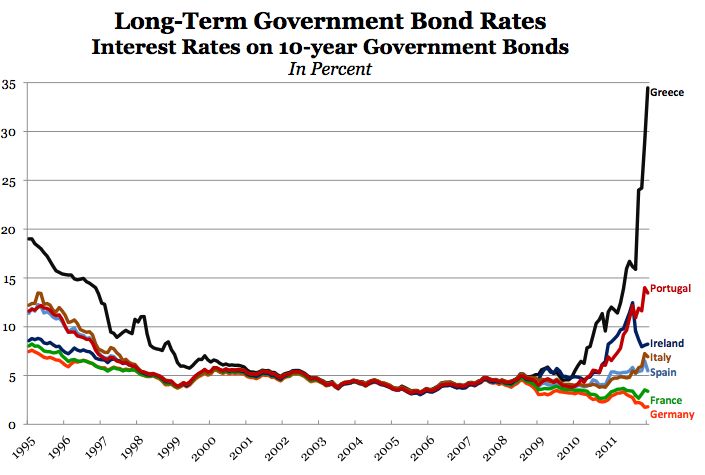
That did not happen. Nothing happened. Not even a blip. The market (correctly) assessed this as being the usual partisan political bickering.
Even the ghost of a chance of going down to the wire as to whether a bond payment would be missed by a single day on US obligations, is in itself tremendously disruptive. The economy is structured around U.S. debt as being the safest paper there is. Don't downplay just how dangerous dicking around with this for partisan points was.
As I said before: the markets correctly characterized the debt ceiling negotiations as a bunch of drama queens on both sides of the political divide acting up & a storm in a teacup because neither side is politically suicidal.
Ted Yoho, rep for Florida, http://www.rollingstone.com/politics/news/the-tea-partys-gov...
Trump (who isn't in congress, but had a shot at being president: http://mediamatters.org/research/2016/05/08/media-slam-trump...)
yes, it is nuts, but people who vote in congress supported it, and the pres. candidate of one of our two parties also said that.
Various parties are required to trust that anything rated D or whatever is risky. They aren't required to trust that AAAAAA+ means risk-free.
In real life, this sort of sophistry only makes terms like "risk-free" and "black" useless.
I fully expect that energy companies have already started to diversify and buy into industries that could disrupt their earnings. Good successful corporations know when to move, RJ Reynolds is probably the best example of a company diversifying when its main product started to become a liability.
Private investors and tax payers are the only victims. The first because their investment is gone and the second who has to pay to fix the the public employee pension funds that may have purchased the same bonds which means the first party is actually stung twice
A government uses debt to pay for stuff. If it defaults on its own debt, it hurts its ability to generate funds without printing currency. So if a government defaults, it not only incites domestic panic and foreign wariness of its markets, it also loses the ability to affordably borrow to pay for programs that can right the ship.
Even for companies where bonds are pricing in a substantial probability of default, it's a big deal if they fail to service their debts. Sprint can survive a 30% drop in its stock price. It probably can't survive defaulting on 30% of its debt.