The various data sources I have access to (CB Insights, et al), tell me that it's down, but not gone. The fact of this article (AngelList's rainy day fund) means that people are starting to prepare for stormy weather. A storm that has not hit yet - but people are skitterish.
Tactically, on the ground, I haven't seen much pull back, but I'm not in CA or NY. And I prefer to get cash-flow positive ASAP, so I might be a little less sensitive to it than others.
Thanks for your response: you raise interesting points (esp. your linked EU funding scene thread - that was interesting) and digging into this will provide some necessary weekend diversion.
I asked you to sum up all seed funding in existence: what number did you get? (This is the number that I call next to zero.) It doesn't matter what year you pick.
Since the rise of of on-demand data centers and software eating the world, Series A is the new Series B, and they expect some commercializable prototype (MVP) and customer traction before they'll talk to you.
So, even though Series A used to be called "Early stage" financing, I'm not sure it's fair to include it in what we used to call early stage any more.
So, to your question: sticking with angel/fund/corp seed, I don't know - maybe $10B or so in the US? You're right - that's pretty tiny. VC as an entire asset class is pretty tiny in the grand scheme of things (certainly very tiny for the amount of press it generates).
I'll take a look into the data this weekend, but I would guess that I'm in the ballpark of a binary order of magnitude with that guesstimate. Close enough to zero to make scrounging for it painful, I agree.
No, that's not even good enough. Even if you have a product in the market, with traction, if it's not millions of MAU/DAU then welp you're SOL. Doesn't matter what technology you built or how good your team is.
The only caveat to that is if you, as a founder, are already a known entity to the venture funds with a previous exit or in the right social network.
Currently I have a thing that is kinda/sorta like a B2B SaaS play, with bottom-up engagement directly with the employees of the target enterprise -- and I've had to shut the doors to (unnecessary) investor interest w/ only about 3K active users.
But, underneath it all the distracting details, I agree. I think the general consensus in this thread is: it's hard.
I will go see what I can see. As for a starting point, I'll probably dig around CB insights, pitchbook, angellist, and the Center for Venture Research at UNH (New Hampshire). Then go from there.
If you are right, that's a very very interesting result.
The lines have gotten so blurry compared to 20 years ago (entrepreneural creativity in action?), so sorting out the wheat and chaff is harder. More data - less definition.
Briefly, most of the published analysis is top-down and less is bottom-up. People seem to bundle Seed+Series-A in most places. There's a lot of talk about medians without a deal-count. There are counts for numbers of deals with a size exceeding some threshold, but that doesn't give us what we're looking for.
Here's a chart - US only: - https://files.pitchbook.com/images/Angel.Seed%20Activity.png
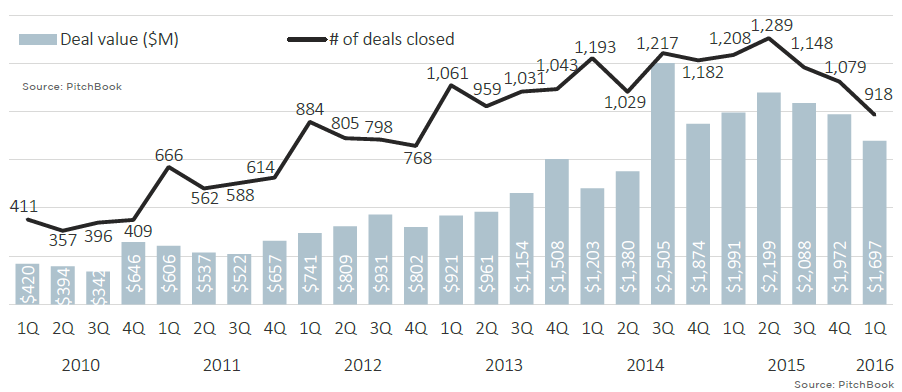
At about a thousand deals at about a million bucks, that's bumping the $1B mark, but doesn't break $2B.
Also if you'd like you can email me at the address in my profile, this thread is getting nested very deep.
That there is next to no seed money in existence, for companies, regardless of whether they are making money, and anywhere in the world (including California which by a large margin has the best funding climate for seed rounds.) That if you sum up the total amount of seed money it is next to nothing.
As an exercise you could try to add up the sum total yourself, and you will see it is next to nothing.