News for hackers. Stuff that matters.
Re:Nanorobots That Can Travel Down the Bloodstream and Preci... by JoeAltmaier on Tuesday August 16, 2016 @12:07PM (#12298369)
If. US is currently at 12%. Education, health care and pensions currently amount to > 60%. So its easy to cry wolf. We're really in a much better place than chicken little would have us all think.
Re:Nanorobots That Can Travel Down the Bloodstream and Preci... by imaginenore on Tuesday August 16, 2016 @01:07PM (#12298866)
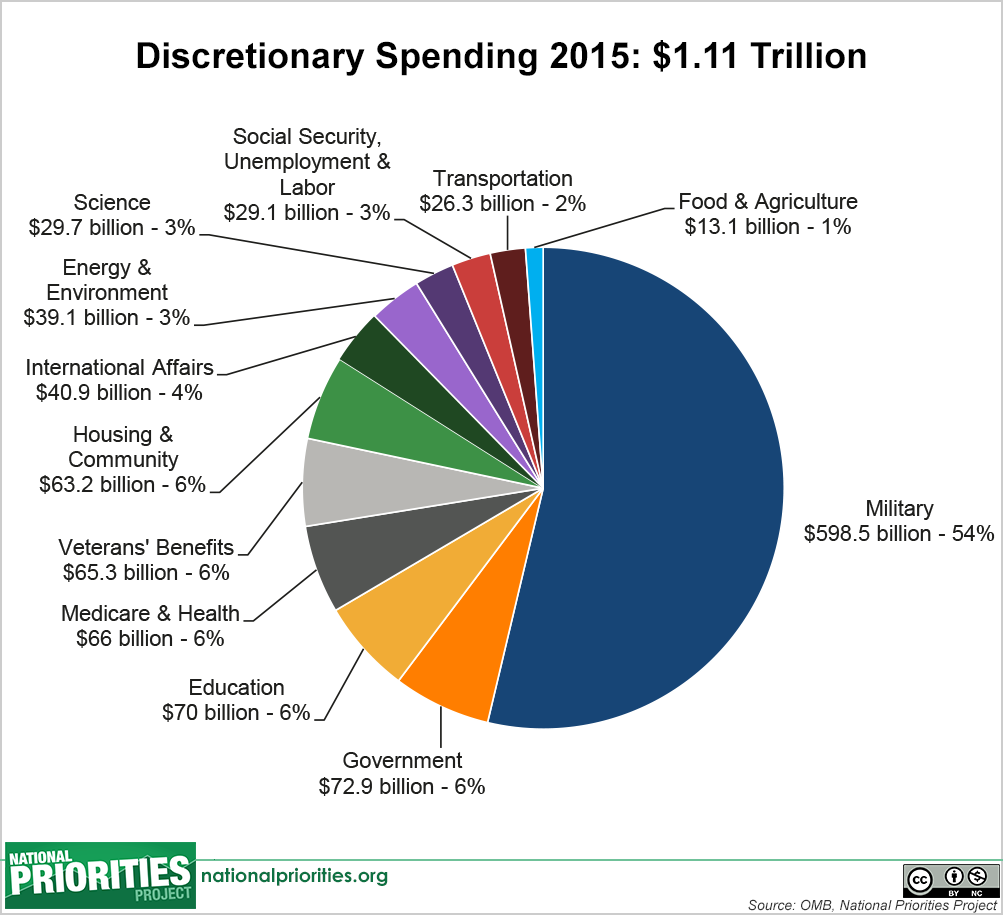
No, the US is currently at 54% military + 6% veteran benefits, while 6% education, 6% medicare + health, 3% science.

https://media.nationalpriorities.org/uploads/discretionary_s...
Re:Nanorobots That Can Travel Down the Bloodstream and Preci... by JoeAltmaier on Tuesday August 16, 2016 @04:05PM (#12300237)
No, the :US total spending is just as I listed:

http://www.usgovernmentspending.com/us_budget_pie_chart

Showing that abbreviated 'discretionary spending' subset of the budget is uninformative at best; dishonest at worst.

Re:Nanorobots That Can Travel Down the Bloodstream and Preci... by astazangasta on Tuesday August 16, 2016 @06:43PM (#12301200)
Uh, why? That's the portion of the budget that Congress actually has control over. Furthermore the mandatory portion (entitlements) are fundamentally different - you pay into the system through payroll taxes and pay out later during retirement. Vastly different from taking money from income taxes and using it to buy guns and planes.
Re:Nanorobots That Can Travel Down the Bloodstream and Preci... by dragonwriter on Tuesday August 16, 2016 @06:58PM (#12301278)
> That's the portion of the budget that Congress actually has control over.

Congress has control over the whole budget. Unlike, e.g., the California Legislature and voter-mandated Constitutional spending in the state budget, there are no "mandates" in the "mandatory" part of the federal budget from some authority that transcends Congress, and it is well established that past acts of Congress do not bind future Congresses, or even future acts of the same Congress.

> Furthermore the mandatory portion (entitlements) are fundamentally different - you pay into the system through payroll taxes and pay out later during retirement.

That's not entirely true. While mandatory spending does include the payroll-tax-funded Social Security and Medicare programs, it also includes programs that are funded from general revenues like Medicaid, SNAP, EITC and the Child tax credit, etc.

Re:Nanorobots That Can Travel Down the Bloodstream and Preci... by astazangasta on Tuesday August 16, 2016 @12:47PM (#12298695)
In FY2017, $582.7 billion of $1.149 trillion in discretionary spending is on defense. Where do you get 12%?
Re:Nanorobots That Can Travel Down the Bloodstream and Preci... by NoGravitas on Tuesday August 16, 2016 @01:13PM (#12298917)
I imagine he is counting non-discretionary spending, like Medicare and Social Security, which are large, but are also separately funded.
Re:Nanorobots That Can Travel Down the Bloodstream and Preci... by cm3 on Tuesday August 16, 2016 @12:16PM (#12298433)
Assuming the percentage you cited is right, I do think the relative numbers are less important in my assertion than the absolute because with the current tools at hand it's hard to reduce that > 60% part. Only by finding better tools through more research can we, for example, reduce the need to spend that much on health care and pensions. If you consider the absolute amount spent on the battling part of the forces, I would like for battles, if they have to be fought, to shift into cyber space. Just getting rid of money spent on munitions alone would be huge. And more cyber wars means stronger need to build and use more secure IT infrastructure which will benefit everybody.