Dilma, on her part, gave in to the austerity camp (both left and right can't seem to give up this mentality) and made matters worse. In part, this was driven by inflation fear mongering by the media.
The economy was already slowing down in 2011, and Roussef's government lowered interest rates and started giving subsidies to certain sectors and companies in order to stimulate economic activity. Some economists said this was a bad idea with potential disastrous consequences considering the global slowdown that was happening. IMHO, they were spot on. The private companies that went under since then were mostly the ones that were financed by public money. It was a failure of cronyism.
Social and infrastructure spending might have been high, but I think they were actually insufficient. Politics and economics are too skewed to the right in Brazil. Look at our budget surpluses for the last few decades:
https://brasilfatosedados.wordpress.com/2014/12/07/3047-supe...
And then look at the UK's budget history:
http://3.bp.blogspot.com/-u_6bLBEcvus/VIL2bc4et6I/AAAAAAAAB7...
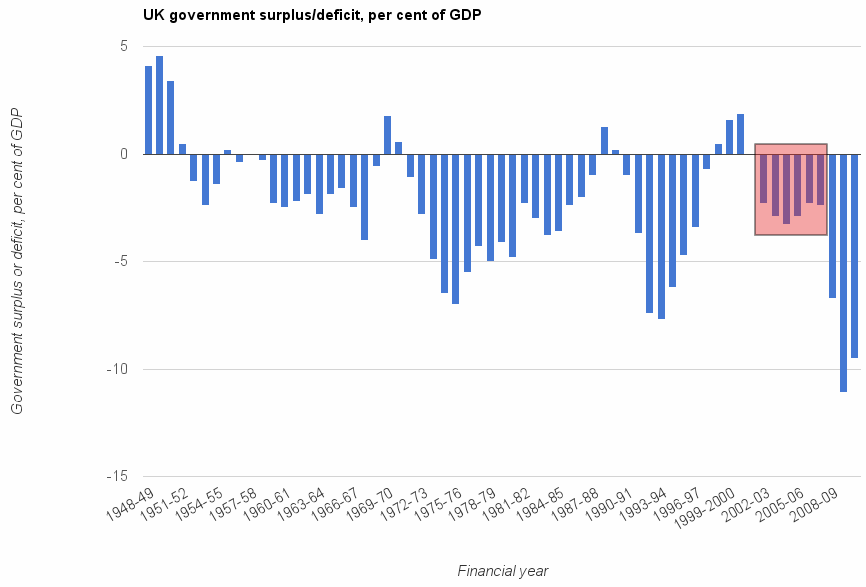
Even Thatcher had deficits all along.
This is the most absurd out of touch with reality statement I've read this week.
Brazil has 30+ parties almost all with "social" or "socialist" in their name. It's 50 shades of red down here.
PT - Centre-left; PMDB - Centre; PSDB - Centre (implemented neoliberal agenda in the 1990s); PP - Centre-right/Right; PSD - Centre-right; PR - Centre; PSB - Centre-left/Left; PTB - Centre; DEM - Centre-right (this I find hard to believe); PRB - Centre-right.
The "right" or "centre-right" would get votes from democrats with a big smile...
The fiscal responsibility law is a thing. Governors and mayors have been taken down from office for much less.
These "renowned scholars" that you mention are all tied to the workers party so their views are absolutely biased. Even the Bar order of Brazil, knowingly left leaning and pro-workers party has declared support for impeachment.
> In all, a complex scenario that does not bode well for the immediate future of the Brazilllian democracy.
How come? This is democracy in action. The law and the constitution are being followed to the letter.
Did Collor's impeachment undermine our democracy?
About the other point, regarding the future of the country, I did not mean the impeachment going through would undermine our democracy - this sort of discussion has no place here. Just that the overall economical and political landscape is cloudy at best. Operation java-jato is likely a good thing, but a "Mani Pulite"-like outcome, with corrupt politicians passing essentially pro-corruption laws, and the ascension of an inept "strongman" (in italy it was Berlusconi) is something that can easily happen in the coming years.
In particular, it is clear the congress voted for her ousting due to a series of reasons unrelated to the allegations. One reason is the dismal state of the economy, likely due in no small part to Roussef's policy decisions. Another reason is that a majority of politicians, from all major parties, are facing serious corruption charges from a large, unprecedented, investigation conducted by the federal police, and the impeachment acts as a diversionaty tactic (there are recordings proving this is not a conspiracy theory). Lastly, there is the usual power struggle, that is fiercer and more complex in an environment with many political parties.
In all, a complex scenario that does not bode well for the immediate future of the Brazilllian democracy.