There is some truth to what you're claiming, but I'm tired of this "California just wanted to freeze itself in the 1960s and look how wrong they were." In truth everything was going pretty good for everyone until the last decade or two.
You can see exactly that continuous spectrum of decay in California in many places. The state has become ever more polarized into rich and poor, with less and less middle, during that entire time. This is partially a process that was going on everywhere in the US, but all the extra regulation in California that was designed to halt that process actually made it worse.
The California middle class has been massively eroding since the '70s. Before that, you could drop out of high school and still get a job that would lead to you owning a house within a few years. Now, owning a house is impossible for almost everyone.
The land regulations that restricted supply have made long term housing prices grow far faster than the national average: http://www.doctorhousingbubble.com/wp-content/uploads/2015/0...
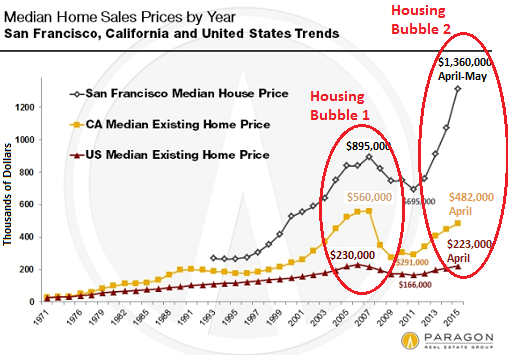
Huge tracts of formerly middle class suburbs near San Francisco and LA have become massive ghettoes -- where you still have to pay half a million dollars or more to buy a house next to thugs who openly sell crack 24 hours a day, where people are shot a couple of times a month. Where else in the US do you pay half a million dollars for a house in the ghetto?
The middle class jobs have mostly evaporated -- other than sinecures in California's vast bureaucratic and public employee apparatus, in which case you get a job for life with a powerful, politically-connected union to keep you from ever being fired for any reason. Good luck getting one of those unless you have a friend or relative who's already there.
Yes, things are great if you happen to be a high skilled tech worker in San Francisco during the late 90s or from circa 2010 to present, but this is a very small fraction of the population. Most Californians who don't have advanced computer programming skills only got squeezed harder by that influx of new money pushing up real estate prices still further.
And we haven't seen anything yet. Just wait till the "smart farm" trend really kicks in: http://www.economist.com/technology-quarterly/2016-06-09/fac...
Soon, very soon, robots will be picking all the produce in the Central Valley, and there will be millions of newly unemployed low-skilled workers flooding into San Francisco and LA looking for work.
Rent control in SF was a direct response to Prop 13 and certain landlords enacting disproportionate rent increases. Strict zoning had been happening before prop13 (1978) and still continues to this day based on the desires of each community and how each would like its city planned.
Yes, rent control was intended to alleviate the problem of large rent increases. In practice it has only made large rent increases even worse -- by shifting them from long term tenants onto "people who have moved recently," which does not necessarily correlate with "people who are not long term residents a community." This is precisely the sort of unintended and unforeseen consequence I referred to in my post above. New tenants paying market rate rent are forced to subsidize the long-term tenants' rent. (Besides, it is inherently xenophobic, which is a seperate issue.)
It is a wealth transfer from "people who have moved recently" to "people who have not moved recently." It incentivizes residents to never move, so that they can keep their rent control, and it incentivizes landlords to raise the rents as high as possible when a unit is released back to market rate.
The perverse and unintended effect is insanely high market rate rents, which eventually leads inevitably to the disintegration of the same lower income communities that rent control was designed to preserve, as rental units are inevitably slowly released back to market rate. Poor people sometimes move, too, or die. Young adults moving out of their parents' place can't afford to live in the neighborhood where they grew up. Only much richer people can afford to move in.
These regulations had numerous unintended and unforeseen consequences, however, which collectively had the effect of exacerbating rather than curing all of the economic problems that were changing society in the 1970s.