I'm not sure about moose, but with more nimble animals, swerving is no guarantee of avoiding collision. A deer can change direction quicker than an automobile, and if it had any sense, it wouldn't be running across the road in the first place. It's definitely safer to slow down and honk your horn than it is to try to guess which direction the damn thing will jump.
[EDIT:] When I was learning to drive, my father often recounted the story of a hapless acquaintance who, in swerving to avoid a snake, had precipitated a loss of control that killed her infant child. He's not a big fan of swerving for animals.
I've tried to pick the least graphic images possible:
http://img.radio-canada.ca/2015/08/09/635x357/150809_kr04b_v... from http://ici.radio-canada.ca/regions/saguenay-lac/2015/08/09/0... -- which ended up killing the two occupants of the car.
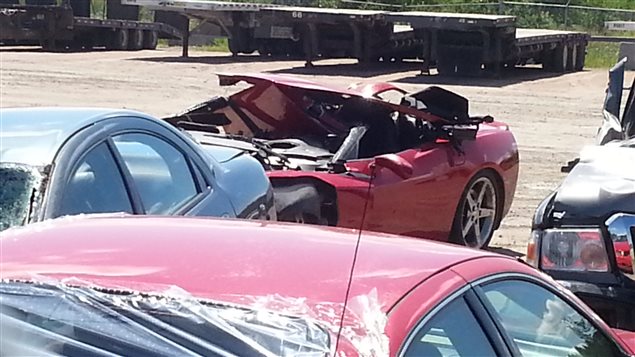
This one is interesting because you may very well hit the moose facing forwards: http://www.snopes.com/photos/accident/moose.asp
I don't think there is much to be gained in terms of safety. Let's not forget that while you may have large moose, there's a range where they can still be much smaller while growing and still damage smaller cars fairly easily.
Roof landings don't always end well -- my Civic was trashed when a deer basically bounced up and collapsed my roof on the passenger side. My head would have been trashed as well had I been a passenger!
In general, if you cannot stop, hitting something head on is the best bet. Modern cars are designed handle that sort of collision with maximum passenger safety.
Imagine a two lane road with a car traveling toward an obstruction in its lane. The distance required to get the car out of the obstructed lane via the steering wheel is much less than stopping it via the brakes.
There's a reason performance driving has the concept of brakes being an aid to your steering wheel as opposed to being operated as a standalone system.
I'm pretty sure that hitting a full-grown elk is a poor choice, and often a fatal one. A large, full-grown elk can weigh 600 pounds and stand 5 feet tall at the shoulder, which means it will probably go over the crumple zone and directly strike the windshield.
This happens commonly with moose in New England, which run up to 800 pounds and 6.5 feet tall at the shoulder. A car will knock their legs out from under them but the body mass strikes much higher and does an alarming amount of damage to the passenger compartment. You can Google "moose car accident" and find some rather bloody photos.
The standard local advice is to try really hard to avoid hitting moose, even at the cost of swerving. I would prefer that an autopilot apply a similar rule to large elk. Even if you wind up striking another obstacle, you at least have a better chance of being able to use your crumple zone to reduce the impact.