The premise that Japan would rather automate than allow immigration seems to be kind of a false dichotomy, since Japan is exploring immigration as well[0].
Culturally, in general, it may be true that Japanese people would rather have fewer foreigners than more foreigners, but the actual policies of the government seem to be slightly more pragmatic regarding automation versus immigration.
[0]https://www.japantimes.co.jp/news/2016/01/06/national/social...
Or look at America, the world's biggest melting pot. Just because Japan has a preference for their own ethnicity (like most other countries around the world, India, China, most of Europe, etc.) doesn't mean they aren't wrong and IMO not on the wrong side of history. People I know here in the US have no issue having real friends, people they hang out with and regard as equals, who are ethnically Asian, Indian, African. In other countries, this simply wouldn't happen.
Oh stop it. We aren't a melting pot. We are nation with nearly 80% white population. And there has been tons of anti-immigration laws in the US.
https://en.wikipedia.org/wiki/Chinese_Exclusion_Act
https://en.wikipedia.org/wiki/Asian_immigration_to_the_Unite...
Yes, the cities have some diversity, but most of the country doesn't. The vast majority of towns/rural districts/counties/etc are 95%+ white. There are a few that are 95%+ black and 95%+ native/hispanic.
> People I know here in the US have no issue having real friends, people they hang out with and regard as equals, who are ethnically Asian, Indian, African.
And we also have racial strife, violence, etc. We also wiped out the natives, put japanese americans in camps, had pogroms against the chinese, enslaved and brutalized blacks, etc. Go read about the LA riots.
The US is one economic collapse from major racial hatred and violence. Go read about what happened to the chinese in the US and the mass lynchings during economic strife. As long as the bubble keeps getting inflated, everyone will behave more or less. If that bubble ever pops and there is an economic crisis, you'll see what american is really like.
The US is 61.6% white, 17.6% hispanic/latino, 13.3% black, and 5.6% asian.
Source: https://www.census.gov/quickfacts/table/PST045215/00
Drawing on techniques from social network analysis, PRRI’s 2013 American Values Survey asked respondents to identify as many as seven people with whom they had discussed important matters in the six months prior to the survey. The results reveal just how segregated white social circles are.
Overall, the social networks of whites are a remarkable 91 percent white. White American social networks are only one percent black, one percent Hispanic, one percent Asian or Pacific Islander, one percent mixed race, and one percent other race. In fact, fully three-quarters (75 percent) of whites have entirely white social networks without any minority presence. This level of social-network racial homogeneity among whites is significantly higher than among black Americans (65 percent) or Hispanic Americans (46 percent).
Links:
http://www.theatlantic.com/national/archive/2014/08/self-seg...
http://cdn.theatlantic.com/assets/media/img/posts/2014/08/cr...
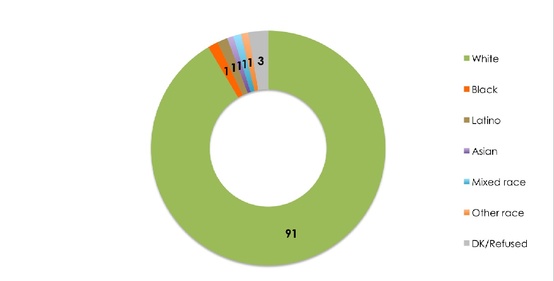
You can explain the whites who have no connection to any nonwhite by saying that nonwhites tend to be concentrated in particular areas such as Louisiana or New York City, but that makes the nonwhites look significantly more integrated compared to the whites.
I love how people love to pretend that the US is some kind of idealized place. It isn't.
I mean look at all the Black Lives Matter stuff. Look at asians complaining about quotas in colleges and lack of opportunities in hollywood/etc. The same with hispanics.
Only the US has had major success integrating on a national scale. There are parts of England, major cities in France and Germany are pretty good, but the countryside is still divided. And much of the countryside is still divided in the US, too, it's just that there is a visible contrast for us to speak out against.
While US may be an ethnic melting pot, it is steeped in WASPy culture (apologies for the racial term).
Europe while bland food-wise is far more diverse (linguistically atleast), so there is more to "preserve".
Russia seems to remember the days of Eastern Orthodox vs the Vatican (now repeated by Putin et.al).
India is, diverse yes, but those who make it out are mostly the outputs of a colonial system which wanted to replicate WASPs. Kind of the same thing in Africa.
China is kind of asserting its own culture, but Mao's men didn't leave much tradition behind to stand on. The schizophrenia is now quite visible; but then it's not clear if it would have been better if Chiang Kai Shek held on to power.
Japan is slightly bit better, but the tradition seems to have become frozen, and quite irrelevant. I'm not sure if it was more fluid before Meiji.
Perhaps, the reason why the Anglo-American world is so fond of diverse peoples is its task - for the better or worse - of synthesizing a universal culture.
Either you haven't travelled very much, or you have but spent most of your time in resorts and tourist attractions.
Suppose we let dogs breed randomly. Soon, there would be no poodles. There would be no golden retrievers. There would only be mutts.
Suppose we let bison and cattle breed freely. Pure bison would soon become extinct.
Invasive species all over the world are forming hybrids. Many pure original native species are being lost to these hybrids. Do we care? I think many people do care. It makes just as much sense to bemoan the loss of people who look Irish or German. Genuine light hair and eyes are going away. As recessive traits, they may pop up rarely, and much more rarely in combination.
It doesn't make the population younger/healthier, nor does it expand the local consumer base.
That's like saying it's built into humans to murder and rape. Some 'innate' human behaviours are actually based in circumstance. And even if our xenophobia is truly something we're born with, not cultured into, we can still aspire to be better. We can make it our culture to aim higher.
Which is a myth. And especially in the case of Japan where the only people willing to learn the language are going to be those who are more educated/successful.
And from all accounts Japan is going to start suffering from the effects of an ageing population far quicker than it will take humanity to develop robotic technology capable of cooking food, caring, cleaning etc to a level equivalent to that of a human.
In Japan the main fear comes probably from China, since it's a lot easier for Chinese people to learn Japanese (similar characters) than for occidental people, and there is also a "relatively" high inmigration from poor Chinese people.
It's also expected that people don't want their wages depressed by imported labor.
A democratic government enforcing the above ideals (if supported by a majority of citizens) is expected. That's why Japan is exploring automation instead of immigration for its workforce.
EDIT: @krapp (HN is throttling my posting ability)
Japan is overhauling immigration, but only as a last resort:
https://www.bloomberg.com/view/articles/2015-12-07/immigrati...