While I'm a firm believer that private cars (at least at a scale seen in the U.S.) and dense cities are fundamentally incompatible, I'm not quite onboard with getting rid of roads altogether. What about bicycles? Emergency vehicles? Construction equipment? Furniture deliveries? Deliveries of merchandise to stores? None of these things are going to be able to get around without a road network of some description, albeit hopefully one significantly reduced in scope from a typical American city.
There are roads of old, but closed to traffic and heavily modified. In case of emergency, fire engines can get in. Bicycles and pedestrians can comingle happily on a normal day.
My hometown's (Ljubljana) pedestrian zone is more than a kilometer across. It's quite awesome.
They also boost the traffic the surrounding businesses get and make it easier for cafés and restaurants to add a terrace area.
Well-executed pedestrian zones are one of the easiest and most effective ways of making a street more liveable in my opinion.
Edit: Also, (preferably one-way)streets where the sidewalk-to-road ratio is a lot higher than usual. Case in point[1]
[1]: https://www.google.com/maps/@47.5003418,19.0510879,3a,75y,17...
Streets are things which are where humand can play, people bike and walk, go to stores, around the places we live and work, etc. They are 'Places' where people can live about their day to day lives. Very human-friendly.
'Roads' which are higher-speed connectors between Places. Highways are a very high-speed type of roads.
In a typologically healthy region, there is a clear distinction between streets in roads, but in the US there is a blurring, and we often see what are sometimes dubbed 'stroads' - a mutant street-road hybrid, the sort of thing we typically see in the US with wide, fast, multi-lane streets, lined with strip malls and the like. They're hostile to human and make walking between locations at best boring and tedious, and at worst dangerous.
http://www.strongtowns.org/journal/2016/5/22/engineers-shoul...
Note his definitions are a little different than what I used, but have roughly the same point
The city centre is essentially car-free, with a ring-road highway around it. The centre is dense enough to have most things you'd want, but small enough that you can walk across it quickly.
Heavy rail is even better, and if you're designing a city from scratch, the biggest challenges to building heavy rail aren't as much of a problem.
Specifically getting food/goods/supplies to businesses, restaurants, hospitals, and other facilities that are required for such a city to exist. You could potentially utilize rail for this but then you face the last mile problem. Additionally considering things like emergency services, rail seems like it would be entirely inefficient for getting someone immediate medical attention.
As another commenter suggested, emergency vehicles especially could still use pedestrian walkways, which would still be needed to get from station to endpoint, and should be sufficiently wide to allow a lot of free movement. The so-called last mile. As a perk, pedestrians and bicycles are easier to move to part ways for emergency vehicles.
I think that a lot of freight could be handled the same way. A limited number of licensed carriers could operate light mule vehicles to bring freight from the nearest station (assuming rail stations had decent cargo-unloading stops as well) and operate along pedestrian walks during low traffic hours. (Your mail and your deliveries should not be delivered during regular starts or ends of the work day, or mealtimes. I'd go so far as to say construction traffic should be in the dead of night.) Since they'd need to coexist with pedestrians, but only travel a very short distance, from the nearest station, I'd propose these would be slow as heck, and since they wouldn't be traversing rough terrain, they could have extremely low ground clearance as well.
The key importance is that these pedestrian walkways be first and foremost, for pedestrians, and that personnel transportation vehicles be non-existent along them. The occasional off-peak freight cart isn't going to be a huge burden on transportation efficiency or pedestrian safety.
I just spent a week in Paris. Do you know much faster it's transportation is than walking? It's about a 2x multiplier. That's it. I can take multiple subway connections and get there in 30 minutes or walk the streets in 60.
Several hundred billion in subway is no faster than a moving sidewalk in an airport.
We can do better. We must do better.
Tough to get a firetruck somewhere without roads. We have come a long way in reducing the fire risk in new construction buildings, but 'stupid finds a way' is far from being a solved problem.
US fire truck manufacturers are starting to look at their European brethren (companies like Metz out of Germany) for examples of how to accomplish the necessary tasks on much smaller platforms.
I think we're still a long ways from being able to do away with fire trucks entirely though. Firefighting is a very dynamic activity, with a lot of contingencies that need to be covered, and the 'big toolbox on wheels' model works very well.
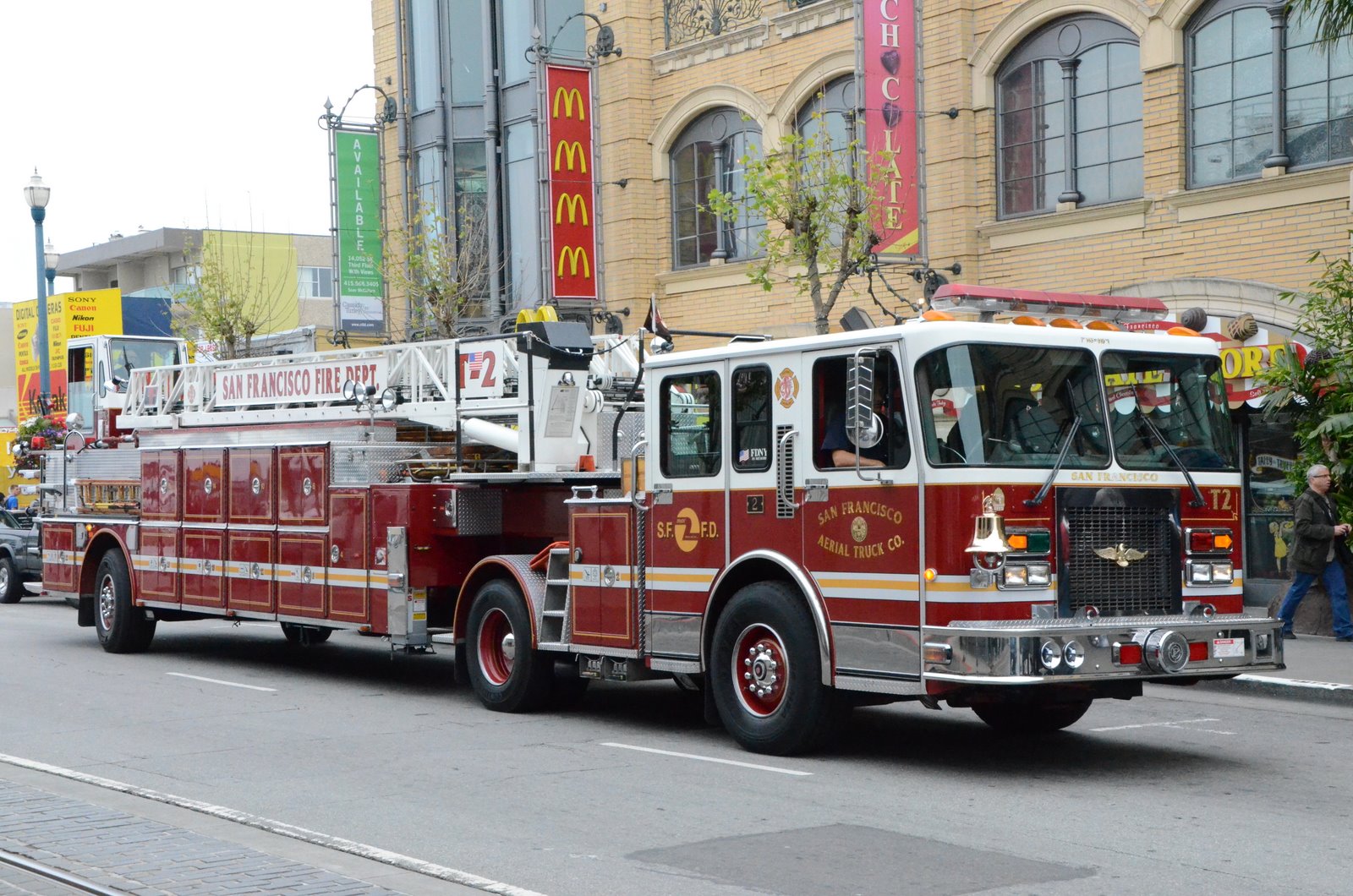
Maybe a bit narrower/shorter though.
You still get the volume but don't have to punish the people who live in an area for the 0.001% of the time fire trucks need to be there.
It's important that a transportation system account for all needs, but fire trucks aren't a need they are one potential solution to the emergency response use case.
Modern subway systems are automated with barrier walls and doors making it near impossible for a human to end up on the tracks. If built like this from the get-go, collisions between transit and pedestrian could be virtually zero. Plan your stations based on the distance needed to reach EVERYWHERE in a reasonable walking distance, make sure your system has the capacity to meet the daily working population, and you really don't need direct A-to-B transportation.