However broken SF's development process may be, it isn't the limiting factor to new development. SPUR estimates the regulatory costs for a San Francisco project at about 20% of the total costs [2], and most of that is the low-income housing set-aside (which is ~10-15%, varying by project). The majority of the costs of any new project are land, labor and materials. And San Francisco truly is an exception, in that it's one of the few cities in the world where there's no more undeveloped land.
People love to make generalizations based on community meetings (which are always a circus, in any city) and the cost to do a bathroom renovation or alter a garage door, but to a large construction project, these kinds of bureaucratic costs are a fixed expense. Land, labor and materials drive everything.
Edit: I'm stating facts here, and citing sources for those facts, directly from developers. I have no idea how you can downvote factual information. If you want to have a reasonable conversation about housing in SF, you have to take these basic economic questions into account. They matter.
[1] https://westnorth.com/2014/03/18/between-rocks-and-a-tall-pl... [2] http://www.spur.org/publications/urbanist-article/2014-02-11...
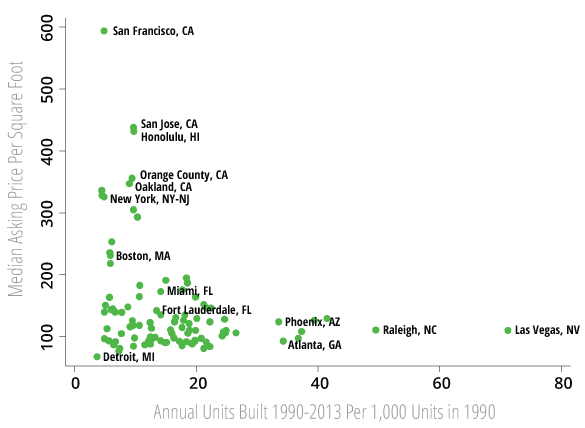
The data shows, clear as daylight, that prices are only ever this high in cities which refuse to build any new housing:
http://www.spur.org/sites/default/files/wysiwyg/asking.price...
In Houston, which famously has no zoning, you can buy a condo in a downtown luxury high-rise for $200 per square foot (http://www.zillow.com/homes/for_sale/Houston-TX/condo_type/6...).
"few cities in the world where there's no more undeveloped land"
Downtown San Francisco is full of undeveloped surface parking lots. Here are some maps I made:
http://i.imgur.com/iSik6Zw.jpg

http://i.imgur.com/zNFjk6v.jpg

http://i.imgur.com/HygnC5e.jpg

http://i.imgur.com/SJs576L.jpg

"The majority of the costs of any new project are land, labor and materials."
That's highly misleading, because if development gets easier then rents go down, and if rents go down then land prices go down. The paper at http://faculty.washington.edu/te/papers/Housing051608.pdf estimates that excessive regulations are responsible for half of San Francisco's housing costs. That was in 2006, so it's almost certainly more now.
That graph shows only that housing is more expensive in cities that haven't built a lot (it's actually not clear, since there's no R^2, so you can't interpret it). It doesn't tell you anything about why those cities haven't built.
"In Houston, which famously has no zoning, you can buy a condo in a downtown luxury high-rise for $200 per square foot"
Houston is over 600 square miles, with few geographic impediments to construction. San Francisco is 50 square miles, surrounded on three sides by water. There's a latent variable you're ignoring.
"That's highly misleading, because if development gets easier then rents go down, and if rents go down then land prices go down."
Development doesn't "get easier" as rents go down. It gets harder, because it's harder to justify the costs of a project to investors.
The $300/sq.ft. estimate is a nationwide baseline estimates for high-rise construction. They're labor and materials costs, and are unrelated to land, rents, local policy, etc. High-rise construction becomes especially difficult as rents drop, which is why you don't see it outside of the most expensive markets in the world.
"Downtown San Francisco is full of undeveloped surface parking lots. Here are some maps I made..."
Highlighting every parking lot you see in SF (which is what you've done here) isn't a counter-argument. They're land that is being used for a current economic purpose (unlike, say, most of the land surrounding Houston, which is being used primarily for jackrabbits and snakes).
In fact, you've highlighted a number of lots in my own neighborhood that are currently in the process of being developed. Why weren't they being developed before? It wasn't worth it until residential demand in the neighborhood went up. You're assuming that these lots weren't developed "because regulation", when the answer is "because nobody wanted to build there".
"The paper at...estimates that excessive regulations are responsible for half of San Francisco's housing costs."
As far as I can tell, it's not a reliable source. It's a paper about Seattle, which runs a regression based on a small sample of land-use restrictions from a Wharton database, and claims (without proof) that regulations added $409,000 to housing costs in SF from 1989-2006. Aside from not passing the data analysis smell test, that number includes all regulations -- including state and zoning restrictions, many of which are perfectly reasonable.
The numbers I'm citing are directly from SF developers, via SPUR. It's possible that "unreasonable restrictions" drive up land prices more generally in SF, but you'd need a better analysis than this to prove it.
I don't necessarily dispute this, but your putative arguments could be applied to lots of industries, and seem inconsistent with the wide range of quality / price points for most products.
In so far as real-estate is a product, differentiation between quality and price points is primarily a function of location...as Peter Thiel might put it [but probably doesn't], each lot is a monopoly. There is cheaper housing in Detroit and solely based on the opportunities afforded by location and not necessarily the nature of improvements one might deem it of lesser quality than a similar structure in San Francisco.
Anyway, I've been involved in a bit of housing development over the years. The few developers I know who do affordable housing specialize in it [as the many upmarket developers do in the upmarket]. Developers who don't specialize in affordable housing typically don't do it. The market analysis and proper institutional investors are not orbiting the market rate housing and general commercial development herd...and most developers stick to their track record.
This is false. Direct subsidies are one of many means used in California to achieve targets for affordable housing, but affordable housing does not mean subsidized housing. That's particularly important in the context of this proposal, a key part of is proposing additional non-subsidy mechanisms to encourage affordable housing (by reducing the local-review barriers to new developments which include it, and reducing regulatory barriers to new units on existing lots.)
When bills like this talk about "affordable" housing in new developments, they don't just mean "the rent in this unit has to be kept below $X per month" (as in rent control). The "affordable" units are turned over to a government agency, such as the Mayor's Office of Housing in San Francisco (http://sfmohcd.org/), which administers them and decides who gets to live in them. For example, last year, the city of San Francisco decided that people who lived in the same neighborhood as a building would be first in line for that building's affordable units (http://www.sfexaminer.com/affordable-housing-lottery-being-t...). The building owners' approval was not required, because the program is run by the city.
Well, the most relevant counterexample here would be the California Health and Safety Code Sec. 50052.5 [0], which provides the cost-based definitions of "affordable housing" which apply to various income tiers (which are also those relevant to the present proposal from Gov. Brown.)
(These definitions are often prerequisites to certain subsidies, but it is meeting the definition, not the subsidy, that makes it "affordable housing".)
> The "affordable" units are turned over to a government agency
Proposals (including the present one from Gov. Brown [1]) conditioned on a certain share of affordable housing usually require that the developer make a commitment that they will meet the applicable cost-based definition of "affordable" for a period of time, and that that commitment will be enforceable by a public agency (the present proposal requires that this be done by the developer recording a land-use restriction enforceable by the public agency.)
This does not require that the property be turned over to (or even managed by) a public agency, though certainly there are affordable housing developments that have occurred where there was either direct ownership or management of the units by a public agency, nor does it require that the housing be subsidized in any way (though at the "lower income" tier, the population for whom they are targeted to be "affordable" to is also the population eligible for Section 8 housing subsidies, I believe.)
[0] http://www.leginfo.ca.gov/cgi-bin/displaycode?section=hsc&gr...
[1] http://www.dof.ca.gov/budgeting/trailer_bill_language/local_...
In my experience, as appears to be the case here, local governments often "encourage" developers to offer below-market-rate housing as part of the residential zoning rules. Here's an example: http://gothamist.com/2015/12/18/de_blasio_zoning_affordable....
Otherwise, your logic implies developers in a place like Houston should only build high end units. That obviously doesn't make sense.
Going further, there's more money to be made on larger loans and hence incentives for any developer financing purchases. Easier to sell on mortgages backed by higher quality assets.
Affordable housing development is a specialty. It requires relationships with politicians willing to forgo maximizing the property tax base, specialized lenders, and a unique deal flow pipeline. E.g. think about the attractiveness of the 30 year affordability requirements in the legislation to the commercial market.
Anyway, the effects of legislative changes will be felt ten to twenty years out...many of the shovel ready projects funded by the stimulus are still under construction.