An adoption curve leveling off is a normal thing in business; money can still be made. When did the adoption curves for insurance, paint, homes, jewelry, soft drinks, etc. level off? Long before Berkshire Hathaway came along, but they have done pretty well in all of those of markets.
I think BH has a good chance of getting a return.
Edit: They're paying a modest dividend as well. AAPL is becoming more of a mature stock, but that's not a bad thing.
For one thing you haven't considered that this might be priced into their P/E ratio, unlike most other growth tech companies. If you were a "gambling man" this would be part of the equation in deciding if they are over- or undervalued.
There's no Android device on earth that's nearly as hip as the iPhone. Regardless of how many old people are on iOS.
They became unappealing because they were simply unappealing to young people and there were more appealing options for young people.
Android has yet to produce anything that even remotely resembles a more appealing option to these demographics. Apple is an expert in "hip." If you have an Android and your friend has an iPhone, you know that your messages are showing up green whereas everyone else's are showing up blue. This lack of totally 100% superficial conformity alone means that Android has a monstrous hill to climb with younger people, e.g. the people who care most deeply about acceptance amongst peers.
Certainly skewing old wasn't the only factor for Cadillac but it definitely was a component and they are trying to spend their way out of that image (both with ads and with more performance-minded cars).
I agree that Apple is an expert at hip but their time dominating is limited. It gets harder to be hip when so many people, especially those much older have them and mom/dad/grandma/grandpa all want to Facetime you. Younger people have been migrating their time away from Facebook because of the saturation.
I disagree on Android and the data doesn't back up your statements. Android is comparable with younger demos [3] and has more market share [1] (esp. outside the US) [2] so they don't "have a monstrous hill" to climb with younger people. Android and device manufacturers are positioned quite well.
It's going to be a challenge for Apple to continue to ask for a premium price when they no longer have a compelling quality argument and Android OS and devices keep getting better with many outperforming the iPhone. People are also getting tired of Apple's closed systems. They are "The Man" but most consumers haven't realized it yet. The squeezing they do with storage is ridiculous.
[1] 52.8% market share in the US, Jan 2016 - https://www.comscore.com/Insights/Rankings/comScore-Reports-...
[2] 80.7% market share globally, 4Q2015 - http://www.gartner.com/newsroom/id/3215217
[3] 52% of millenials have an Android device vs 44% for iPhone, 2014 - http://www.techtimes.com/articles/15084/20140908/draft-andro...
Therefore Apple is becoming uncool? Kids are moving away from Facebook not because old people are using it and that makes it uncool. It's because old people are using it and that means old people are watching them with it. Facebook is also just getting worse and worse as a product, while things like Snapchat are getting better and don't have parents/employers looking over your shoulder.
Re: Android, these are the same arguments we've seen since Android first started getting market share, yet Apple is still chugging along just fine. Market share is only one part of the story, and it's so far from an accurate indicator of "in" factor (exclusive things are often "in") OR of product health/profitability.
"People" are getting tired of closed systems? Which people? FOSS advocates? Hackers and tinkerers? Thank god there are 100x more people with equivalent checkbooks and less idealism when it comes to which devices they purchase.
http://www.marketingprofs.com/charts/2013/10957/how-iphone-a...
iOS seems to have better kids content and iPads and iPhones are quite durable from drop with protection.
Cadillac was a luxury brand that completely lost the plot, in terms of quality, service and importantly: brand.
As a result, luxury customers went elsewhere almost entirely (hello German sedans) and it stopped being an aspirational brand.
With younger buyers mostly not interested, most of success was selling to older customers for whom the brand still had left over positive associations, plus some die hard "no foreign cars" types. But this just made the brand problem worse, cementing the "old person car" brand.
So yes, they're fighting it now (without much success). But the real problem was that they started to peddle bad cars, and competitors ate their lunch. This in no way resembles the current situation with iPhone.
$80B in 1993 are equivalent to $114.79B in 2007.
By the way, a company doesn't need to do 10x the stock price to deliver 10x to investors. They can pay dividends. They can sell divisions.
We have been enjoying exponential growth for a while now:
https://ourworldindata.org/wp-content/uploads/2013/11/long-t...
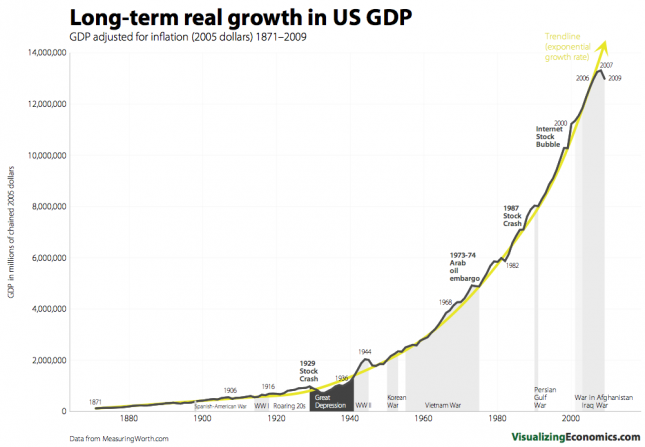
So Apple (and Samsung, etc.) may have exhausted a lot of the growth opportunities in the mobile market, but there are still other markets for them. Apple didn't even have a phone product 10 years ago, so it's hard to say what their future endeavors will be.
Betting on Apple doesn't mean betting solely on the iPhone.
(I think) you only take into account the US Market but the emerging world is late to the party and should represent a big piece of the pie. It hasn't reached majority tech adoption nor is it no longer hip.
That said, I also think its a loosing move because of the downwards trend in AAPL stock- bit that's only layman's conjecture. I guess it depends for how long they want to hold it.
I think it hasn't yet reached critical mass yet in plenty of second world countries. In Romania for instance there are plenty of lower end phones (specially /w teenagers) not because it's not hip (on the contrary, it yields social status) but because compared to the average wage here it's expensive as hell. The iPhone SE will probably sell heavily around here.
EDIT
An US (correct me if I'm wrong) airport might not actually give an accurate picture of the market since the lower class doesn't fly planes that often.
http://www.marketingprofs.com/charts/2013/10957/how-iphone-a...
Rationale here from a comment over 3 months ago:
https://news.ycombinator.com/item?id=11035168
> last time I was on an airplane (December), every single older woman over the age of 60 had an iPhone. This means that it's not only reached critical mass (the late majority on the technology adoption curve has been achieved), but now it's no longer hip.
> I'm not sure what will be next, but I'm guessing it won't be Apple's.
> Were I gambling man, I'd have shorted Apple's stock right there after that airplane ride.
So when I'm wrong, y'all can roast me proper.