I wonder if you would compare/contrast with short selling UPRO ?
That is, short selling the triple-long S&P 500 ETF.
The thinking here is that a long ETF (especially a triple long one) loses value every single day[1] due to the natural decay of long ETFs ...
So in a flat market, your short position is positive, and in down markets it is very positive. Further, it's not an option - you're simply short an ETF - so you can hold it through a market rally if you wanted to.
I have never employed this hedge, but it interests me.
[1] except for up-market days, of course ...
If you were able to short TVIX or SPXU or any leveraged etf for a long period of time it seems like a near 100% chance of massive gains which makes me think there is a catch.
Futures work on margin with relatively low fees so if you wanted leveraged short exposure to the US market that's what you'd naturally trade.
One of the posters below who describes buying a put and selling a call at the same strike is describing a roundabout futures trade. The put/call method would have far higher transaction costs, though.
Yes, that's the point - the idea is, instead of buying the short ETF, you short the long ETF.
They both decay, as you would expect an ETF to do, but by shorting the long, the decay works in your favor...
Shorting is (roughly given efficient market assumptions) equivalent to buying a put and selling a call at the same strike. If the stock has no chance of going up a lot, the call will be relatively cheap, and so selling the call won't change much.
Edit: on the other hand if it has low volatility in both directions, then both are cheap, and it's a bit more complicated. Buying the put will be cheaper, but shorting will also require less margin because the margin provider will have less risk. (See e.g. http://openmarkets.cmegroup.com/3785/understanding-margin-ch...).
This should cancel out in theory, but might not for various reasons like transaction costs.
http://i.investopedia.com/inv/articles/site/short_vs_put.gif
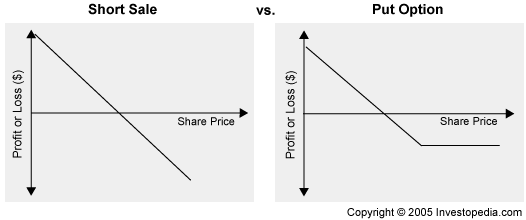
This link is simple and doesn't point out strike price or take transaction fees into account but you can draw similar graphs that do.
Any reason you chose spy over qqq or others?
I would love to find two assets that are inversely correlated but somehow both have a positive return at the same time, but I haven't found that yet :)
In the end for a big liquid etf like SPY, they aren't that much different than going short. Now for small companies that could skyrocket overnight and destroy a short seller, puts offer some protection since your loss is capped at 100% instead of theoretically infinite losses.
edit: I should add that puts give you leverage. To short 100 shares of SPY you would need $20000 worth of margin, while to buy 1 sept 2016 in the money put (100 shares worth) you probably only need to cough up $800. If the delta value of the put is equal to 1, your gains or losses will move inline with that 100 share short position.