This is always my go-to response when people ask me about my diet. If you simply eat only when hungry, and only eat real food, you're going to be in decent shape on average. There is a lot of detail and difficulty hiding behind those two simple requirements though.
For example, eating only when hungry implies that we stop eating when we are no longer hungry. Avoiding binge sessions is sometimes very challenging. And accepting a simple definition of "real food" can be surprisingly challenging. Things that don't make the cut: Frozen pizzas, almost all fast food, even orange juice.
I wonder how much of the fear of fat comes from people believing the saying "you are what you eat"?
Fat is 9 calories per gram, while carbs and proteins are 4. If you have a budget and you're counting calories, fat is more expensive per gram, so you might naturally develop an aversion to spending your budget on what appears to be less food (even if it's only appearance).
Too much fat is also unhealthy. How much is too much is still being debated, but there is a difference between a weight loss diet and a healthy diet. All things being equal, a 2000 calorie diet of buttered bacon doughnuts is still likely to cause more problems than a 2000 calorie diet of vegetables, fruits and nuts.
Not to pick on you, but there's this idea that fat must come from processed crap.
What about a 2000 calorie diet of meat, (real) butter, (good) oils, cheese, nuts and vegetables? Is that unhealthy?
The jury's still out.
Your example is one of a healthy diet, IMO, and fats are part of a healthy diet.
My one and only point is that too much fat, even from natural sources, is unhealthy, and the jury is not out on that, it is a known, proven fact.
Okay, I'll bite. What is a "good oil"? All oil is fat, and consuming fat causes serious health problems. The only "oil" you need are polyunsaturated fatty acids which occur naturally in whole vegetables and nuts.
The only oil I consume, apart from naturally occuring ones, is extra virgin olive oil, which the consensus from both sides of the fence is "it's good for you".
I think whatever sources you are leaning on for your claims would have the same issues that all the sources demonstrating good things about olive oil have, there is no central consensus for any of it, making that a pretty weak argument.
You said Olive oil is NOT healthy. Can you explain how pouring saturated fat on a meal is supposed to improve it?, don't come back at me like I'm trying to mix things up.
Well, where are they? I find it laughable how no one ever seems to be able to cite evidence exonerating unhealthy olive oil in these types of discussions.
http://www.aboutoliveoil.org/oohealthbenefits.pdf
(Now that I've pointed you to an easily found resource, will you read the cited works?)
Okay, now I'm convinced you really are kidding.
(the citations of scientific papers are on the bottom of each page...)
Note the in industry material in my comment above. I anticipated this response, I didn't have to edit it to put that in.
Anyway, have fun.
That's probably because a diet with 70% fat is extremely unhealthy and will likely lead to coronary atherosclerosis. Also, 5% carbs? How are you getting any nutrition in, since fruit and vegetables are almost all carbs?
Vegetables are often relatively high in carbs but low in total calories, and so the contribution of their carbs to your total calories can be low even if you have a lot of vegetables in your diet.
For instance, I recently had a steak and corn for dinner. The corn was 80 calories per serving, 15 g of carb, so 75% of calories from carbs. The steak was 600 calories, 3 g of carb (from the steak sauce I used, not the steak itself), with is 2% calories from carbs. I had two servings of corn with my steak, so the total meal was 760 calories, 33 g carbs, which is 17% calories from carbs.
If I had not chosen corn I probably would have chosen a can of green beans (70 calories, 7 g of carbs, which is 40% calories from carbs) which would have made the total meal 6% calories from carbs. Heck, double the green beans...two full 14.5 oz cans (almost a kilogram of green beans!), and the total for the meal would only rise to 9% calories from carbs.
Or consider salads. I use a pre-made salad mix [1] (I'm lazy). One bowl of this is 20 calories, 3 g carbs. That's 60% of calories from carbs. I use a dressing on this that is 240 calories, 4 g of carbs, so 7% calories from carbs. The salad mix combined with the dressing gives me 26 calories, 7 g carbs, so 11% calories from carbs. Recently I add some chopped up ham to this that added 200 calories, 0 g carbs, making the total salad 6% calories from carbs.
[1] http://www.freshexpress.com/product/refreshing-mixes/iceberg... and yes, the nutrition values I gave above do not match what they give on the site. I'm going by what is printed on the actual package rather than the web site, although it is a little disturbing that they are different.
Exactly, which is why you're supposed to be eating a lot of them.
> I had two servings of corn with my steak, so the total meal was 760 calories, 33 g carbs, which is 17% calories from carbs.
760 calories and not a whole lot of nutrition. For the same caloric price, you could have several salads packed with vegetables, legumes and whole grains, packed with antioxidants, vitamins, minerals and fiber.
Well, I do eat more than just a single meal a day. I also had a salad that day, and a sandwich on whole grain bread. It's not like every meal is a big slab of meat and a couple servings of one vegetable.
My main dietary planning since early September has been around carbs, because my glucose levels have been creeping up, even though I had not made any dietary changes. My HA1c hit 8.9 early in 2015 [1]. I cut back a bit on sugary drinks, and it dropped to 8.1 by early September. Then I started aiming for no more than 40% of calories from carbs, and by my next test 3 months later it was down to 5.9. I hadn't actually intended to cut calories, but as a completely accidental side effect my daily calories ended up half what they were before, so over that 3 months I lost 45 pounds, and have lost another 15 since then. My blood pressure is down noticeably, too.
For my 2016 food tracking spreadsheet I added a column specifically for sugar, and am thinking of modifying my "40% from carbs" goal to allow a higher percentage from carbs as long as the percentage specifically from sugar stays down. That will flip a lot more fruits and vegetables and grain-based products into the "go ahead and eat a lot of these" category.
From blood tests and food tracking, as far as I can see the only nutrient I'm low on is protein. I'm getting on average about 75-80% of what is recommended (based on the 0.36 g of protein per pound you weigh guideline). So, I like to toss in a delicious slab of meat now and then to boost the protein, like I did in my steak and corn dinner the other day.
As long as I feel fine, and my blood tests continue showing no problems, I'm just going to keep on doing what I'm doing, because it is leading to good steady weight loss and is almost effortless and should be sustainable indefinitely.
[1] And yes, this is with medication.
Greens, nuts and non-sweet fruits (olives, tomatoes, avocadoes, peppers) have negligible amount of carbs.
Who said? It's not very scientific, but if this supposedly "good for me" food makes me crave more, makes me bloated, tired, and crash after 3 hours and gives me stomach discomfort, is it really good for me?
Oh, I went through it for years, my body probably knows best.
Every single civilization which has eaten predominantly carbohydrates, like root vegetables and rice, for all of human history.
Stomach discomfort is caused by fiber, is common if you're coming off a meat-heavy diet, does go away once you return to eating healthy.
"forget about macros" - > be conscious of the starch and sugars you intake. if you have the choice between potatoes and nuts, eat nuts. choose green before white. getting all your calories a day from starch isnt ideal.
http://www.peertrainer.com/gfx/en_us/nut_density.jpg is an example chart i found after 10sec of googling
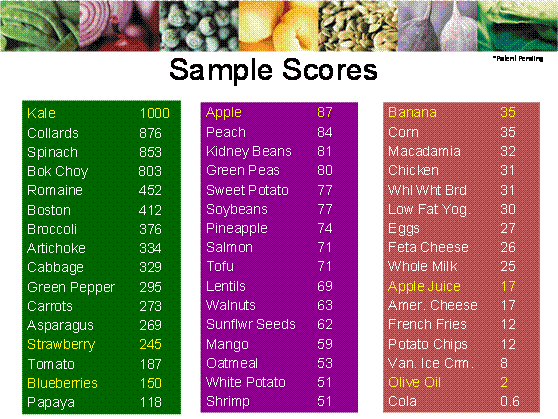
you might say potato is higher than chicken. but im not going to turn potato into muscle, i will turn chicken into muscle.
at the end of the day, fat and protein are necessary to survive, starch is optional.
Erm .. so? One can't survive on spinach alone, so I don't see this as a reason not to eat potatoes, or other starches.
> im not going to turn potato into muscle, i will turn chicken into muscle.
Well, why not? Every single whole plant food has a complete amino acid profile and sufficient protein (5-10% of calories).
i am talking about being mindful. saying "dont worry about macros" is the antithesis of paying attention to what you eat. for the most part, starches are fillers.
If you cut out starches, you need to replace those calories with other food. If it isn't vegetables, it'll probably be animal products, which are way less healthy than the innocent potato.
> for the most part, starches are fillers
I don't think so.
"THE potato is a very important constituent of the diet of many civilised nations, and it may be considered to furnish, with bread, the bulk of the food of the rural population of such countries as Poland and Russia. There is little doubt that the Polish or Russian peasant is nevertheless very healthy and able to do extremely hard work under trying conditions. Deficiency diseases such as beriberi, pellagra or scurvy are practically unknown in Poland."
The value of whole potato in human nutrition
if the goal is to lose weight, the calories should NOT be replaced, by meat or otherwise.
While I would tend to agree with you, apparently there's many people that thrive on starchy food (potatoes, rice). There's some unknown mechanism at work here, most probably it's the gut flora diversity.
Complete nonsense. Cholesterol = animal products, which contain estrogen, which lower testosterone. You don't need cholesterol in a healthy diet, in fact it's completely antithetical to healthy eating.
My flatmate, who's dieting with me, is appaled by the amount of fat I'm eating, constantly asking me if it's healthy or whether I'm just going to get fat even if I am well below my TDEE. My response is basically "a calorie is a calorie", i.e. I'm below my TDEE => I'm losing weight.
I know that the reality is more complicated, and the article does explain that very well; satiety is more important for dieters, and there's also the unknown factor of gut microbes: am I comfortable low carbing because of satiety or just because my gut flora is different? Nobody knows actually.
This is a fascinating subject and there are far too many experts and anecdata that everybody's right and wrong at the same time. Experiment, if you feel physically good and are not overeating (by counting calories) you're on the right track. Take dieting advices with tons of salt. Make them your own.
Personally I struggle having more than two meals a day and eating more than 1800 cals (I'm 1.86m and 88 kg). If I were high carbing I'd go over the limit just to keep my hunger at bay. I once binged (on processed crap I was craving) and ate around 4K cals. I honestly don't know how to do that on low carb, and especially eating healty. Unless I eat nuts: can eat over 1K cals in nuts in a single sitting.
And whoever said you NEED to eat n times a day: shut up, you're wrong.
My advice: eat when you are hungry, eat real food, forget about macros.