Not only has Vancouver built a lot, it simultaneously cultivated immigration programs to bring external capital into the local housing market. http://www.tandfonline.com/doi/abs/10.1080/14616718.2015.111...
Other countries, like Japan & Germany, treat housing as a consumable good or even something that depreciates. So even though Tokyo is one of the most developed cities in the world, housing actually goes down in value. http://freakonomics.com/2014/02/26/why-are-japanese-homes-di...
Vancouver isn't a country. The country is Canada, and Canada has places where your real estate will depreciate, like somewhere in the middle of Saskatchewan. How properties value over time is determined by the market conditions. Neither Canada, nor Germany nor Japan are communist states which flat-out dictate your property value.
The values of the buildings on a property themselves depreciate as they age, everywhere in the world. Nobody will pay as much for a run-down place that needs demolition as for a newly built or renovated, "move in condition" place. That doesn't matter so much if the property is valued 10:1 or more over the structures on it.
Tokyo is an ambiguous term because it simultaneously refers to a metropolitan area in which some 37 million people live, which spreads far beyond the city, and the property market prices and dynamics differ.
Japan as a whole went through general deflation through the 1990's and early 2000's and it may be returning. Its population has also been shrinking.
IIRC Bldgblog wrote that the US has about four ground-level parking spots per car. (Can't find the posting again now, but http://www.bldgblog.com/2007/10/greater-los-angeles/ and everything it links to is a fine place to start.) If you build some highrises, plus big flat malls and office parks, plus four parking spots for each car owner that's expected to move in, plus enough streets, then the highrises don't matter. You could build them half or twice as high and it wouldn't make a real difference to the density.
When Grorud (IIRC) in Oslo was built, the planners wanted tall buildings for density. An architect whose name momentarily escapes me came up with a counterproposal, namely copying the houses you see here (the most popular in the country at the time), and adding three large parks. http://www.agderposten.no/polopoly_fs/1.1060255.1397321665!/...

The counterproposal had the same density, despite the three additional parks. Guess what was built though.
http://i.imgur.com/UFhH4VY.png

That tiny, barely-visible bump at the end of the red line is the "building boom".
I haven't looked at Canadian data, but 100% of major US cities that built enough housing between 1990 and 2013 have low housing costs:
http://www.spur.org/sites/default/files/wysiwyg/asking.price...
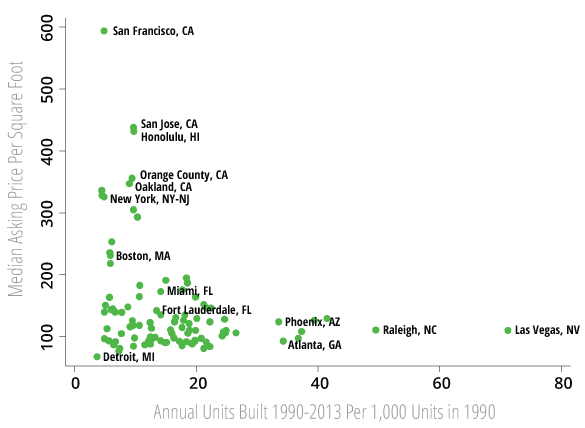
Data on SF housing production is from reports by the SF Planning Department (annual number of net new units). Data on population is from the Census Bureau, via Google Public Data Explorer.
Guess what, housing costs in Vancouver are almost as ridiculous as in San Francisco.
I'm not sure what the answer is anymore, besides revolution!