Wrong.
This video and test were done by the IIHS, an insurance-industry funded groups. The DOT crash tests are lame; it took the IIHS to push offset-frontal crash tests like this. The Federal government thinks that all auto crashes are frontal head-on crashes with no offset whatsoever.
IIHS and European tests are far better, but as usual, the US standards are stupid and backwards, just like they are for vehicle lighting and everything else. The DOT requirement for those idiotic "sealed beam" headlights are what kept the fronts of cars looking so ugly for so long, while the Europeans had moved to better-designed halogen bulbs and housing long before but couldn't export them to the US.
> Wrong.
>This video and test were done by the IIHS
I believe GP was not referring to video, but to the safety legislation leading to starkly improved safety performance of the 2009 vehicle (I thought their second line made this very clear)
This is very much the free market at work. Money (which people like to call "Greed") drives both consumers and insurers to find the scientifically best car. Insurers have more appropriate loses, and customers have fewer deaths (or a better safety level for their dollars spent).
The IIHS makes the knowledge about car safety much less asymmetric in the market.
The UL does a similar thing, and I think this is the model that is more effective.
It doesn't take an act of congress for the IIHS to come up with a new test and new standards as technology improves and new areas of risk are discovered!
Edit: I see my parent is being downvoted. He pointed out the basic facts of the situation, but since it was not sufficiently authoritarian he is being downvoted. I feel this site is anti-intellectual.
I believe Ford made a big deal out of their padded dashboards in the 1950s as well but I would have to dig up references to that.
While Volvo has a great safety record they are not even close to the only manufacturer with a history of adding safety features to their cars. Safety is good business, the US domestics have known this for decades.
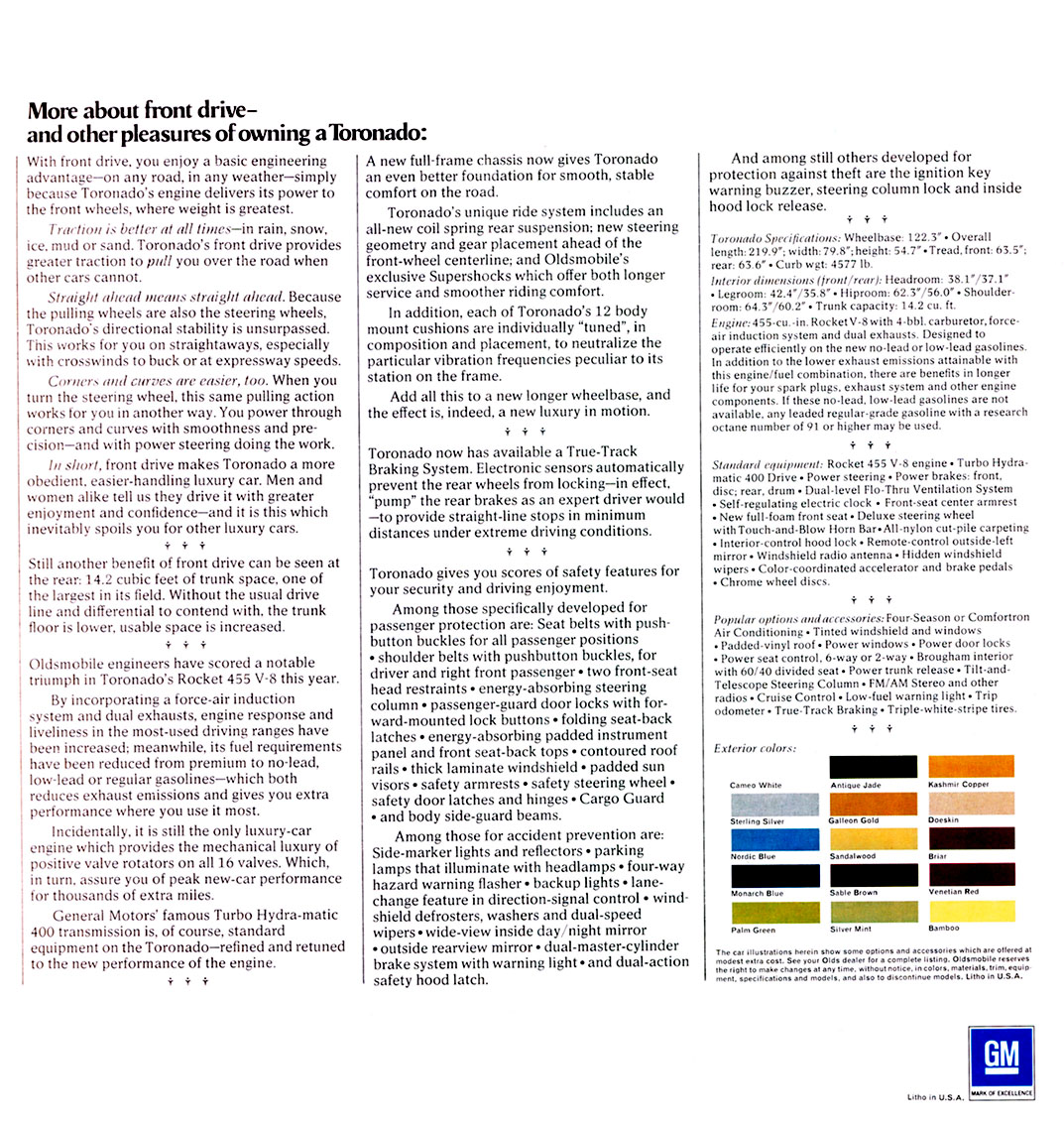
The 1971 Oldsmobile Torornado brochure prominently features ABS and specifically calls out the safety features available in that year: http://www.lov2xlr8.no/brochures/olds/71toro/bilder/6.jpg
"Top Ford Motor Company executives went so far as to arrange a meeting with President Nixon to plead against a federal regulation that would have required air bags in all cars, starting with 1973 models. The meeting had the desired effect: Mr. Nixon ordered the regulation quashed. Eleven years after the 1971 meeting, a transcript from secret Oval Office tapes disclosed the conversation."
I believe the Toronado air bags might have been offered just to provide a tool to say consumers did not want them.
Earlier on, they also fought seat belts. Then later, they fought for state laws mandating seat belt use by drivers, just so they could say the airbags were not necessary in the presence of seat belts. And a bunch of other stuff. Classic cartel behavior.
For some reason, VW didn't see it that way wrt the diesel emissions.
Maybe you need to recheck your understanding of other motivations.
Given the obviousness of the above, the real question is how you came to make such a silly post. My best guess is that you simplified the positions into "companies accept emission standards = companies GOOD on environment, but VW cheating = VW BAD on environment", and that's how you saw a contradiction. Please take a bit longer to think your posts through.
VW has over 450,000 people - all viewing the world differently ( as demonstrated by VW's corporate actions differently)
Out of 450,000+, excluding the dealerships, not one agreed with you enough to blow the whistle.
GM's response to the aforementioned? One of petulance and cowardice. They had to be hauled into Congress, kicking and screaming of course, before anything was done.
In general I think it's widely agreed that all businesses almost universally tend to oppose most forms of gov't imposed change.
and Saab, which was a point of contention when they were acquired by GM (Saab people insisted on safety, GM put profit first) and probably is the reason Saab (the original) is no longer
That's a claim that can change auto insurance big time.
If I had to guess there will probably be tests like the Institute for Highway Safety does but to test autonomous car software, maybe mostly simulated so they can run a huge number of tests again and again (a Matrix-for-Cars).
Yeah, that's the problem; it means you can't insure away the problem, and each jury gets told to slap on a high enough penalty to ensure the SDC maker "never does it again", and you know how that goes.
The problem isn't the insurer's solvency, but the SDC maker's.
One venue that has caps, for similar reasons, is vaccines. Because vaccines are safe and necessary, we need a way to ensure vaccine makers exist and aren't sued to bankruptcy over the inevitable few deaths, so there's a special system for ensuring compensation of the victims, and makers can accurately set aside a known quantify of money for those deaths.
http://www.thehindu.com/news/cities/Hyderabad/45-killed-as-b...
And it's not just this. I've personally witnessed at least 2 Volvos on fire on Bangalore roads, although thankfully, there weren't any fatalities. The positioning of the fuel tank is reportedly flawed in these buses.
Diesel doesn't burn in open air, without at least a wick and an existing source of ignition.
When Volvo began making cars, they were very beautiful, artistically designed instant classics, like this one: https://s-media-cache-ak0.pinimg.com/736x/99/b5/39/99b539384...

The founder of the company was passionate about making and driving beautiful cars, and he succeeded and built a pretty impressive company on that. However, he didn't pay much attention to safety, and died in a car wreck.
His wife inherited the company, and instead of selling off the assets and retiring, decided to take the helm and begin producing the safest cars possible. Ever since, they've been on the leading edge of safety development. The cars weren't quite as pretty, but they didn't kill as many people.
https://upload.wikimedia.org/wikipedia/commons/d/df/1988-199...

Volvo had a very strong safety emphasis already in the '50s, introducing many firsts in the automotive safety field. In that decade they introduced shoulder belts as a world first and padded dashboard as an European first (Tucker had this already in '40s but only 51 cars were ever made).
And ultimately decided to make the patent (US 3043625) license-free and open (essentially copyleft)
http://web.origin.volvocars.com/SiteCollectionImages/TopNavi...

A friend had a sporty two-seater Volvo P1800, and it had this exact seat belt clasp. It felt like something out of an airplane - solid, metal, no-nonsense - and it basically was, because the designer used to do ejection seats at Saab.
Except Volvo, which was usually ahead of regulations on safety. They had each of those things before they were mandated.
Volvo's CEO has announced that they want to eliminate all deaths in Volvo cars by 2020. He also says that if a self-driving car has an accident, it's the manufacturer's fault and the manufacturer's financial responsibility.