Interestingly though, most exceptionally high earners have post-graduate degrees, according to Gallop[1]. When you exclude that group, the non-college graduates make up the largest portion of the highest earners.
If there is causality here, it seems one has to be mindful to continue their studies long enough to see the benefits. Simply getting a degree does not seem to pave the way to a better income.
[1] http://content.gallup.com/origin/gallupinc/GallupSpaces/Prod...
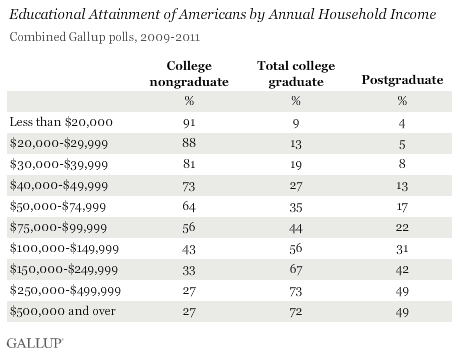
However, it's less clear if the higher incomes are caused by the increased productivity afforded by education, or it's merely a signaling effect: productive people go to college to signal to the employer that they are intelligent, hard working, and willing to commit to a career in the field by irreversibly burning years of their lives and future incomes on the hope of penetrating the respective professional field. It's most likely, a combination of both.
What critics of the education bubble point out is not that a degree is necessary to earn a good income; but that the onerous costs of modern education have to little to do with the actual productivity gain and useful skills students earn in return.
In support of this view we can see how the MOOC revolution failed to produce significant effects on the labor market: it's not that MOOC education is has low value (quite the contrary), it's that is cheap enough that too many people can afford it, negating the signal (or "sheepskin effect" of an expensive degree).
That $1.3M in 2015 dollars, and over 47 years of (potential) employment from 18-65, it's $27,000/year.
Of course, past performance is no indication of future results. And I suspect that this is the kind of statistic where "average" is misleading: Most exceptionally high earners have college degrees.