Or, more generally, any potential value of it is subjective, and evaluations of merit aren't actually taking even that into account.
Offensiveness doesn't seem even remotely relevant; some people may enjoy works that others find offensive. On the other hand, foring others to involuntarily fund "art" without using any measure of the value provided either to the people viewing it or to the people funding it (and utterly disconnecting those two groups) seems ridiculous, and leads to problems like this. And then you get into definitions of "art", and criteria for what should and shouldn't get funded.
With all the myriad ways of connecting with potentially interested audiences today, much of the rationale for speculatively funding art no longer exists. If you make something people find worthwhile, you don't need public support, and if you're not, you shouldn't receive public support. Produce samples, get people interested, find patrons (or customers, or both), build larger projects, repeat. And if you want to work on something that nobody else cares about enough to fund (or that you don't care about seeking funding for, for any number of reasons), that's called a "hobby".
That doesn't mean that "culture" devolves into exclusively "pop culture". It doesn't take a large number of interested people to provide a substantial amount of funding; a very small amount of money from a thousand people can fund a career for one. So this certainly doesn't mean that only the makers of mass-market popular culture can get funding; quite the contrary.
Defining "art", or setting criteria for receiving funding, then becomes irrelevant for anyone other than philosophers or art critics. If people like something and want to support it, they can.
> Or, more generally, any potential value of it is subjective, and evaluations of merit aren't actually taking even that into account.
Art is art, there doesn't need to be some line in the sand where things are suddenly "good" or "art", or "bad" and "garbage". But there's definitely some kind of range of quality, and subjectively if the work isn't moving the audience, it's not subjectively "good".
I think you tap into the notion that "good" can be different for different audiences, and I think that also makes sense. I'm not particularly moved by most religious art, but I recognize it as art because of its capacity to move others.
Trying to create a precision semantic framework around art is a fool's errand. But I think there needs to be some kind of recognition that there's a kind of ordering in art that happens. The stuff on display at the MoMA or the NGA's Modern Art wing or the Tate Modern? Somebody ranked that better than anything else they could have spent their limited conservation funds on. It was more "worthy" than other pieces. So this ranking happens de facto no matter what any philosophy of relativism in art pretends to be about.
I saw the original series in the early 90s in a retrospective in Manhattan, and your characterization of it as "garbage" is shallow and erroneous.
First off, they are large prints, and beautifully colored and detailed. They have a beautiful, aestheticized quality. The series of photos also uses other bodily fluids like semen, milk, and blood -- fluids which are highly symbolic, especially for Catholics (Serrano is a believer).
Seen as a body of photos, it comes off as transgressive, sure, but also suggestive of processes that run the world -- reproduction, excretion, nourishment, care for young. But also, at the very same time, richly symbolic in the Catholic tradition.
As a point of reference, if you are familiar with the works of Gilbert and George (NSFW: http://www.harpersbooks.com/pictures/16976_cspread1.jpg), who have also worked with large scale photos of shit, semen, etc. -- Serrano's works are not provocative in the same way. His series was actually rather philosophical and meditative.

I was raised Catholic. Milk and semen are not symbolic to Catholics. Neither is urine. Blood is, sort of, but dowsing a statue in it would be to miss the meaning of it entirely. That's saying something because lots of things are symbolic to Catholics.
The entertainer, Madonna used to drape herself in Catholic symbolism as well, even filming her music video in Churches and featuring herself having affairs with the statuary. I don't think anyone of any intelligence attributed any more to it than an attempt to shock the audience. I'd argue that Madonna's work is more aesthetically pleasing that Serrano's, (a framed turd is still a turd,) and that's really the only differentiator in this case.
Of course, blood has a very central role in Catholic services and doctrine. Milk is also heavily used symbolically in the bible (Hence I have said to you, "You are to possess their land, and I Myself will give it to you to possess it, a land flowing with milk and honey." I am the LORD your God, who has separated you from the peoples.) -- but is probably not specifically Catholic. Semen and that type of "seed" are indeed used a lot in Christian symbolism. I don't know about urine.
So...the significance of these fluids is considerable. People may and do recoil at the notion, but there it is.
Have you seen the full series of Serrano's work from that time period? That's what I'd invite you to do, rather than judging His intentions from small photos on the Internet. To see if there's anything in it for you.
Yes, I remember Madonna's work from that era that engaged those kinds of symbols. It was just designed to shock, as you say, just pushing buttons. (She has done better work, "Vogue" still stands up.).
But Serrano is really, as I said, more aesthetic and philosophical than just a shock artist. That's why I counterposed Gilbert and George. That's what trying to shock looks like. (Those photos are life size, e.g. http://www.candidmagazine.com/wp-content/uploads/2014/07/ins..., so they make quite an impression.)

the symbolism may be in their exclusion and denial from the catholic cult. in many of its strains catholicism is so exalted you're only supposed to have an eternal soul, your body is filthy.
which brings us back to modern art is just juvenile satire. my take on this is it's necessary (and won't stop being necessary as long as there are new people coming to this world) but in now way should be the only or the most cherished form of art.
Um, nope. That's called Manichaeism and it was condemned by the Catholic Church as long ago as the 5th century. The body is considered sacred in Catholic beliefs, but it doesn't have any special symbolism that would make something like Piss Christ make sense.
The problem with art nowadays is simple: it doesn't speak to us, humans, it doesn't help us through depression, it doesn't accompany our joys, it doesn't make us dream, hope, imagine the future, have nostalgia about the past, it doesn't help us with any of our human feelings. Like the OP said, it's an incestuous thing (or "intellectual masturbating", as one of my friends would say), with some stupid multi-millionaires and billionaires mixed in this whole thing who provide the funding.
Two examples:
https://en.wikipedia.org/wiki/File:Mauer-betlehem.jpg

http://nypost.com/2013/10/21/new-banksy-artwork-has-fans-flo...
He's not an amazing artist to me, but I think he's clever, and I respect his work.
Your definitions of "classic art"[1] and "modern art"[2] have to be pretty narrow to argue this. I know anyone can pull a few counter examples to any objectivist statement on the arts, but I have a very difficult time believing any argument that's based on the earnest belief that classic art drew on "positive" emotions while modern art is driven by "negative" ones. What kind of art are you looking at?
Just want to point out; that Jeff Koons piece is displayed publicly.
[1] https://upload.wikimedia.org/wikipedia/commons/8/82/Francisc...

[2] https://upload.wikimedia.org/wikipedia/commons/4/43/Bilbao.K...
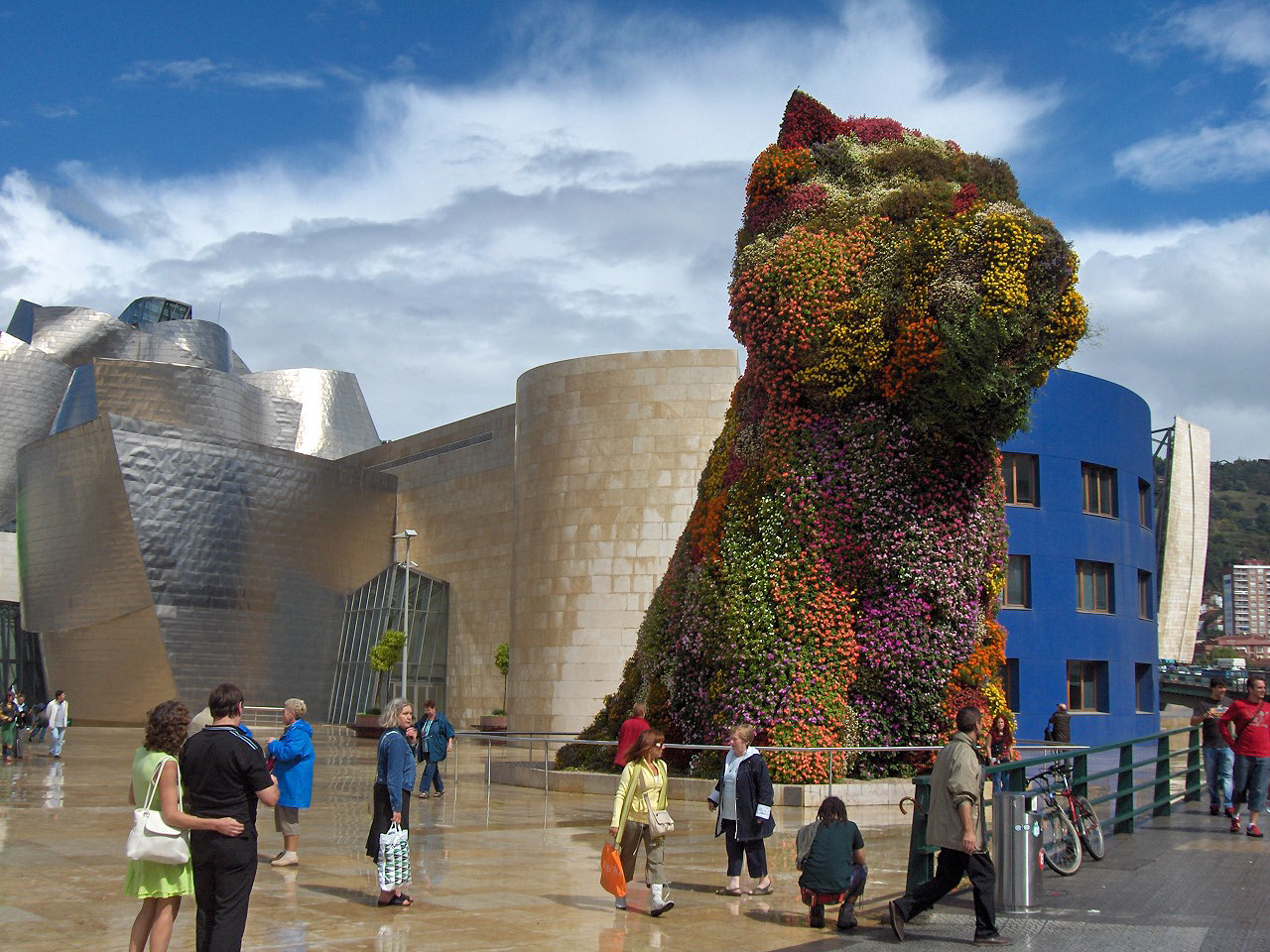
It's the old "if you mistake a bush for a lion that's fine, but if you mistake a lion for a bush you are dead" cognitive bias. I've thought for a long time that it manifests in art via shock, negativity, outrage, etc. being a cheap route to profundity. You have to work hard to make positive art profound because the bar is higher... you don't get the easy free profundity points negativity gives you.
This video brings up the notion that modern art has been reduced to nothing but personal expression. And I think that's the problem. Artists aren't that special and I'm not particularly interested in their expression, I'm far more interested in what expression art can inspire in its audience...and modern art hasn't been effective at doing this.
If art is about mimicking the real world, some will be much better than others and there will be only one best
If art is about capturing the perfect moment to inspire emotion, one could argue there are a thousand ways to do it.
If you believe artists should all speak in the same voice, i would say many would lose interest. If you allow artists to speak in their own voice, the cream will rise to the top. Naturally, the most sellable and marketable products will be given the limelight (pop art as an example) and omce those go out of fassion, a new fad will arise
As much as i agree that many modern peices look like they are pictures mixed with bleach, i dont think that is a bad thing. We have a free art market today while in the old world only the best were commissioned.
However, an artist that only talks about his own personal experience will not make art that anybody else wants to see. There has to be some sort of connection to the lives of other people around him, otherwise his art is meaningless to all but himself. And meaningless art is a contradiction in terms.
Art should be an interpretation of the real world that its audience can somehow relate to. Artists aren't all that special as people, but they can be special in that they can get other people to think about the world around them in a new way. Of course, all interpretations factor in the view point of the author/artist, and that's OK - else we really would have a whole bunch of artists producing identical stuff, and who wants that? The important thing is that somehow, the audience has to be involved in the work of art.
And by the way: what's so bad about some artists being better than others? Isn't that the way it's supposed to be? After all, nobody would claim all programmers are identical in skill, so why should all artists be?
There was a recent exhibit i found particularly interesting where the artist used real dead bodies. This was interesting because he was legally alowed to and others would pay to go see it. The art itself is not appealing but it applies to the fourth wall. Our world today is filled with so many loopholes and rediculous businesses that an art peice like this reflects on it. If the artist did not speak selfishly, these kind of rediculous loopholes may never be exposed. But in the same notion, would should look at our own lives and recognize art is not a unique case, obvious and loud but far less damaging in many regards
modern art = i could do that + yeah, but you didn't
(credit to Craig Damrauer)
To me, good art is the combination of a couple things: skill and vision.
Vision, the intent to express some idea (hopefully interesting) is absolutely needed. Even if I don't understand it, I can respect that someone is trying to make a statement of some kind.
Skill, of some sort is also needed for me to call it art. If there was no craft involved in the creation, no practice, no iteration... then I don't consider it worthy of my time. Show me something that you can do that I can't, basically.
If your "art" consists of a couple common items that took all of ten minutes to put together, that is not art to me. You may be making a statement, which is great, but it is not great art.
So? The "yeah, but you didn't" about a lot of modern art is different than the "yeah, but you didn't" about someone saying "I could be a hollywood star", "I could win the Tour de France", etc.
In the modern art's case, people could totally "do that", and that they didn't only proves that they didn't bother.
But the 'you didn't' part is more about self-promotion and networking than aesthetics.
If you park your abstract canvas on the desk of Important Gallery and wait for them to offer you an exhibition, you'll be waiting a long time - unless you've already made a name for yourself through self-promotion, networking, and (cynical?) cultivation of galleries, patrons, and important collectors. Or you've been already been canonised by same as The Next Big Thing.
So from the point of view of art-as-marketing, you couldn't do that.
Put crudely, no one cares unless they can make money from your work (top tier galleries, collectors) or cultural capital (national galleries, museums.) And money isn't going to happen unless you're already on the inside having come up through art school and made the right connections, or you're enough of an edgy outsider to have a bankable story.
I have a fine arts background (design and painting lessons at an art school, etc.), so yes, I know that it can be hard to create some abstract art. But that's only the case if you have a specific hard visual end goal that you need to get to.
In most modern cases the only difficulty is only "conceptual".
That said, I don't think art is good only when it's "ealistic", or that art is good only when its hard to execute. Some modern pieces can still be both hard -- requiring a whole team to create -- and crap.
So, I agree that conceptually challenging art can be good too.
But for most of modern art I have the impression that the conceptual part is also a half-thought gesture to just make something to sell, often by an idiot who wouldn't understand a true concept if it bit them in the ass, and who just goes through the motions. Or by someone who thinks that he's creating some painful manifestation of his unique experience, but is just producing stale, cliched crap.
>But the 'you didn't' part is more about self-promotion and networking than aesthetics.
Exactly. Which I don't consider the important part of what art should be about.
>So from the point of view of art-as-marketing, you couldn't do that.
Well, except if I was cynical, devoted the same time, and was into ass-kissing and socializing.
Which might be hard, but it's hardly laudable.
And now you've circled back around to what I think I'm poorly stating as a central point. Modern art exists only as a way to sink wealth into physical goods. It doesn't have to be good, it doesn't have to mean anything, it just has to be expensive and likely to grow in value.
Al freír de los huevos, lo verá.
And you got the parts wrong: it's the artist presenting some crap that's more like Quixote (although often an insincere Quixote who doesn't even himself believe in the crap he makes), and the critic that's more like Sancho.
Are you implying that the artist is some kind of special person, whose training or inherent sense of aesthetics etc, make him produce stuff that laymen can't produce?
Because if you are, then besides the obvious fact that lots of artists are even less training in the arts or aesthetics than some laymen, you also ignore that the whole point of 20th century art was that art is not some special "sphere" but it belonged to everyone and even kids could do it just as well as "artists". Down to snubbing traditional art education and history.
Dadaism and surrealism were all anti-artist in that sense.
Good artists are/aren't special in the same way that good programmers are/aren't special.
You need an expert opinion to see through the fake reviews and artificially inflated prices. There is a way. Among artists, it's generally accepted who has more raw talent, who's more prolific and so on. It's never absolutely clear but it's clear enough. As an artist, you work with these other artists and it becomes apparent after a while. Spoken or unspoken. Matisse respected Picasso. Picasso respected Cezanne. Cezanne respected Monet, and so on. Those aren't fake endorsements. It's not like a sport where you just follow a predetermined formula, add up some points and choose a winner. It's about perception, which is what artists really do. The painting is the end result of how that artist lives and perceives the world--that's the raw talent. But if you're not in that environment, you're not going to notice it. You get movements like Impressionism, where somebody like Monet earns respect from peers and that reputation spreads and it expands from there.
In a different section there was a large room filled with everyday objects wrapped in tin foil. In the room next door was an empty room, over which in the corner an "artist" had emptied an entire can of self-hardening foam and in an another corner an "artist" had welded together two large steel plates that looked to have come direct from the steel mill.
Bored with this, I went to see the "special exhibit" which was a Mark Rothko exhibit split into two sections: one where he painted giant rectangles using different colors, and one where he painted giant rectangles using the same color on top of it self (red on red, black on black, etc.)
How am I, as a viewer, supposed to know who's better? The steel plates at least took some logistics and welding skill to transport and make. But...meh? If that entire museum sunk into the river it was next to with all the works of art in it, would humanity be any poorer for it?
As for that curator, that show, maybe they're trying to build up some emerging artists by connecting them to Rothko, who we recognize. Important questions are: Who was first (to wrap tinfoil objects) and how serious were they about it, and how does it fit in context with past work? Hypothetically, a wrapping of tinfoil might be more meaningful if you're familiar with that artist's body of work, maybe there's a certain "tinfoil" sensibility you would miss without familiarity with the artist's past work. Or is the tinfoil more a reaction or comment? Sculpture must be held accountable for choice of material, so the choice of tinfoil was deliberate for its properties or public connotations or both. Duchamp's urinal gets a lot of attention, but at that time in history it was a new idea and he had the respect of his peers already. So I think sculpture more requires you learn the history, they tend to get more conceptual than painters and it ends up involving philosophy sometimes. But also you get a feeling for materials and how they're put together, similar to the feelings you get when entering someone's home, you can't literally explain it, but you sense it's there.
Writing this on my mobile btw. Just in terms of craftsmanship, that would impress an engineer, that's a whole different world and there's "craft" museums, where it's not about concepts as much as it's about the tools and the work and perfecting the work process, the engineering. Sculptors need some craftsmanship to be taken seriously, but it' primarily about the ideas and concepts. Personally, I appreciate craftsmanship so I might gravitate to work that's less philosophical and more about structure, space and craftsmanship.
Last point about field paintings. It may just look like one boring color. I agree these are boring, but there's two areas to consider. First, there's a lot of choices involved. How was the canvas constructed, a flat color painting becomes a sculptural object, how are the corners wrapped, is it cotton or linen or oil or latex? Also there's different chemical pigments for different reds, so red isn't just a number on a color wheel. It might cost thousands of dollars to get that much of a certain pigment. Also what kind of oil was used? Is it glazed? How was the paint applied? How was the glaze applied? Endless decisions just to make a one color painting. Then you get into all the strange "color therapy" stuff that I never learned, but some people take colors and the physiological effects very seriously. Also hanging and lighting pieces like that in context with other work, maybe the curator has some ideas behind that, there could be a regional or historical connection. It's not for everybody and I usually rush past the really plain field paintings, but I definitely enjoy some of the abstract expressionist painters that incorporate fields of color.
Perhaps they think of pseudo-art as a simple attempt to rake in money from collectors, pieces made only to fill space in corporate office parks, or work they could "get from any art student." They become wary, as in their mind they don't want to be conned by a pseudo-artist or amateur.
Of course, that mindset assumes that pseudo-art exists or at the very least acquiring it is prevalent threat.
One popular and respected local artist (now owner of several galleries bearing his name) once told me, "I have to finish one painting a day to support myself as an artist." Are those paintings pseudo-art because he intended to make profit off something he knew would sell? I struggle to think of people who know his work and wouldn't consider it "art" or him an "artist."
Is the corporate sculpture fake simply because of where it's displayed or who contracted the artist?
Just because the student's name isn't popular or their skills are still lacking refinement, should they be denied the ability to become a master? If they do manage to make that transformation and their early work becomes more valuable than ever, why only then is it not pseudo-art?
Obviously, I'm not asking you to answer these questions or even acknowledge their relevance. It's just sort of a train of thought your comment kicked off.
I remember when this was part of the national debate around the NEA. The reason that the people seeking to defund this stuff was that it simply was garbage as art. If classic art sought to pull on "positive" emotions and move and inspire; modern art seemed determined to confuse and then move on to outrage.
Somewhere in this dwelling in negative emotions, modern art became indistinguishable from a satire that nobody was bothering to produce. It was an overly serious bunch of belly button dwelling backed by amateurishly crafted production most pre-schoolers regularly produced. Instead it became a game of one-upsmanship and gross-outs devised in the minds of 10 year old boys. Anything that wasn't deliberately trying to rile the audience was laughable "craftsmanship" and interesting in any way. The art scene became incestuous and further and further isolated itself from any potential audience.
Classical art was put out in public places for any passerby to see -- Michelangelo's "David" was displayed in a public courtyard. While it's true that classic forms became tired and formulaic, the modernist movements didn't generally replace those forms with anything of particular value.
There's interesting things going on in art in the modern world, but modern art isn't one of them.