Now, ordinarily it would be bad enough that almost all of your clients are using the same encryption key, but it got much worse from here - turns out there was a bug in a proxy server they had written, so that every once in a while client B's traffic would be routed into client A's session, and hilarity would ensue; because the "keys" were the same, Client B's traffic looked like normal traffic from client A, so nobody could ever figure out why Client A would call us up and complain that he was getting fills for orders that he'd never sent! It took me forever to figure out WTF was going on, but one day I was watching a logging display and noticed garbled traffic showing up in Client A's logs, and it was garbled because it was a user who actually didn't auto-logon at 0930 in the morning and subsequently had a different encryption "key" resulting in his traffic not being decoded properly. From there, it became obvious what the problem was.
Edit: Yeah, yeah, I know - you're thinking "Wait, XOR? shared secret? But, but... how did they do key exchange?" Well, how the heck else would you send a client the secret key for the session - in plain text, when the client first logs on, of course!
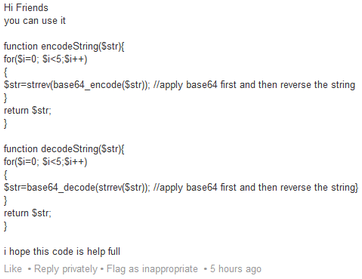
"No one would ever expect the data to be base64-encoded twice! Mwa ha!"
There's less entropy per character if you know it will always be alphanumeric versus a string that of random bytes.
If you take 32 bytes from /dev/urandom and base64 encode it, it has the same entropy as the original binary string (unless you use it in a way that will result in it being truncated).
But the total entropy of the two strings is unchanged. One is just longer.
In short: You're correct, but with nuance that bears stating explicitly.