No other country really has the ability to project power period, Russia can't the Chinese can't, most NATO nations don't have enough supplies for limited engagement and very limited ability to operate even within the local theater (e.g. European forces required US tankers to refuel during Libya, they've also ran out of munitions and jet fuel within the first 3 days of the campaign).
So for the most part I don't see any country with a capability to even remotely threaten US superiority out side of MAD. Russia is completely limited, it's defacto a land locked country without a warm water port this is why they've tried to invade Korea 3 times since the 19th century. And also why NATO mostly overlooked Crimea because they've understood that's the last redline for Russia.
China well, China doesn't even has a joint command, they've never really went to war any where or conducted any military operations. Their military structure is ripe with corruption and every couple of years they lose one of their chiefs to some political investigation once they decide to take one bribe to many or too few.
Their expenditure per soldier is laughable, and their equipment although getting better is still decades behind the US and they've shown to have very little self reliant R&D capabilities, what they can't buy they steal which never results well.
The US Army is still the best professional Army in the world, while we all like to point and laugh that they mostly recruit white trash and immigrants their officers and senior NCO's hold probably the best toolkit of military education and experience in the world.
The article doesn't argue that China or Russia are going to project power off the coast of New York anytime soon; merely that our relative capability to project power off of their coasts is in decline.
Ship defense systems are quite advanced these days for the most part they can knock out anything out of the sky no matter how low or high it flies.
Yes it can be done, but it's just as easily can be countered through asymmetric means by the US the only thing they'll have to do is to change their doctrine.
SAM's were considered the end of air combat as well initially, in 1973 SAM's pretty much devastated the Israeli air-force, the US learned from that experience and developed made quite a bit of changes to their 'Wild Weasel' doctrine which allowed them to routinely destroy soviet SAM's in Vietnam from 1975 onwards. The Israelis then took that and improved upon and 1982 destroyed all of Syria's SAM sites in a single day of what then was the most advanced Soviet SAM installations in the world outside of Russia by using drones as the lead target aircraft instead of an F4E phantom with jamming equipment and covering the sky with anti radiation missiles as soon the drones got painted. Today you have solutions like these https://www.youtube.com/watch?v=0acJ3xyhaJo that build on top of that and bring it to the next level.
Combat isn't a static game of RPS, if China has carrier killing missiles then the 1st shot in the war will be to take those out, using, drones, submarine launched guided missiles, electronic warfare or what ever else will be developed to combat that threat. Once the threat has been reduced to a level which allows the carrier strike group to operate it will be put into action, yes not all missiles might be destroyed but any residual threats will be dealt with by the air defense systems of the carrier and it's supporting vessels.
Now again this isn't claiming that this gives a US carrier group some super immunity, fucks up can still happen, but if your doctrine is set up correctly it's not going to be a case well gosh they've made some carrier killers now we can't use our carrier anymore.
An operational carrier houses over 5,000 sailors, airmen, and marines. Sinking a carrier is akin to completely obliterating a small city in terms of loss of life. In terms of economic cost, it's even greater - a carrier costs around $5b just to launch. Add in the costs of fuelling, salaries and training for the crew, armament, the aircraft aboard... the other dozen or so ships in the strike group...
I don't think it's unwarranted to assume that the total economic cost to build and deploy a US carrier strike group exceeds the budget of most countries' navies.

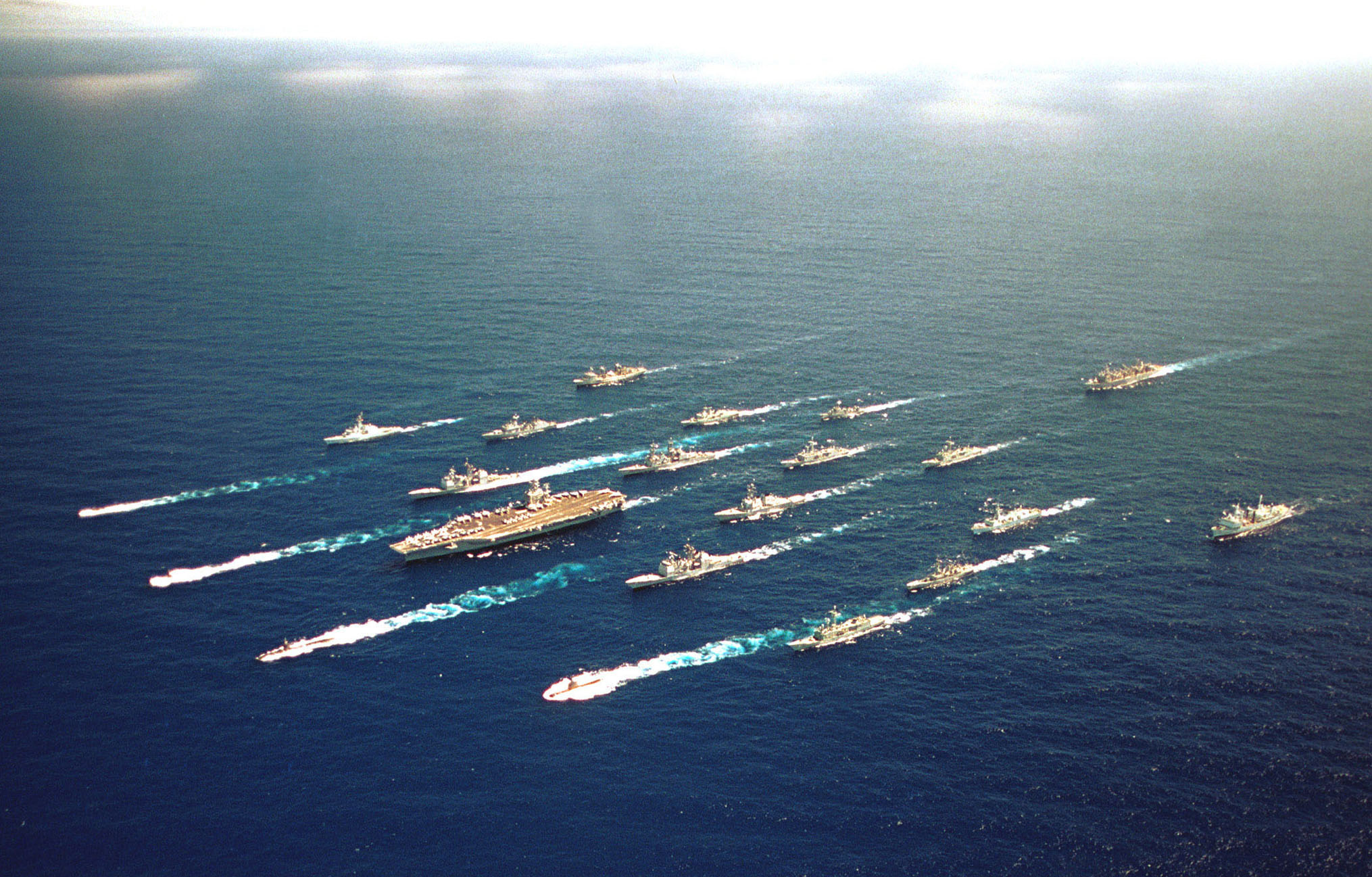
(4) Tactical submarines
(2) Aegis Guided Missle Cruisers
(2) Landing Assault Ships
(1) Frigate (or perhaps an oiler)
There are a variety of other cruisers and destroyers in the picture that I can't make out. I also suspect (as noted above) that there are one or more "boomers" cruising under the waves (but close by).
A U.S. carrier group can bomb a country in the ground - a country like Iraq. The safest place for a U.S. carrier group when in a conflict with Russia or China is.... in the harbor at home.
Are U.S. Navy surface ships sitting ducks to enemies with modern weapons? http://www.johntreed.net/sittingducks.html
And by the way, the Falkland Islands war is one of the most underestimated, least understood wars in warfare. The next major conflict will only know two kinds of war ships - submarines and targets.
Let's weigh them and see which one is a duck! https://www.youtube.com/watch?v=zrzMhU_4m-g
No other country has the same ability to project power that the United States does. It's perhaps unprecedented in the history of the world. Perhaps its military might is reduced from Reagan-era heights, but Russia is also a shell of what the Soviet Union was, and China has not yet filled that void.