tremendulo
Yes, a mother is constrained by having to look after her other children and the household, but it is an organic set of constraints which is customised to the particular family and has arisen in part out of their previous interactions and out of her family traditions. Furthermore it can be altered (by her). It's not a bureaucratic scheme designed to maximise the convenience and minimise the legal/financial risk to the daycare and its staff.
Yes, there are horrific families and there are no doubt daycare workers who are more affectionate than others. But this doesn't affect the argument.
>And who are you to tell people who they do or do not love?
Who do I have to be? I've merely claimed that daycarers don't love the kids in their charge. I think our great-grandmothers would have known this instinctively and would be horrified at the direction we have taken as a society in this regard.
(1) There's no such thing as a professional parent. It's a relationship. (2) Professionals have expertise in some domain, e.g. heart surgery, but as the article shows, there's no expert knowledge of childcare. There's no prevailing child-rearing philosophy. (3) Professionals are paid significantly above the minimum wage.
>know how to provide the love
No. A mother loves her child, but love can't be provided as a commodity, like complimentary chocolates. Even if a carer tries her hardest, this will fall short, because she doesn't love the child. She's also heavily constrained by having to follow procedures, timetables, attend to other children, and so on.
>Yes, being abandoned by your parents can be traumatic, but that's not what daycare is.
That's exactly what it is: somewhere to put your toddler while you head off to work. Or it's a convenience. But in reality small children need someone they trust and are close to available at all times.
Don't forget that those circumstances include the decision of whether or not to have children in the first place.
>But please keep those opinions to yourself
That's silly. This is a discussion which you're not obliged to read and I'm not a best-selling author or anything like that. More importantly, in response to lovemenot's request I tried to move beyond opinion and give an explanation. You're free to criticise it on its own merits if you don't like it.
>or at least recognise that blanket advice to all parents in all circumstances in all countries at all times is going to be worthless and probably wrong.
But I did recognise it: 'I'm not arguing that one-size-fits-all; there are many legitimate parenting styles'. Also 'Yes' at the very start.
Btw, using one's own child as an example in a discussion like this increases emotional investment and then it's harder to determine what's true. Better to argue abstractly I think.
Let me re-formulate my explanation of why daycare is bad:
(1) Small children need love and attention; they also need adult help available; they need to feel secure. (2) Love, attention and help aren't raw undifferentiated qualities. The quality depends on the source. A familiar source which knows the child is required. (3) The anxiety induced by an early childhood separation from such sources is potentially traumatic and long-term.
Therefore, young children shouldn't be separated from their mothers and/or close relatives.
>I believe this must be correct in the majority of cases.
'At least you should indicate why you believe those millions are being raised [rightly] rather than merely assert it as fact.'
Good people already know that daycare is bad, even those who use it, even though they can't explain. So yeah, it's axiomatic.
>however, the second is not in the general sense
Au contraire, it's a perfectly true general statement that children can't get love and attention at daycare. From minimum wage, high-turnover staff looking after a large number of kids in a bureaucratically-controlled environment? No way.
Actually I guess most people wouldn't want or expect employees to love their charges anyhow. It would likely be construed as 'inappropriate', as when a teacher hugs a pupil.
No, that's what I'm arguing against. Parenting manuals are arguing minutiae while children are increasingly being brought up by strangers who don't love them. Of course there are exceptions. So what?
>So this is moving in the right direction.
Aren't you being a bit quick to judge here ;-)
In simple everyday terms I'd say small children need love and attention like a plant needs water. They can't get these reliably at day care. But most of us already know this.
Yes, while often getting fundamentals wrong, e.g. there are millions of two year olds in day care.
Yes and even if there somehow were credible, reproducible studies that addressed all aspects of parenting and all childhood outcomes then these still couldn't tell one how to parent because there's a moral component.
That's how we used to live, in small roving bands where all males are close relatives. Total lack of privacy. No dentists. Parasites. Obsession with the spirits that apparently lived in trees and rocks, also the evil spirits which brought disease and thunderstorms (cholera not having been identified). Endless wars with other tribes...
https://images.huffingtonpost.com/2015-04-28-1430240960-5078...
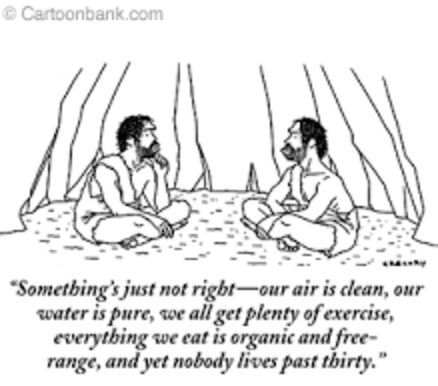
Now, obesity has replaced malnutrition. Distraction has replaced boredom. Social media has replaced gossip. These are better problems to have and they're solvable in turn. Then we'll see what the next problems are.
I'd also rather get up to switch the lights on. Moving about periodically is healthy, right?
Yet it frequently is a matter of 'either or' since the smaller reward robs me of the mental resources required to create or bring about the larger reward. For example if I party now I won't get the new job later on because I won't have the energy to learn the relevant skills.
Yes, and real musicianship is more complicated still since hearing and playing abilities co-evolve as one cycles round and round a new piece. For example, notes previously played too quietly can be played louder merely by hearing them as louder. At least that's the way I experience it. If true it adds a whole new meaning to 'active listening' since motor activity may be included in the loop.
Assuming that free will does exist then if James hadn't believed in free will then by this act would he have made his own will unfree?
Reward and punishment are an amplification of a generally unwanted signal. I'm not advocating these; I'm not taking a moral stance. Rather I'm talking about what people already do irrespective of what they think or say they are doing.
Children learn language because it helps them to get what they want. If reward and punishment guaranteed results then adults would be able to reliably recite the multiplication tables (which they can't).
We like to say that people (especially children) shouldn't be punished; they should only be rewarded. And then we deny that we are still punishing them, after all, for example by silence and withdrawal.
The reality is you aren't in a relationship if you only get praise and positivity. That feels meaningless or even creepy depending on the intensity. A genuine connection will feel positive/neutral most of the time and negative occasionally, since we are knowledge-creating entities. For example, in a computer game you're learning optimally if your win:lose ratio is somewhere around 80:20. I would guess this applies to our relationships too.
Neither reward nor punishment will 'work' in the absence of the other. This is why tyrants go over the top with punishment, because all blame and no praise is lack of relationship too.
Engineers work with objective reality and so they are humble at least with respect to knowledge. This will be evident from their behaviour in most cases but there will be some who are appear arrogant yet competent. I would conclude that they are humble in private.
>That said, as far as I can tell, acting fearful (especially acting fearful of losing status) is one of the quickest ways to lose status
Yeah, good point.
Status -- those to whom we accord the highest status seem to be people who genuinely don't care about status; Money -- companies which aim only for profit become incapable of change. Presumably something similar applies to individual fat cats; Stability -- societies which aim for stability get wiped out by the next invasion or natural disaster.
...which is perhaps why most people don't work so hard! So what are good things to want?
(And maybe evolution gave us curiosity to save on battery power with the new knowledge it produced!)