tmh88j
For good reason, they're not built for it. A relatively stock WRX is going to be destroyed after a few outings of hard driving on rough terrain[1]. The WRC winning Subarus[2] were fully built racecars from top to bottom and share only styling with the ones sold at dealerships. They're very fun and capable on solid pavement for a cheap car, but the rally pedigree is all marketing.
[1] https://www.youtube.com/watch?v=aT-o8vuhRok
[2] https://cars.bonhams.com/auction/27996/lot/87/1999-subaru-im...
You should let Porsche and Chevy know that all the lap records they set with the GT3 RS and ZR1 could be even faster with some proper wheels ;)
Costco groceries are expensive because you're forced to buy in bulk. You can leave HEB with 1 tube of toothpaste or a single potato. You can't leave Costco with fewer than 5 tubes of toothpaste or several pounds of potatoes. I love Costco and imo they win in a few areas like the butcher, but HEB crushes them in the variety of desirable groceries hands down.
I'm not trying to convince anyone who will agree on a data-driven premise without actually seeing the data. The article states that a record number of cities have $1m+ starter homes, but there's no easily accessible list of those cities. I couldn't find it, where did you see it? I gave up after clicking about 10 different links and only landing on another vague article or advertiser's product.
It varies, but mostly yes. I think they're limiting the definition of a "city" to as small as possible to inflate the prices for a scary headline. Austin is the most expensive metropolitan area in TX. Fire up zillow if you can access it, search for Austin, TX with a $600k limit and it'll automatically put the city boundary on the results. You'll find plenty of listings, over 1900 standalone homes for me as of right now. Including townhomes and condos it's over 2800.
Anyway, my point is that it comes across as deceptive by providing ambiguous information with no easily accessible data to reference and loading the article with as many advertising links as possible.
That's exactly what they're doing and I even put a snippet from the article in my comment. Here it is again
> For buyers navigating today's market, Zillow Home Loans' BuyAbility℠ tool provides a personalized, real-time estimate of the home price and monthly payment that fit within their budget. Home listings on Zillow also include a down payment assistance module to help shoppers identify local programs that may be available to them.
Doubt. They don't define what constitutes a city and seem to be purposely be hiding the data. There's only a count of the cities per state with no mention their names. I followed link after link and couldn't find them and gave up. Texas supposedly has 7 of these $1m+ starter home cities. Austin is the most expensive metropolitan area, and there are plenty of < $600k homes in centrally located areas. Venture out to the suburbs like Pflugerville, Cedar Park or Buda and you'll have plenty of options with $400k to spend. There are only a handful of small pockets around the city where $1m won't buy you a starter home like Zilker and Tarrytown.
> For buyers navigating today's market, Zillow Home Loans' BuyAbility℠ tool provides a personalized, real-time estimate of the home price and monthly payment that fit within their budget. Home listings on Zillow also include a down payment assistance module to help shoppers identify local programs that may be available to them.
> For those who decide renting is the right call, Zillow Rentals® lists options across every price point and property type — including single-family homes, apartments and individual room listings. Renters can also use CreditClimb to report on-time rent payments to the major credit bureaus, building the credit history that will put them in a stronger position when they're ready to buy.
This is just fear driven advertising. BUY NOW OR YOU'LL NEVER OWN A HOME!!
I haven't seen so many low effort and obvious astroturfing posts linger on the front page than in recent months. They never mention what they're doing and have no proof of their work. There was a post the other day titled "Tell HN: I'm 60 years old. Claude Code has re-ignited a passion"[1] that had tons of traction with no substance. It was posted by an account created that day and the comments were filled with bots responding about how productive they are, but no mention of what they're actually doing.
It's annoying seeing these obvious spam/astroturfing posts take attention away from interesting content that's worth reading.
[1] https://downloads.python.org/pypy/
[2] https://en.wikipedia.org/wiki/Python_(programming_language)#...
> The younger programmers I work with who had no exposure to the GoF book.....and they communicate amongst themselves just as efficiently as my generation
> The generation that learned to program after design patterns had faded as an idea learned just as quickly and communicates just as well as the generation that studied them assiduously as junior programmers like I did.
I've never read GOF so I don't know if they emphasize communication, but I have read and studied many other programming pattern books and communication is low on the list of reasons to learn them in my opinion. Their only purpose for me is to organize code in a way that has been proven to "scale" along with a codebase so that you don't end up with a plate of spaghetti.
int() and float() behave like type casting, bool() does not. It's a truthiness check that would be more aptly named istruthy(). In python non-empty strings are truthy, so providing any string except for "" to bool() will return True, including "False".
The comment I responded to didn't seem to realize that because they asked why it behaves the way it does, so I explained.
> I'd honestly much prefer bool() threw an exception on receiving a string, rather than act the way it does now.
They serve fundamentally different purposes. bool() is a truthiness check and not a type cast like int() and float(). It seems like a lot of people take issue with the name, because it was called something like istruthy() the discussion about it wouldn't be happening.
I haven't worked for any massive companies with thousands of employees where there might be a lot of bureaucracy, but the few I've worked for ranged from ~100-700 and it was pretty easy to get interviews for referrals. One of my employers encouraged referrals and offered bonuses if it led to a hire.
GM does. Their engineers have set multiple track records[1] and vehicle-specific lap records[2].
[1] https://gmauthority.com/blog/2025/02/c8-corvette-zr1-sets-fi...
[2] https://www.roadandtrack.com/new-cars/a10206481/the-chevrole...
You won't notice them if you're not interested in cars, but there are tons of them and Lexus/Toyota are responsible for quite a few. The RC-F, IS500 and LC500 sound amazing, as did the GS-F and IS-F. Toyota also made some iconic engines such as the 2JZ-GTE in the MKIV Supra and the 2GR engine that Lotus used in the Evora.
Loud isn't the goal, the tone is. The Lexus LFA is a perfect example of this[1]. It's not extremely loud for a car of that caliber, but it's lauded as one of the best sounding cars ever made. Poorly designed exhaust (or no exhaust in the case of your broken muffler) on an otherwise great sounding engine almost always ruins the tone and makes it unbearable to listen to. Bad exhaust on a bad sounding engine is just miserable.
[1] https://www.hotcars.com/heres-why-the-lexus-lfas-screaming-v...
> remember the time when GM said it’s not going to include CarPlay in its vehicles? And how most of hn was in revolt?
Most OEM's made terrible infotainment software that is outdated, lacking features and often extremely sluggish and clunky to use. CarPlay and Android Auto are able to bring modern features OEM's can't seem to figure out, like Google Maps integration instead of some terrible maps implementation that is outdated, as in not having addresses added in the last few years, not just "old" and cumbersome to use. I can just open up google maps on my phone, type an address and directions appear on my screen. Same with music streaming apps like Spotify.
> here comes News that says we should get rid of touchscreens, why is hn supporting this?
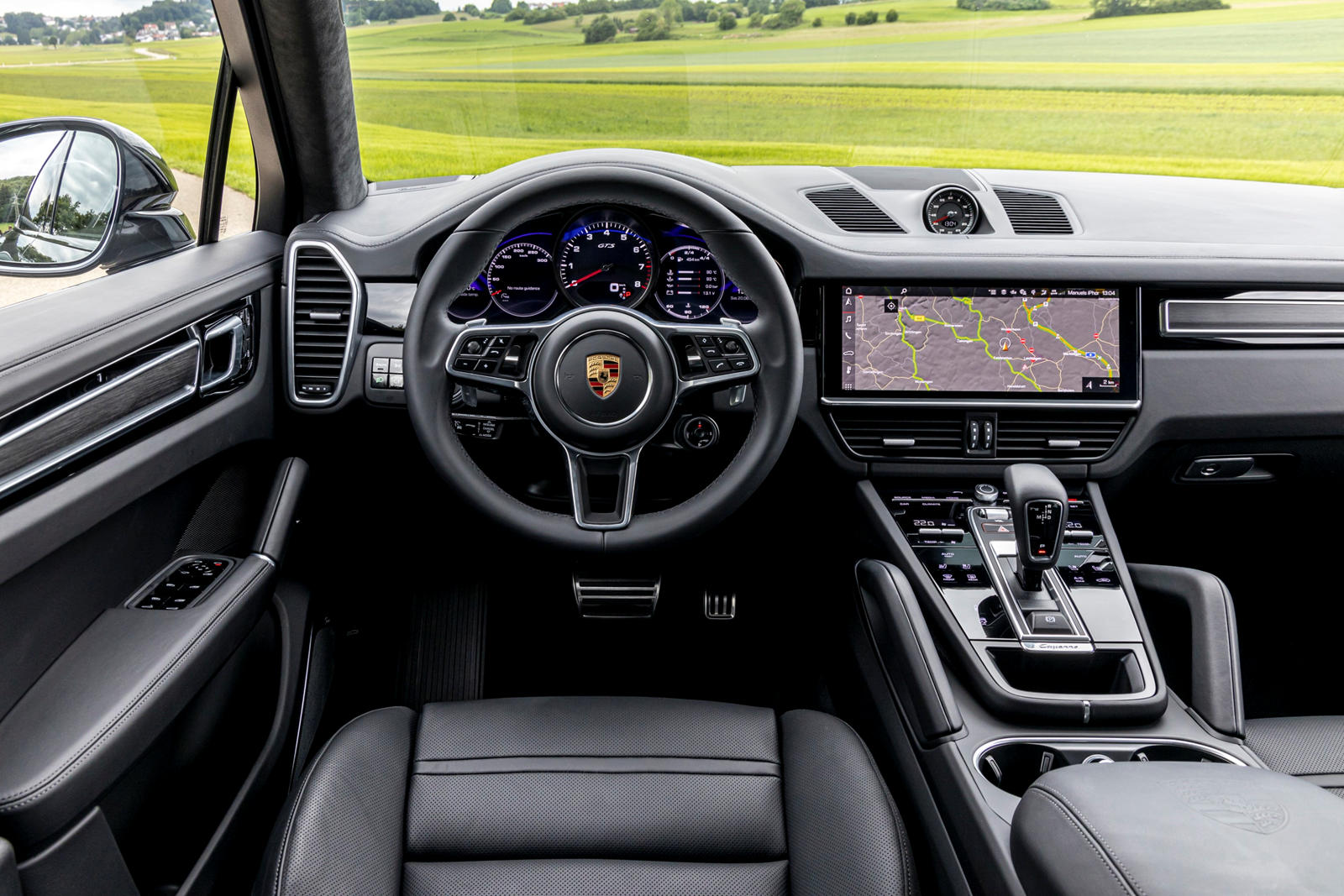
Not eliminate touchscreens entirely, but rather stop putting every single control they possibly can into them making vehicles dangerous to operate. Putting climate, radio, lighting, etc... into a touch screen, especially when buried in sub-menus, is just lazy cost cutting. The other big complaint are touch capacitive "buttons" and sliders. They're distracting and difficult to use, especially on anything but perfectly smooth roads. For example, the Cayenne's interior is basically just a wall of touch capacitive "buttons"[1] that you can't easily reach down to press with your eyes on the road, you have to look down at it. The other issue is feedback from it. Constant beeping from input on menus, like Toyota, just becomes obnoxious. Buttons provide instant mechanical feedback that does't lave you guessing if you pressed on the right spot. Here's a clip discussing some complaints about VW doing all of this to the Golf [2] and how frustrating it is to use.
[1] https://cdn.carbuzz.com/gallery-images/2022-porsche-cayenne-...
That's just the chain of responsibility pattern [1] and I've only seen middleware operate that way. Why wouldn't you want control over the order?
[1] https://refactoring.guru/design-patterns/chain-of-responsibi...