spodek
1. Keep building the podcast
2. Publish my next book, on sustainability leadership (in conversations with big publishers already)
3. Continue my mission: to help change American (and global) culture on sustainability and stewardship from expecting deprivation, sacrifice, burden, and chore to expecting rewarding emotions and lifestyles, as I see happen with everyone I lead to act for their intrinsic motivations.
In my case the emotions have been joy, fun, freedom, connection, meaning, and purpose.
Everyone should watch the channel Not Just Bikes https://www.youtube.com/channel/UC0intLFzLaudFG-xAvUEO-A, by a guy who moved to Holland and learned what makes those transformations possible, in my opinion.
The videos are short, informative, engaging, and thought-provoking. Hopefully action-provoking too, since my country, the USA, can use a lot of that change. People here act like it's impossible, but they thought so there too. It's possible and role models help.
I choose software based on the freedom behind their licenses and always will. I value my relationships with others over mere technical differences.
I hope you at least learn something of our existence, besides that without people who think and act this way, there'd be no Wikipedia, Linux, Wordpress, or alternative to Windows.
Historically, this was true but no longer. There is a fraction of the life that the ocean used to support. A great source is the book Once and Future World, which describes captains' logs before steamship. They reported that ships at sea would be stopped in the middle of the ocean, far from land, by schools of fish that densely packed. Today, people are happy to see a whale if they visit the coast. Not long ago, people could see whales as far as the eye could see all day long some times of year.
Also, to call the waters "oxygen-starved" in response to climate change misses the cause and effect. Specifically, human behavior is causing these things. They aren't just happening. If we change our behavior, we can change the results.
Clarifying the cause and effect helps clarify what to do about it besides passively watch it happen.
Also, there are fewer places where you hear no car noises or planes at all.
We can do something about it, but it takes work.
Everyone thinks it will be dirty and ineffective, but then finds it oddly satisfying.
This sentence is the most important, describing a failure in education. Once I learned to teach through project-based learning, I'm never going back, largely because of student feedback, that they learn more and are more engaged.
I'm not saying we don't learn from lecture at all, but a lot less relative to other ways. Maybe some subjects or professors work with lecturing, but not subjects that I studied in college.
Second, not lowering birth rates involved billions of people suffering and dying. There is no option where we keep living above sustainable levels without consequence.
Also, the patterns revealed in their models are useful for understanding patterns in nature and human interaction with it.
It suggests to read at an inch or two past comfortable for a few hours a day. At first it seemed too good to be true, but not completely implausible. I'm curious if anyone has tried or had luck with it.
I think it was in him in his class who asked us how planes flew. I raised my hand and said the Bernoulli principle. He showed how despite schools teaching it forever, it couldn't be right. Otherwise planes couldn't fly upside down but they do.
One thing we know reduces emissions and pollution: stop digging and burning fossil fuels. We're using every excuse not to. Everyone has their thing they want to do that delays capping the wells and closing the mines. Beyond overconsumption, we can't even talk about overpopulation without losing our shit (though a few people and nations have made great progress, see Mechai Viravaidya, for example).
If we could prove beyond shadow of a doubt that no dangerous asteroids would hit Earth for a million years and that pursuing Mars accelerated our environmental problems here, I don't doubt that the same people would come up with new justifications and keep going, even if counterproductive.
The General Public License. The foundation of Linux, Wikipedia, and more. Every company and government agency that took it on lost. It uses the rules it wants to subvert to subvert them.
The United States Constitution. So far it has withstood onslaughts and survived. We may be seeing the end of it, but people have said that before. It's inspired many others. The United States may be young, as cultures go, but our Constitution is, I believe, the oldest.
When I stopped eating meat in 1990, people saw it as a burden on them. Over the years, more joined the bandwagon, not that I did anything that people haven't been doing for centuries. Now if anyone seems to need to explain, it seems the omnivores, though all families are unique.
Our mainstream culture generally says growing the GDP helps everyone, that "a rising tide lifts all boats." Some of us see the evidence pointing the other way and avoiding needless shopping helping people more.
Here is a graph: https://joshuaspodek.com/wp-content/uploads/2021/11/ReduceFo...
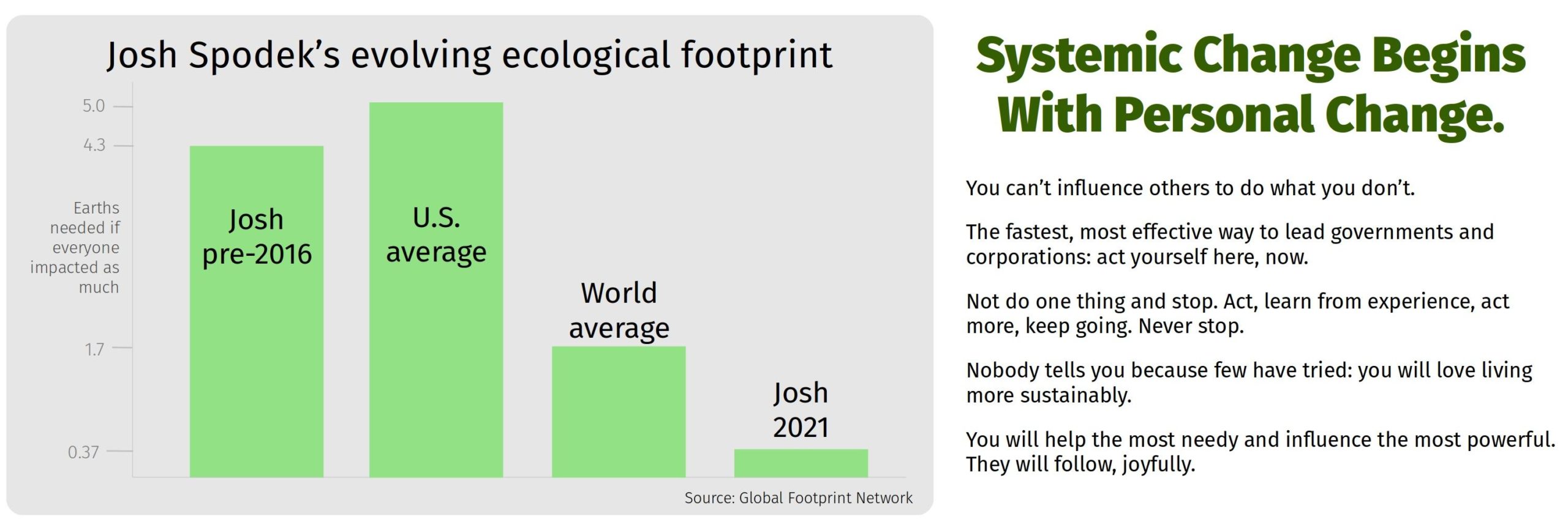
On my blog https://www.joshuaspodek.com I post my electric bills, that I pick up litter daily, that I haven't flown since 2016, haven't filled a load of garbage since 2019, and more. Most importantly, that each of these changes improves my life. Or watch my TEDx talks on sustainability leadership: https://joshuaspodek.com/tedx.
Leadership, not individual action is the point. Yet more important and magnifying my effect, I lead workshops in food deserts, coach executives and politicians, and host a podcast helping change American and global culture from the attitude I read in your post, that sustainability and stewardship are burdens, deprivation, or sacrifice, to expecting it will improve their lives, help the most vulnerable, and create stability and abundance.
Future generations will look back at horror at how we chose temporary indulgence over what makes us most human: caring for each other, especially the helpless and vulnerable, and stewarding nature.
2. Plastic, at least single-use, forever chemicals, and similar chemicals. Soon we will see them like asbestos or marketing cigarettes to kids. Yes, they increase the GDP, but they kill.
We could improve our lives by cutting out most of the useless, pointless junk instead of solving every problem by burning more fossil fuels.
It teaches the system and how to fight back by a Propublica investigative journalist who had to fight the system himself.
Today, visitors to Maine feel lucky and pleased if they see a whale. Ships used to see whales as far as the eye could see all day long.
I recorded a couple video essays of the book for a bit more:
Here in New York City, people delivering food, packages, etc are one of the major biking contingents, I guess invisible to the Hacker News community.
Sadly, here in New York City, kids can't ride bikes around for fun except once or twice a year when they close Park Avenue or if you get an open street. I don't see why kids riding casually shouldn't be a major interest of the population. If the streets aren't safe for them, maybe change the streets and disallow cars instead of depriving kids of that space.
Do they think people at farmers markets want to wall them off and keep poor people away? A moment's thought and they'd realize everyone involved is trying to fill in food deserts, reduce big agriculture subsidies, that McDonald's is causing poverty in time and money, but their defensiveness and I'm-so-smart-ness blinds them.
Here's the review: https://joshuaspodek.com/the-science-book-of-the-decade-ener...