snakers41
It can be easily surpassed. Just create a simple wrapper and publish it. And voila, you are can use everything for free again)
All of these FOSS licenses are just beautiful constructs, not related to how the world really works.
A simple question. How do people, building true FOSS libraries, make their ends meet, if everything is 100% free?
> ethics or enforcement are a distant concern.
The main thing that you are missing is that ethics and capitalism are very distant concerns.
> they make sure that nobody can use it except corporations without morals? What the fuck?
We live in different worlds, man.
The summary of your complaints is that you want to use NC software or artefacts for profit (basically to resell it in some form or another) … and you cannot because you are so moral.
But … just use it not for profit, or pay the authors, if you use it for profit. Simple, right?
> even more so than proprietary software
As an experiment, try stopping to use any non 100% FOSS software (or any software you did not pay for) for a day and report the results.
One of the intents is NOT to service corporations for free or promote such services.
The reality is much simpler - in real world anyone hardly cares about licenses, companies and corporations steal all the time, it is only the matter of the amount of money you want to invest in litigation.
The only real silver lining is that all popular software licenses basically prohibit authors from defending their rights ... most prominent FOSS things are financed by corporations as a means of competition ... an or course you (i.e. me) should use a license that deprives me of any possible rights.
Also ONNX boasts native quantization that just works.
But we are not currently actively working on this. Most likely ONNX will only be available only for commercial customers for special buds, but we are not decided on this yet.
https://www.reddit.com/r/MachineLearning/comments/v9rigf/p_s...
Well ... maybe there is a correlation?
> it is very fast and scales quite nicely on CPU with 4 threads (~ twice the speed), but not further (I tried it on a 64 cores box).
Well, practically it does NOT scale even past 6 threads. 64 cores are just overkill, and most likely it will only hurt performance.
> Not sure why since they seem to be using torch's native threading support. > surprisingly, it is not that much faster when run on a GPU
Probably for the same reason, you can speed up the NN only so much. Realistically it can be made 2-3x faster still. Also currently we abandoned batching, so GPUs are not really required at all.
> the quality (as in: what I'm hearing, not a formally measured metric) is good but (YMMV) not as good as turtle.
I believe the compute required during training and inference … may differ by 3 or 4 orders of magnitude (!).
Also note, that some speakers and languages just sound better due to high quality of source material and the amount of work invested and polish.
> it breaks with strange error messages if the text you feed it is too long
Well, there should be a warning somewhere, but it works with text no longer than 512-1024 symbols.
> there is mention of "a model for text repunctuation and recapitalization", which I wonder if it could be used to break a very long text (eg a book) into pieces that can be digested by the tts engine
This model only restores some punctuation marks and capital letters.
There are libraries like razdel for this - https://github.com/natasha/razdel
- https://github.com/snakers4/silero-models#text-to-speech
This link leads to the TTS section, whish contains the full list of all of the speakers and languages.
They do not. The do not care about them as well.
> Harvard Medical School is pirating software I wrote. > It's not worth a law suit against a $40B entity. > It doesn't matter what license I used. They stole it. > You can enforce SA, and get changes back. It's designed for exactly this purpose.
It can be enforced, yet you cannot enforce it. By your own logic, in real life licenses hardly matter at all.
Typically, JAVA ~ commercial usage, and they are typically able pay for a license and / or they can use a model behind an API.
It is explicitly stated, that PyTorch is the only real requirement. Bash is not required, i.e. models can be run on Windows or ARM with PyTorch.
> Also, I'm not entirely sure what "out of scope" mean?
There was no tangible benefit in making a bash CLI for us.
There can be made a simplified version, with ONNX models (or plain Torch jit) maybe and some outer logic, but we did not do it yet for lack of incentive.
- 8 kHz, 1 thread 15-25, 4 threads 30 - 60 - 24 kHz, 1 thread 10, 4 threads 15 - 20 - 48 kHz, 1 thread 5, 4 threads 10
the numbers are seconds of audio generated per second
It is true that the model is based on PyTorch + python, but the majority of complexity (like SSML parsing) is tucked inside of the model.
Theoretically one can make a simplified model without any of those features in plain PyTorch or ONNX, but so far we did not have proper motivation to do.
As for CLI, this also seems simple enough, but out of scope for us.
- https://www.reddit.com/r/MachineLearning/comments/v9rigf/p_s...
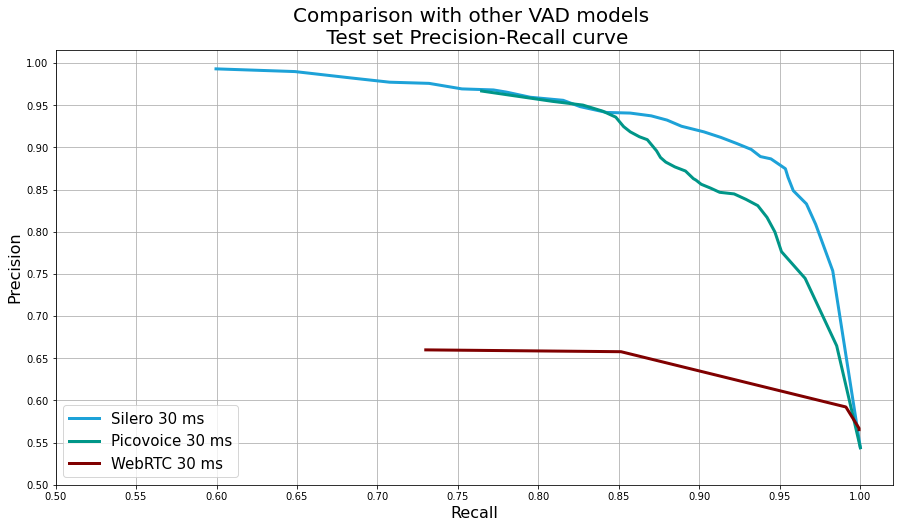
- Epic metrics (best in class as far as we know); - Much shorter and flexible chunk size (30, 60, 100 ms); - Radically faster inference, i.e. model forward pass takes ~1ms for a 30 - 100ms chunk; - Radical simplification - there is literally just one model for everything now;
- https://github.com/snakers4/silero-models#speech-to-text - https://github.com/snakers4/silero-models/wiki/Quality-Bench... - https://habr.com/ru/post/519562/
Disclaimer, this is my project