linedash
I 'worked around' the issue for the longest time by leaving covid based processing going on folding@home, which would force my CPU into turbo mode.
Eventually I found out that if I disabled cstates, it mostly went away.
https://www.cvedetails.com/vulnerability-list/vendor_id-1775...
Take Ireland for example. You're not going to be making US level money but I'd say you could easily double what you're making now and there's the potential to go much higher than that.
Too many customers run really old versions of code that need older versions of PHP and so on. We can't not provide them without losing the business. We do of course, make newer versions available.
The other fun one we periodically get is customers doing PCI scans or similar and getting warnings for out of date versions of OpenSSL, Apache, etc. Nope; just backporting showing the old version numbers.
Source: hoster
Others in this thread have already indicated why this study doesn't help with much. Unfortunately it will just give the anti-fluoride crowd ammunition.
Honestly I think this information is actually too dangerous for anyone to have - companies or govts. I'd like to see this kind of level of information gathering made illegal.
Personally I consider two processes and 40MB of ram to be negligible for the benefits it brings.
You can indeed use it as a standalone top without either of these processes too. You're just giving up one of the main benefits (replayable logs) outside of the extra stats.
In short; you're moaning about what exactly?
Writes to replayable binary logfile with 10 minute system-state snapshots and uses process accounting to ensure it see's every process during that time.
Gives more metrics than any other top; including network, disk and all the counters that you have to check the man page to know what they refer to.
Its counterpart atopsar lets you replay the data for specific stats in an easily viewable format; i.e; - atopsar -m - this shows the memory stats for todays logfile in 10 minute increments.
It goes on every single server I manage without exception. With atop you can actually see why it died instead of guessing from old log entries.
Screenshot of atop : https://www.atoptool.nl/images/screenshots/genericw.png
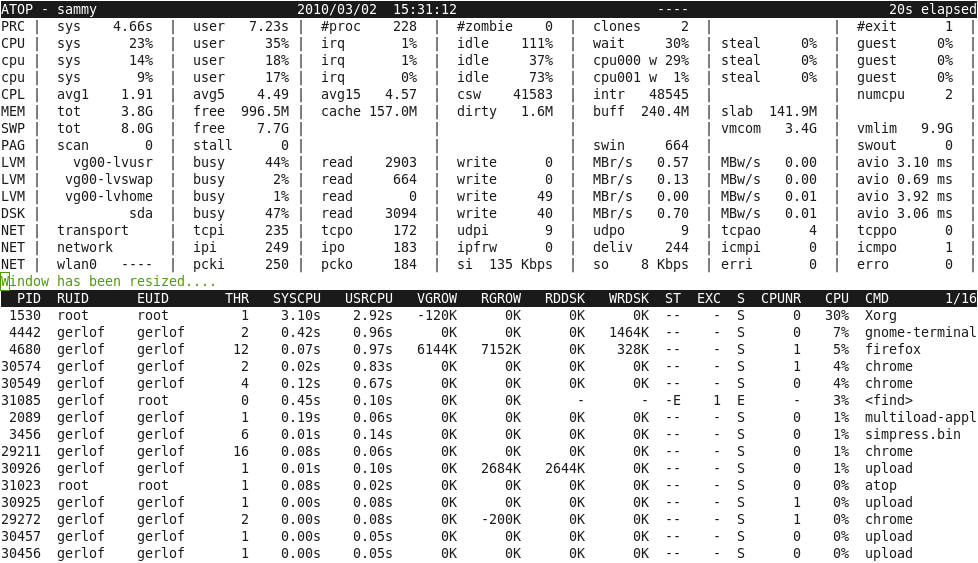
Example output of atopsar:
  # atopsar -m

  *snipped*  2.6.32-896.16.1.lve1.4.51.el6.x86_64  #1 SMP Wed Jan 17 13:19:23 EST 2018  x86_64  2018/03/27

  -------------------------- analysis date: 2018/03/27 --------------------------

  00:00:02  memtotal memfree buffers cached dirty slabmem  swptotal swpfree _mem_
  00:10:02    14027M    928M    839M  6335M    1M   4645M        0M      0M
  00:20:02    14027M    963M    842M  6393M    1M   4641M        0M      0M
  00:30:02    14027M    756M    873M  6617M    1M   4638M        0M      0M
  00:40:02    14027M    576M    871M  6596M    3M   4634M        0M      0M
They even give you a hello world sample curl when you opt to add the webhook. At the simplest you can just replace the hello world text and bam -- you're sending to slack. Just takes a very simple json input.
For a tool like this; quality documentation really is a must. And it isn't.
$ [data is generated] | awk '!/something/'