irchans
Simplifying all of math is another endeavor, but I imagine that you could have a bunch of LLMs trying to shorten existing Lean proofs.
counting zero integer decimal positional notation 100, 1000, … the four arithmetic operations + – * / fractions decimal notation 0.1, 0.01, … basic propositional logic (Modus ponens, contrapositive, If-then, and, or, nand, …) negative numbers equivalence classes equality & substitution basic algebra – idea of variables, equations, … the idea of probability commutative and associative properties distributive property powers (squared, cubed,…), – compound interest (miracle of) scientific notation 1.3e6 = 1,300,000 polynomials first order predicate logic infinity irrational numbers De Morgan’s laws statistical independence the notion of a function square root (cube root, …) inequalities (list of inequalities) power laws (i.e. abac=ab+c ) Cartesian coordinate plane basic set theory random variable probability distribution histogram the mean, expected value & strong law of large numbers the graph of a function standard deviation Pythagorean theorem vectors and vector spaces limits real numbers as limits of fractions, the least upper bound continuity Rn, Euclidean Space, and Hilbert spaces (inner or dot product) derivative correlation central limit theorem, Gaussian Distribution, Properties of Guassains. integrals chain rule modular arithmetic sine cosine tangent π, circumference, area, and volume formulas for circles, rectangles, parallelograms, triangles, spheres, cones,… linear regression Taylor’s theorem the number e and the exponential function Rolle’s theorem, Karush–Kuhn–Tucker conditions, derivative is zero at the maximum the notion of linearity Big O notation injective (one-to-one) / surjective (onto) functions imaginary numbers symmetry Euler’s Formula eiπ+1=0 Fourier transform, convolution in time domain is the product in the frequency domain (& vice versa), the FFT fundamental theorem of calculus logarithms matrices conic sections Boolean algebra Cauchy–Schwarz inequality binomial theorem – Pascal’s triangle the determinant ordinary differential equation (ODE) mode (maximum likelihood estimator) cosine law prime numbers linear independence Jacobian fundamental theorem of arithmetic duality – (polyhedron faces & points, geometry lines and points, Dual Linear Program, dual space, …) intermediate value theorem eigenvalues median entropy KL distance binomial distribution Bayes’ theorem 210≈1000 compactness, Heine – Borel theorem metric space, Triangle Inequality Projections, Best Approximation 1/(1−X)=1+X+X2+… partial differential equations quadratic formula Reisz representation theorem Fubini’s theorem the ideas of groups, semigroups, monoids, rings, … Singular Value Decomposition numeric integration – trapezoidal rule, Simpson’s rule, … mutual information Plancherel’s theorem matrix condition number integration by parts Euler’s method for numerical integration of ODEs (and improved Euler & Runge–Kutta) pigeon hole principle
mathematical used less often: Baire category theorem, Banach Spaces, Brouwer Fixed Point Theorem, Carathéodory’s Theorem, Category Theory, Cauchy integral formula, calculus of variations, closed graph theorem, Chinese remainder theorem, Clifford algebra (quaternions), Context Free Grammars, countable vs uncountable infinity, Cramer’s Rule, cohomology, Euclidean algorithm, fundamental group, Gauss’ Law, Grassmannian algebra , Graph Theory, Hahn-Banach Theorem, homology, Hairy Ball Theorem, Hölder’s inequality, inclusion-exclusion, Jordan Decomposition, Kalman Filters, Markov Chains (Hidden Markov Models), modules, non-associative algebras, Picard’s Great Theorem, Platonic/Euclidean solids, Principle of Induction, Probabilistic Graphical Models (Bayesian Networks, Markov Random Fields), Pontryagin duality, Quaternions, Spectral Theorem, Sylow p subgroup, repeating decimals equal a fraction, ring ideals, sine law, tensors, tessellation, transcendental numbers, Uniform Boundedness Theorem, Weierstrass approximation theorem. From http://artent.net/2012/11/27/100-most-useful-theorems-and-id...
https://www.youtube.com/watch?v=-ga41edXw3A
The Amiga was the second computer that I ever owned. The first was a C64 that I bought freshman year. (My father bought a TRS-80 before that.)
(* Mathematica Notation, Assume x>0 ) If[ x < 10^(-10), 1+ x/2, ( order x^2 error ) If[ x> 10^10, Sqrt[x], ( order 1/Sqrt[x] error ) (else) Sqrt[x +1] ] ] ( I guess the If statements take too much time. *)
I asked GPT to write code to address their question and the code was quite acceptable drawing the circle and finding the correct intersection point. It would have take me about 40 minutes to write the code, so I would not have done it myself.
Currently, GPT is great for writing short programs. The results often have a bug or two that is easy to fix, but it's much faster to have GPT write the code. This works fine for projects that are less than 100 lines of code where you just want something that works.
https://chatgpt.com/share/690f675d-c340-8013-b598-41fe487b4e...
It has the nice properties that you can do any number of sets (in theory) and all the boundary intersections are either osculating or perpendicular.
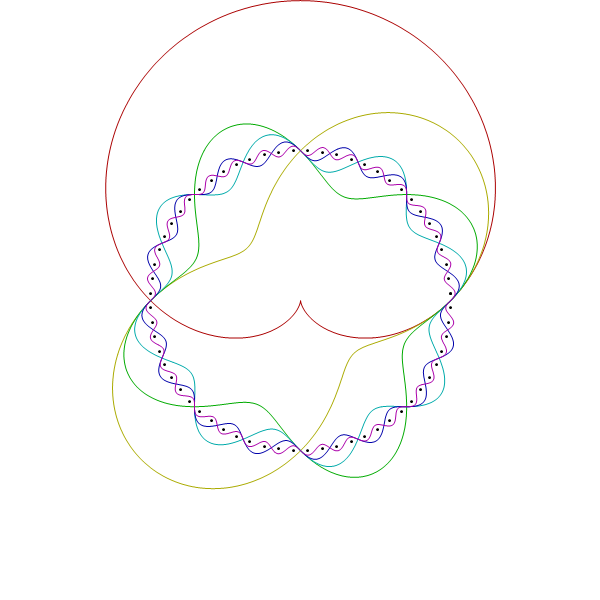
Very cool.
There might be a simple way to do this with a crypto-currency. If possession of a credit card is considered proof of age, then possession of cryptocurrency should also be considered proof of age. Maybe the user could play $0.01 to the porn site using crypto currency to prove that he is over 18. If done properly, no one, not even the government, would know who the user was.
Here is another idea.
You have independent stores where the clerks can sell proof-of-age certificates to people. These certificates are essentially just 20 random Base64 characters. By law, the independent stores are not allowed to identify the customer (who pays with cash). The store clerk is only permitted to issue certificates to people who appear to be over the age of 18, no id required. The store keeps a list of every certificate that they have sold along with the month in which the certificate was sold so that the certificates can expire after several months.
Now I claim that it is possible to create open source zero knowledge proof software that runs on a server for each store, a few government certifying authorities, the porn websites, and on the users computer so that as long as the stores don't identify the users, no one will be able to identify the user. The government will not be able to tell which certificate was used to access the porn. The government will not have access to the certificates. It will not be able to tell which store issued the certificate. The porn site will not learn the certificate of the user nor will it know his identity.
Also, the number of lines of code needed for each program of the five needed open source programs will be less than 1000 lines, maybe less than 100 lines.
I think that all of this could be done at a cost of about $50,000 to develop the software plus the cost of running the servers. I feel like I could write all the code for less than that.
The system is not perfect. You have to trust the stores to not identify the customers and to do a decent job of identifying who is over the age of 18. Some kids will get certificates by copying their parent's code or copying the code of an older friend. Some 16 year olds will look like they are 18 and they will be able to buy proof of age certificates. But, over 80% of kids under 17 will not be able to view porn.
Despite the low cost and effectiveness of the idea above, I am not sure that it is a good idea. I don't like the government censoring content.
"Readers comprehend “the boy hit the ball” quicker than “the ball was hit by the boy.” Both sentences mean the same, but it’s easier to imagine the object (the boy) before the action (the hitting). All brains work that way. (Notice I didn’t say, “That is the way all brains work”?)".
It should be, "the SUBJECT (the boy) before the action (the hitting)." (I added caps for emphasis.)