huurtehoog
It's entirely clear that they cut cables and intend to cut more. It's not training, it's current aggression.
Anyway, this analysis is not predicated on my self worth. I just think software development will be closer to engineering, and worked on by less people, than it is today. I used the word "hope" because I am betting on that outcome, I am positioned to take advantage of it. But it is not what I "wish" would happen, not even close.
Why do you think this has anything to do with "feeling special" or wishing to be some old-timey "craftsman"?
Suit up and brace yourself is all I can say. We should all be concerned in protecting our communities from the adjustment. Not in an doomerist way but you know prepare to weather a storm. I think it will be worse than 2008. But I also think that the next boom will be very very interesting and with a lot of great opportunities to advance humanity and technology.
The next turn of the spiral will always be higher and wider.
I think we are seeing bloat accelerating and the boom will eventually go bust.
My hope is that from the ashes of the current boom/bust cycle we might actually get "software engineering" once the dust settles and society catches up with technology in terms of culture, regulations, education etc.
It seems to me that a big bust is about to follow the 15 year boom that started out as "web 2.0" and saw the rise of web app framework, "front end" development, "x as a service", start ups "pivoting" to software tooling creating bloat to tackle problems created by bloat etc.
A lot of jobs will be removed from the tech industry, I think. But the work in software development will be more interesting 5/10 years from now than it is now. Paid more in line with the rest of the economy and thus not attracting so many uninterested actors, and more aligned with market demand instead of driven by a labor oligopsony, held more to account once regulation catches up with technology etc. I think we might actually get "software engineering" after this.
We may never again have as many "software developers" as we did in early 2020s. That shift is sure to have severe economic, political, social, and cultural consequences.
I am especially interested in how the work in security, assurance, performance, and such hard problems will evolve in respect to the large amounts of LLM-generated code. I see a lot of opportunities there. Not in terms of how many people will be able to work on that but in terms of how much income those competent enough will command. Individuals and teams. There are some really interesting developments in spaces that have historically been shunned by the framework configuration crowd. It seems to me that the advocates of speed over quality in software development are about to be swallowed whole by the tide of code they unleashed.
Technology is a convenient escape goat and a lot of glue-code gigs were made possible by the market distortions I mentioned. But I do think a big correction is taking place and we may have passed the high water mark of employment in software development. Especially cushy jobs being overpaid to configure frameworks, as this sort of work is proving quite tractable for LLMs.
I do think there will be more opportunities in high skill software engineering created by the new tooling on both sides - demand for building and maintaining automated systems as well as dealing with the consequences security, reliability, etc, wise. At this level the industry has been short staffed for several years and that trend should intensify I believe. There is lots of money to be made in being very knowledgeable on fundamentals and detail oriented. That has been true for a while and it seems to me that it will be only more so for the foreseeable future.
There is a lot more to this discussion than one time series from the BLS, I have linked just 4 that are worth skimming elsewhere in this thread.
I am not trying to prove a point one way or the other. The topic interests me and there is a lot of analysis available on the problem of finding the productivity growth in economic data corresponding to the ever increasing investment in computer technology.
To me it is clear that it is an open problem, and the literature available is a great reflection on statistical methodology in economics.
> But if the question is whether there has been any productivity impact at all, I would say there are multiple indications of that.
That is indeed the question, and I have not found one paper that conclusively states that there is clear evidence or clear absence of a measured statistical effect.
If we're going by anecdote I know way more people who quit caffeine than nicotine.
> So what is astounding is that the effects of the AI revolution may be visible in national-level economics data after only 2 - 4 years since the technology was introduced, and we're already wondering if we have shifted into a "high productivity growth era"!
I feel compelled to repeat the conclusion from the letter I linked. I used it as an example of how much of an open contention the productivity-from-computer-technology issue remains
> As more data become available, it will be important to continue to monitor whether current patterns represent the early stages of a new era of booming productivity or merely a temporary uptick in an otherwise slow-growth environment.
That is a severe understatement. Nicotine is consistently ranked as one of the most addictive drugs, near cocaine and heroin.
Only about 6% nicotine users manage to quit every year.
https://nida.nih.gov/publications/research-reports/tobacco-n...
> The idea that the US lost its manufacturing is not based in reality.
But I disagree with your claim that people are right in being extremely dismissive of losses in US manufacturing.
>> Absolutely people were extremely dismissive to anyone saying that we're losing the ability to make things in this country!
Interpreting that as a complete loss of manufacture capacity I agree with you, with the qualification that concerns of relative decline were justified since there was a definite decline in aggregate.
I have to say that overall I don't think economies and citizens of these economies should prefer certain economic activities over others. In principle I think specialization is a good thing. On the other hand, I do think that the US has committed some strategy mistakes in terms of how much manufacturing activity was moved out of the country and how dependent it has come to be on foreign supplies of, for instance, rare earths and advanced IC.
But that analysis is predicated on US strategic goals and geopolitical intent. The coming impasse over Taiwan with China is almost completely self imposed due to the prioritization of short term corporate profit over strategic goals.
But that is a different conversation altogether. I think data from the past 30 years show that alarmism over de-industrialization was overblown as you said AND that there has been nonetheless a significant decline in the previously absolutely dominant position of the US economy in global manufacturing. If that is good or bad, to whom or to what ends, is way outside the scope of internet forum messages.
The role of software in reproducing organizational designs is a fascinating topic. When organizations adopt ERP, or Office, or buy into the Salesforce ecosystem, or use Jira, they are also adopting organizational designs. I think this plays a similar role to consultancy. By adopting software, organizations are implicitly learning about common practices and internalizing industry knowledge.
As for the adoption of LLM-centered workflows, I suspect that the end goal is not having a great new product that does everything better as is often claimed. I think the end game is making organizations dependent on the vendor. That might backfire depending on how the ecosystem evolves in terms of subscriptions to "frontier" vs open-weight models running locally. I am watching keenly.
I think there is a lot to be said in expanding Conway's analysis, and there is a lot of literature on related topics using terms such as "socio-technical systems" and some other venues in organization science that have a similar approach by other names. I think Giddens' ideas on structuration in sociology could be of interest to you.
Anthropology, archaeology, and ancient history all have some great texts on the development of complexity over time, how it grows and how it collapses and why. In fact the first reference to Giddens' work I read in a fascinating little book about the development of complexity in Ancient Greece via practices of feasting, by Small. Also of course the work of Cline on the Late Bronze Age collapse, and Tainter on social complexity growth and collapse more generally, are fascinating.
I do tend to be fascinated by the study of the distant past but if you look up Giddens you can probably find books and adjacent writers that might help you reflect on Conway's article.
I do object to calling his writing "laughable".
Thank you for the article, it seems quite interesting on skimming and I will save it for later.
World total: 17.6 trillion (https://data.worldbank.org/indicator/NV.IND.MANF.CD?location...) US: 2.961 trillion, 16.82% of world China: 4.82 trillion, 27.38% of world total
So you were very much closer to the 3 trillion figure (again, 2026 annualized data is not current, it's forecast). Still quite off from the 1/5th of total. About the same as the EU - 3.03 trillions for 2025 (https://www.macrotrends.net/global-metrics/countries/euu/eur...)
In terms of participation in world total the US has come down from 22.44% in 1997 to 16.82% in 2025 losing 5.38 percentage points or a loss of over 1/5th in less than 30 years.
I'd say there is some justification to claim a decline in US manufacturing.
Again thank you for engaging productively and providing up to date data. I feel like I should offer praise as I chastised you for cursing at me for using data 4 years out of date.
I said elsewhere, I don't have any beliefs about this problem, I am deeply fascinated by the difficulty involved in productivity analyses and especially by the question of missing productivity that we should expect to be driven by the huge investments in computer technology that have been observed over the past half century - and quickly accelerating of late.
It's a fascinating topic and I intended merely to point out that quantifying computer technology driven productivity growth is a hard problem. Any facile conclusions one way or the other are suspicious in my view.
It is not clear to me at all that building and buying more computer and data centers and software is an obviously good investment that should only be increased because it raises productivity. That is the discourse, but there is a very conspicuous lack of hard data to support that claim, and lots of pages going back and forth and proclaiming at the 'conclusions' sessions of papers and chapters that the problem is indeed hard and the work done so far is at best inconclusive.
He never made such a claim. In the introduction to the 1972 print of this book he discusses the forecasts from Turing to his time of computers' abilities to play chess and the then state of the art. He criticizes the early optimism in 1950s mentioning that in 1957 H. Simon though in 10 years computers would excel in chess.
Dreyfus goes on to discuss the history of forecasts and progress in computer chess in a nuanced and highly informative analysis.
Whatever your opinion of his work I don't think it's fair to say his arguments are "laughably wrong" at any turn. I haven't read his books in detail but from what I know he made great contributions to the dialogue about technology and I don't know any instance of his making crass predictions or anything that he wrote that could be labelled "laughable".
Four. 2021 vs 2025. Unless you have numbers from 2026 from the future.
> and you’re going to hassle me about not having accurate figures?
Merely pointing out. The subjective interpretation of the experience is entirely on you.
> What the fuck.
Get more recent numbers that show I'm wrong and your 3 trillion & 1/5th of world total is right then.
The passage criticizing the "invention of writing" is a quote for a legend where a Pharaoh passes negative judgement, to a god by the way, who had invented writing in the story.
Ironically, the dialogue in question, Phaedrus, is about the dangers of misreading text. It discusses writing political speeches not writing per se.
Besides, the dialogue is not about writing itself, but about writing down political speeches and the consequences and impact of political speeches being read rather than heard.
Also, the dialogue dates from about three thousand years after writing was invented.
Some direct quotes from the dialogue:
SOCRATES: So, it is obvious to everyone that speech writing is not shameful, not in itself anyway (258d)
SOCRATES: We are left with the question of the appropriateness and inappropriateness of writing, and how it may be executed in a worthy or an inappropriate manner. Do you agree? (274b)
And this, a very relevant insight for an age when some are convinced that text analysis should suffice for intelligent work:
SOCRATES: Then a person who thinks he has left a skill in writing behind him, and anyone who, for his part, inherits this on the assumption that something clear and certain will emerge from writing, would be full of enormous silliness, and indeed ignorant of the prophetic words of Ammon in believing that written words are anything more than a reminder to a person who already knows whatever it is that the written words may refer to.
Ironically, the sharpest criticism Socrates made of writing in the often misread Phaedrus was of misreading texts.
Values are 2021 because that's the most recent available for US at the same source, to keep consistent.
World Manufacturing output: 16.16 trillion https://data.worldbank.org/indicator/NV.IND.MANF.CD
US Manufacturing output: 2.5 trillion (15.47% of world) https://data.worldbank.org/indicator/NV.IND.MANF.CD?location...
China Manufacturing output: 4.85 trillion (30.01% of world) https://data.worldbank.org/indicator/NV.IND.MANF.CD?location...
Whatever analysis you make, let's use the correct numbers, from which you were off by about 1/5th. Should you think that is a negligible margin, you'd have to consider the US participation in global manufacturing output as similarly significant.
https://www.stlouisfed.org/on-the-economy/2026/jul/ai-produc...
From July 30:
> Since the release of ChatGPT in late 2022, artificial intelligence (AI) has been widely expected to raise productivity. But aggregate productivity data have so far offered a more muted signal: Utilization-adjusted total factor productivity grew only 0.07% over the four quarters ending with the first quarter of 2026
How is any return to be materialized except by increasing economic productivity?
> Probably for the same reason that SV companies hiring thousands of developers struggled to improve their product much past the original product, that was built by a handful of people.
Brooks: "Adding manpower to a late software project makes it later."
> Scale in headcount was a tactic to get investment, then you had to find stuff for everyone to work on. Suddenly people have the time to engineer so hard that we get runtime JSON defined CSS rendering engines to produce the same buttons we've had since 1995, instead of just writing a stylesheet and html.
Brooks: "All repairs tend to destroy the structure, to increase the entropy and disorder of the system. Less and less effort is spent on fixing original design flaws; more and more is spent on fixing flaws introduced by earlier fixes. As time passes, the system becomes less and less well-ordered."
> Code output velocity from AI threatens to be useful, except it's also prone to over-engineering and burning tokens on the unnecessary. It's learned from the best after all. My suspicion is there is a lot getting done, but it's just not that impactful to flagship products.
Brooks: "C. S. Lewis has stated it more perceptively: 'That is the key to history. Terrific energy is expended—civilizations are built up—excellent institutions devised; but each time something goes wrong. Some fatal flaw always brings the selfish and cruel people to the top, and then it all slides back into misery and ruin. In fact, the machine conks. It seems to start up all right and runs a few yards, and then it breaks down.'"
That Santayana quote is a bit worn out but applies beautifully here. It's worth recovering its context:
Santayana (1954, p 82): "Progress, far from consisting in change, depends on retentiveness. When change is absolute there remains no being to improve and no direction is set for possible improvement: and when experience is not retained, as among savages, infancy is perpetual. Those who cannot remember the past are condemned to repeat it"
https://www.standupeconomist.com/pdf/misc/solow-computer-pro...
It's an interesting question and very much not resolved. It indeed led to a flurry of studies in the 1990s, and more recently to several updates and meta-analyses.
The problem of "does computer technology investment causes increased productivity" is an interesting issue in economics and statistics. It is far from clear that the (immense) investment in computers over the past several decades has caused a corresponding excess growth in productivity.
Some of the literature published after 2015 that I have read on this topic:
"Information technology (IT) productivity paradox in the 21st century"
> Thus we are still unable to confirm or reject the existence of an IT productivity paradox
https://doi.org/10.1108/IJPPM-12-2012-0129
-------
"Benchmarking the IT productivity paradox: Recent evidence from the manufacturing sector"
(This one was published in 2006 but I find it relevant because it does a very well scoped analysis in manufacturing firms thus addressing the oft-mentioned argument that computer technology may leverage task productivity in a way that is hard to measure in aggregate)
> However, many scholars from both sides of the IT paradox debate agree that difficulty still exists in specifying how to assess the IT contribution, and the availability of reliable data sets
> Regardless of the final decision to differentiate or conform, our results make a compelling argument that more spending does not necessarily mean better IT productivity.
https://doi.org/10.1016/j.mcm.2004.12.012
-------
"Lessons from three decades of IT productivity research: towards a better understanding of IT‑induced productivity effects"
(This is one of the most inclined to disagree with the existence of the paradox, and still very cautious in the language used for writing the conclusion, e.g.:)
> But to not at least consider the ongoing technological change as an important determinant of the deceleration in productivity growth seems ill-advised."
https://doi.org/10.1007/s11301-019-00173-6
-------
The Productivity Paradox: A Meta-Analysis
(This I'm quoting from the submitted manuscript. I haven't gotten around to reading the published version yet, but:)
> Since the size of the effect helps make the right decision in business-related investments, our result of ICT elasticity being very close to zero with values, about 0.3% for productivity and no effect on profitability, supports the argument that there are better forms of investment to be made
Yes that is in essence the crux of the problem
These long term data suggest that this "excess" remains bellow historical productivity growth
https://www.bls.gov/productivity/
https://www.bls.gov/productivity/images/pfei.png
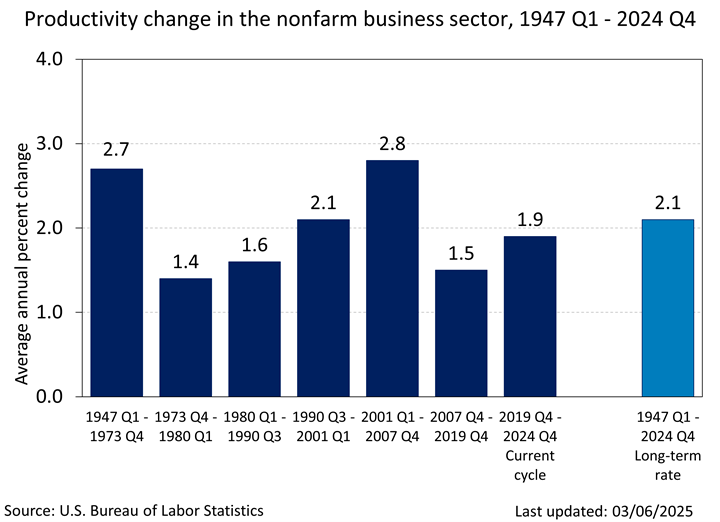
The analysis bellow, more recent than the one you pointed to, is from May 2026, and an even stronger argument to support your position on the side of "computer technology investment caused a delayed excess growth in productivity". And as you can see at the end of my comment, they still write a very tentative conclusion.
https://www.frbsf.org/research-and-insights/publications/eco...
To be clear: I do not take a position. I think this is an open question, a very important one, and I am not fully convinced that the exponential growth in the investment on computer technology over the past 50 years has led to a corresponding gain in productivity, nor that it is entirely a drag and a mechanism for increasing firm size and driving asymmetric profitability concentrated in ever fewer firms as the increased concentration in the capitalization of American stock market index composition would indicate.
That said, the strongest case I have seen for the position that we are beginning to see these delayed gains is the letter I linked above, and it still takes care to conclude:
> As more data become available, it will be important to continue to monitor whether current patterns represent the early stages of a new era of booming productivity or merely a temporary uptick in an otherwise slow-growth environment.