glurgh
I'm perfectly happy to take your word that you're working on something better.
http://www.jwz.org/doc/groupware.html
The browser alone with all of its extra doodads ran on three radically different platform families (Windows 95/NT, Mac OS, Several proprietary Unixes). And that's just the browser. Throw in running one of the top traffic sites at the time.
The internet advertising market which drives a lot of the revenue at many current similar startups was far smaller and less mature, as well. It's difficult to see how we can draw any sensible conclusion about developer productivity from all this.
And we are definitely reacting to each others' notions of how bothered one ought to be by his behaviour.
'Broken moral compass' may be a little harsh but I think you are perhaps swayed too far by the display of resourcefulness and the 'virtualness' and triviality of the setting. I'd see it differently if he were a 14 year old kid, figuring out how the world works. But he's an adult (with a spouse and a mortgage) who more or less tried to extort the developers of the mmorpg into giving him a job. This seems like sufficient information to conclude that he has rather poor ethical judgement or at least, a great deal of ethical obliviousness.
It reminds me a bit of a part of 'Reflections on Trusting Trust' that is rarely cited or recalled - open it up when you have a chance and re-read the last three paragraphs of the last section 'Moral'.
His broken moral compass and naive sense of entitled victimhood are preventing him from leveraging his talents to find the kind of work that he wants. You can easily be misguidedly "relentlessly resourceful". Just like you can be both fascinated and saddened to see it happen.
I'm not a car person or expert in the field but I've done a little bit of work on automotive systems. As the other responders pointed out these systems are designed to, ECC or not, do things like (at the slightest sign of inconsistency or error)
- reset and recover very quickly
- enter reduced functionality or failsafe modes
- fully disable themselves and anything that might cause you to rely on them
They're fundamentally built around the eventuality of them failing and with consideration of the things that need to happen when they fail. They don't usually rely on 'well, we'll just put in a somewhat more reliable component'.
The objection 'that approach can't lead to useful insight' is a reasonable one but I don't think he's taking the approach out of ignorance or because he spaced out on something while typing it up - it's a deliberate choice, whatever its merits.
I'm not. I'm not saying anything about the quality of his argument, I'm talking about the stridently poor quality of your initial one which boils down to 'he doesn't know what he's talking about'. I think that's trivially and factually refutable.
I do think what he's trying to argue is both interesting and difficult and I'm not sure I'm entirely convinced by it. It doesn't merit 'he's clueless' and saying that does a disservice to both the paper and the discussion here.
Your later, concrete objections are actual objections but I don't feel I've understood the paper well enough to engage in them. I'd only say I'm also unsure whether they're really about what the paper is about. The fact that many, in fact most, programming formalisms and paradigms are largely isomorphic is both well-understood and rarely a source of practical insight, which is the stated goal of the paper.
[I guess this is now also a reply to a post that was heavily edited while I was replying to it]
It's not really fair to say that Aldrich 'misses' a discussion of object thinking, he just chooses to put the focus of that particular paper elsewhere - this is from the intro
Some of the advantages of object-oriented programming may be psychological in nature. For example, Schwill argues that “the object-oriented paradigm...is consistent with the natural way of human thinking” [28]. Such explanations may be important, but they are out of scope in this inquiry; I am instead in- terested in whether there might be significant technical advantages of object-oriented programming.
and
This success raises a natural question: Why has object-oriented programming been successful in practice?
This seems like a stubbornly obtuse way to not engage in the paper's arguments.
Reward: Chicken Maharaja Mac
http://www.economist.com/node/1011419
is one, there were others but it doesn't seem to have brought about significant change.
But ignore the meaniepants bit - the commenter has a point - "I flagged, then I unflagged it [etc]" is unintentional drama-generating fluff. You could have just said "The title makes it sound like a purely political story but it's really a Mike Bostock thing and worth a read"
By the DC proponents. Or AC opponents. Definitely part of a long campaign to try to make AC appear dangerous.

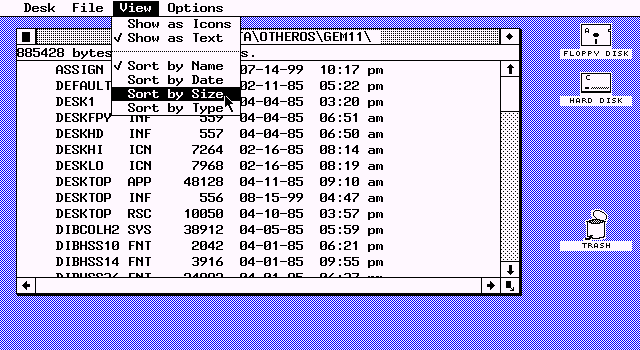
http://en.wikipedia.org/wiki/Atari_TOS#mediaviewer/File:ST_D...

Looks pretty X-like. It seems GEM itself was licensed from Digital Research but their GEM didn't use X.
Edit: Fixed DEC to DR, as pointed out by reply comment below.
NextStep 0.8, '88 vintage.
http://www.wired.com/threatlevel/2010/09/google-spy/
I tend to believe Google's GC and think Arrington is having some paranoid attention-seeking fantasy. At the same time, can some schmoe at Google read a gmail email? It seems like they can.
http://www.microsoft.com/en-us/news/press/1999/apr99/eyepr.a...
DEC used three button puck-style mice, the one you saw was likely attached to a DECStation and I think DEC had been using them for quite a while, maybe from the mid to late 80s. Here's logitech's first mouse from 1982 which is also a puck.