fipar
To all the variables you mention, add that most of my VHS viewing hours were on a Panasonic purchased in the US and adapted in Uruguay to 220v (and 50Hz) and pal-n ... :)
It doesn’t look like how I remember VHS but I think that, other than finding a setup that works (crt included), you probably won’t get useful feedback from people who were around at the time.
In any case, this really does look like a digital filter to me and not like how I remember VHS (I watched those in both ntsc and pal n, and with adapters meant for those who snuggled ntsc hardware into pal n countries).
I can’t find the link now but recently there was a post here about a GitHub Project that takes an audio file as input and gives you as output an audio file as the original would have sounded in some specific cassettes and let me tell you, that one also didn’t sound at all like the originals (I feel more authoritative on this because I still have working hardware).
Since I first read it in Spanish, I went back to read it in English and I still get my first interpretation.
In particular, "We have come to speak to you about the intelligence you are building." set the association in my head of "you == those building the AI"
For code, I think things go in the opposite direction: the system outputs artifacts that are all different among themselves (even more so now that we no longer distribute software via physical copies. Well, bits are always physical, but I mean we no longer ship floppies/CDs/DVDs).
That said, at least in my experience, code review has never been a direct part of factory-line-type QA. That QA is typically done by treating software as a black box and just verifying that it complies with a spec (often times based on a very loose definition of "spec" ...), and this is something that works equally well regardless of whether a human or a machine wrote the software. The type of QA that is done (among other things) by code reviews is checking whether the software's design is such that it will be economically feasible to maintain and extend it, for example.
The one part the code reviews takes a part of (but is in no way error-free) and that you just can't do with black-box testing (or it is much harder to do) is to look for things like backdoors. As our industry moves more towards "agents write software and tests validate that it works," I think a lot about "Reflections on Trusting Trust" and the new and wide attack surface added by people no longer reading the code shipped on their behalf.
At least that's the story I've read online a few times about the bass sound on Sir Psycho Sexy having to do with the dying battery on the pedal.
And, of course, just a little bit before DSP and simulators become available (or feasible for mainstream availability), those of us who were playing as teenagers in the 90s often got weird sounds on account of trying to juice the last bit of the batteries in our pedals. I love it that some among the current generation of kids like to simulate tape hiss, dying batteries, and other things we'd suffer then :)
This is the sheet: https://fernandoipar.com/content/music/poly-d/gemini-argon/c... (the annotations on it are by me)
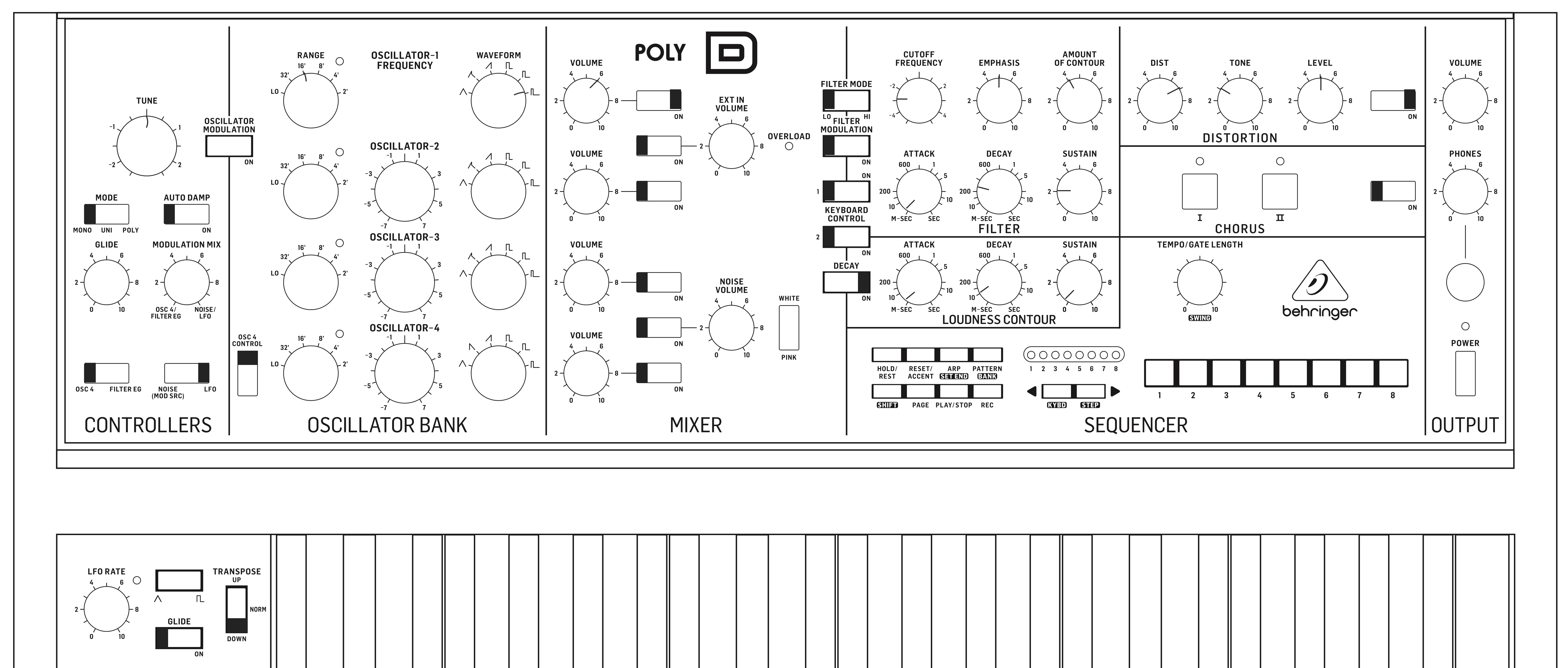
And this is what Argon created: https://fernandoipar.com/content/music/poly-d/gemini-argon/b...
For this simple prompt: https://fernandoipar.com/content/music/poly-d/gemini-argon/p...
I'm honestly impressed.
I know a local company at some point had a disk-drive-like interface to better use tapes (HiLow Datadrive) so maybe he had that, because saving work to cassette the way I saved things to cassette in the 80s would have been painful (not that it wasn't painful in the 80s of course!)
My recollection is it was basically the same computer he had since the 80s. I always have trouble identifying a specific sinclair version because I had clones (tk-90x, then tk-95).
I agree that a computer is not a biological being. I think current LLM-based AIs are not conscious but, as to “everything else we normally associate with consciousness is biological and living,” while I agree that’s currently the case, if I look at AI (in general; not just at what’s popular now) through the lens of Pirsig’s Metaphysics of Quality, consciousness is on the Intellectual level (IIRC he classified what he referred to as Quality into Static/Dynamic and inorganic, organic, social, and intellectual).
A priori, there’s no reason why a level couldn’t be skipped and have intelectual patterns be supported directly in inorganic ones, skipping the biological (I think also the cultural, because if an AI ever is conscious we might as well call it alien and not just artificial: it would be so different from anything we know that it may just come from another galaxy, and it may not need a cultural substrate either).
The language is still alive but I think Scratch has mostly taken its place.
The clavinova does have a piano-like body, very very good built in sounds (including binaural for 2 types of piano in mine), and built in speakers, so there’s that.
On the other hand, this one says “built to order” while clavinovas are not.
All this to say that, while expensive, it does not seem outrageous if the keyboard plays good. This one has after touch too, which makes it more comparable with a synth than a digital piano (though I understand this one is just a controller).
Doing non-verbal thinking has nothing to do with not feeling pain, I don’t think it sounds like philosophical zombies at all.
Nice seeing you Evan! :)
If the table had a primary key, in case you ever face such a setup again (hopefully not!) then I think pt-online-schema-change to add the auto increment primary key while using ROW would probably be a better choice than the steps I mentioned in my first reply. It will rebuild the table anyway but at least it won’t block it while that happens.
What the model calls relations are sets of n-tuples where each attribute value has a domain.
SQL databases call their version of relations tables, and, in that view, a database with a single table is still relational.
Now I don't think SQL databases are relational but the analogy still holds (I'd just say that a relational database can have just a single relation)
If you meant it this way and I misunderstood you, apologies, though I'm not sure I'd say most data is actually inherently relational (even though I do think the relational model is the best one we have so far for databases).
However, if you meant that most data has relationships (as the ones we enforce with foreign keys in sql databases) then I agree with you, and I think using database management systems that don't have good support for representing this type of relationships between data entities will only work in niche cases and will eventually cause more trouble than benefits in general-purpose use cases.
Turns out this time the DB was to blame, but not because of the upgrade.
If the alter table in the blog post is not a simplified version of what was executed (barring changing column names, of course), that means the table had no primary key before the migration, which is a problem on its own.
To be honest, I don't even know if there's a safe way out of that situation in a replication setup, but one plan I would have tried to test in that situation is: - switch binlog_format to ROW (and never look back ...) - run a noop alter table to rebuild the table and hope that with ROW format, the rows get inserted in the same order (hope really hard please, with feeling) - run the alter table
Fortunately, recent versions of MySQL have ROW as the default binlog_format.
In my case, given I work with databases, there's little that agents can do on their own except in the exploratory phase. I have run exploratory phases in self-contained VMs, including containerized DBs within the VM, but when it comes to go to prod, my endpoint could be used to launch a career ending event so I prefer to stay with the current approach. I'm still moving way faster than just 1 year ago, but in a safe way.
But I can totally see your approach working in other scenarios.
When I'm not too pessimistic, I agree with you on the result being a systemic hardening. I just hope the incidents that happen on the way to that hardening aren't too bad.
I do pre-approve read-only tools though, and some very specific tools that can change state (append data to a specific file).
That's what works best for me so far: start with open-ended exploration with me approving everything. Have it fork subagents to write scripts that automate the most common requests from the main agent, review and eventually approve those, and then let it go using those tools pre-approved but coming back to me for anything else. Combined with a stupidly basic "dashboard" (a terminal tab with a view of all top-level agents and their status, so that I can see which one is waiting for me and jump to it with a key or 2) this has made me a lot more productive.
It's fine if your approach works for you, I'm just too old school (and have been burned before) to just let a computer unattended overnight, with an internet connection, even if in a locked down container/vm. Those all have escape hatches and one of the agents will eventually figure it out. Remember that things that happen once every million times, happen all the time on computer-scale :)
Also, let's say I'm the CEO behind any of these. I have access to skynet, and instead of using that to become the most powerful being on the planet (these people become CEOs to become richer and more powerful, whenever a founder says they want to change the world, you need to automatically autocomplete that to "change the world so that I'm richer and more powerful"), I rent out access to skynet by the token? Really?
Sadly, I think it's almost impossible to have a good discussion on this topic right now. Between the skynet camp, and the stochastic parrot camp, there's little room for conversation.
Just in case there is such room between you and I, here are my concerns about AI as it is developing right now:
- The security of our infrastructure sucks, and if it wasn't bad enough with script kiddies and state-sponsored actors, now those will have access to very powerful tools that work at a scale we can't comprehend. If you're concerned about our power plants, water sources, hospitals, etc. getting seriously compromised by this, I'm on board with you. It won't be because the AI is autonomous in a "this is a thinking superintelligence that wants to wipe or enslave humanity" kind of way, but because it's a powerful tool that moves at computer speed and the people using it (the "humans in the loop," ha) will get approve fatigue and at some point just do the coding agent version of the "yes to all" of the late 90s installers.
- The output from AIs will be used to make same very serious decisions with no consideration at all to the fact that they routinely make up facts. I'm fearing "this person goes to jail" and "this person gets killed" decisions. The near future (probably even present time) version of "Computer says No" will be awful.
My only hope is that maybe we survive this and come out on the other side having learned that most things do not really need to be connected to the internet, and just because a number or a statement comes out of a computer, it doesn't make it true.
We'll see, soon enough.
But skynet? Not concerned about that at all. These AIs infecting computers? No, "Soos and the real girl" is a warning about creepy people getting creepier, not about AIs multiplying themselves.
I went through a rough patch from 2002 to 2009 and couldn't afford new hardware, other than when I was finally able to get a second-hand laptop.
Before the laptop, I'd go visit customers with my pc tower and ask for peripherals when I got to their office, fun times. Well, not really, but I can laugh now ;)
I do remember using it to make older games play less bad, but, as you say, this rarely worked, I think precisely because the speed was never the original one (I don't remember the clock speed of my first PC, but the first one with a turbo button ran at 33 MHz which I'm sure is a lot more than twice the speed of the first one; seems closer to 8x from what a quick search implies).
This reminded me of a song about the related job of arriero, aptly titled "El arriero", which includes these lyrics:
"Las penas y las vaquitas se van por la misma senda. Las penas son de nosotros, las vaquitas son ajenas"
Which (loosing the musicality) can be translated as:
"The sorrows and the cows go down the same road. The sorrows belong to us, the cows do not"
I do wonder if having a single bathroom as a child played any part in my reasonably good grasp of concurrency control though!
So now both my wife and myself take time for ourselves to get that decompression time when needed.
To me, it's not just the commute. I actually prefer working from home. I enjoyed his description of Miyazaki greeting the ghosts though, I think I could work from an office if it was my studio, but I'd want it to be very close to my home.
Remote work also makes it possible for me to follow my natural "productivity cycle," which means I often get to work until late in the evening while still being able to have dinner with my family and then just have a short commute to my bedroom when they're (usually) already asleep. I did late-night (and even all-night) work too from offices when I was young, but it's one thing to do that in your very early 20s and with only your parents as family, than as an almost 50 with a spouse and kids.
As for enshittification defenses, besides having a family (including cats, used to have a dog too), having musical instruments within reach is great for when I need a quick break. Some breaks can also involve devices and still not be about dopamine, like when I reach out for my personal laptop to open renoise. Lately I've also taken up drawing a bit. I suck at it, but I still enjoy the activity.
I agree on the benefits of social activities. My workout of choice is weightlifting and I do have regulars that I talk to (plus for some exercises you really do need someone around if you want to safely get to your breaking point).
The one thing I miss from my youth days is social music playing. I hope I'll get back to that someday, but everybody's life is busy in different ways and, unlike getting together for coffee or beer, getting together to play music does require a bigger logistical effort and time budget. While I wait for the opportunity to arise, playing along to records is an OK way to get by.
It was a female voice that said something that could be translated to “the signal will mark it is <time>,” and, the funny thing is, between the way it had been recorded and the fact that signal (señal) and lady (señora) can sound very similar in Spanish when over the phone and followed by a vowel (“indicará” for will mark in this case), a lot of us thought it said “the lady will mark” and, as a little kid, I thought there was an old time-keeping lady on whom we all depended to be in sync. Miss NTP I guess!
In any case, great book. Gave it as a gift to my dad who was a mechanic when young and also rode a motorcycle (unlike Pirsig's' it as an Ariel though).
I have a rich social life that I enjoy, and I also despise working from offices. Fortunately, nobody can force me to do that because I'm not an employee, but it would suck for me if someone had that power over me.
I don't think it's too much of a stretch to accept that people are different and enjoy (and dislike) different things.