einr
Please consider this an official request to delete my account and all the data in it, I'm done with this.
Nevertheless, AI use is not what really stood out to me. It’s that it’s SO MUCH CODE. I have no idea how you guys maintain or reason about the quality or security of something like this. Good luck, I guess.
Especially curious because I see a whole lot of hardcoded english text in there…
https://ghloc.vercel.app/thunderbird/thunderbolt?branch=main claims 141k and most of it is Typescript.
Their Thunderbird for iOS repo is 34k lines.
I'm so very tired.
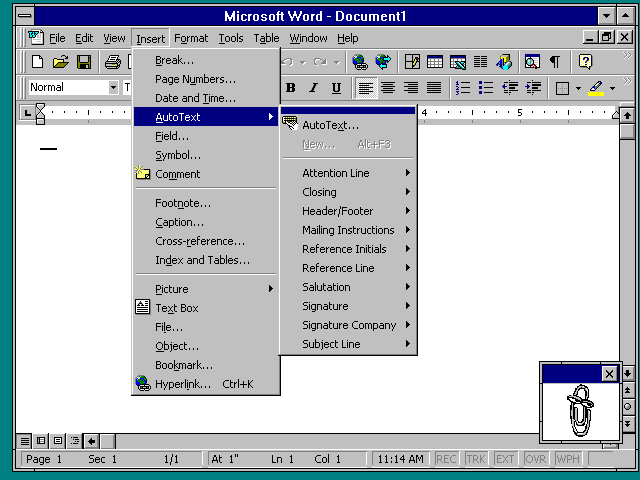
The menu bar in Office 2000 does not look like the standard OS menu bar, for instance. The colors, icons and spacing are non-standard. This is only slightly jarring, because it's pretty well done, but it's still inconsistent with every other app.
This was kind of the beginning of the end for Windows consistency -- when even Microsoft thought that their own toolkit and UX standards were insufficient for their flagship application. Things have only become worse since then.
* This becomes very obvious when you run Office 97 on NT 3.51, which generally looks like Windows 3.1, but since Office 97 renders itself and does not care about OS widgets, it looks like this: http://toastytech.com/guis/nt351word.png
The full name on the chip on some of them is ”Am5x86-P75 DX5-133” which implies a lot of things, some of which are flat out misleading (it does not get very close to ”P75” performance)
https://en.wikipedia.org/wiki/Amiga_Hombre_chipset
It was going to be HP PA-RISC based and have an AGA Amiga SoC, including a 68k core.
Maybe if these theoretical new 68k Amigas became a huge market hit they could have taken the arch further and it could have remained competitive, but all the other 68k shops had already pretty much given up or moved on already (Apple was already going PPC, Sun went SPARC, NeXT gave up on their 68k hardware, Atari was exiting the computer business entirely, etc) so I don’t know that the market would have been there to support development against the vast amount of competition from both the huge x86 bastion on one hand and the multitude of RISC newcomers on the other.
Second gen Pentiums, starting with the 75 MHz, were great.
(Also, a Pentium 60 is barely faster than a DX/2 66 at many tasks — it is a Bad Processor — but that’s another conversation ;)
I agree. Unfortunately, even with chunky graphics and/or 3D foresight, 68k would still have been a dead end and Commodore would still have been mismanaged into death. It’s fun to dream though…
Before it, you could claim that a 68040 was kinda-sorta keeping up with the 486 and that the nicer design and better operating systems of other computers made up for the delta in raw performance, but the DX/2 66 running Doom was the final piece of proof that the worse-is-better approach of using raw CPU grunt to blast pixels at screen memory instead of relying on clever custom circuitry was winning.
Faced with overwhelming evidence, everyone sold their Amiga 1200s and jumped ship to that hated Wintel platform.
Well, no one has mentioned computer hardware until you did.
Surely you understand how "all the motherboards are made in Taiwan" is less of an immediate risk to sovereignty than "all of our business and personal data is stored on American servers and subject to US law"
It would be nice if Europe could produce its own computers, but right now no one can except China, so what is your point? That limited sovereignty efforts undertaken in the realm of reality are futile and that enables you to get some cheap shots in for whatever reason?
In the 90s and up until the early 00s we used to have quite a few pretty serious contenders, but they are all dead now: ICL, Siemens-Nixdorf, Tulip, Bull, Olivetti, etc.
A LOT of them. Zilog only announced its discontinuation in 2024.
But that also means that there are A LOT of them out there, and they are cheap and generally extremely reliable parts. So if you rely on a device with a Z80 in it and you're worried about the CPU failing you can have hundreds of these things on the shelf for ~no money.
So I would say it's of limited utility for industrial applications for now simply because scarcity is not an issue for the real thing. This might change in the future so it's good that projects like this exist.
Due to the lack of support hardware in the C64 (no hardware RAM bank switching/MMU) this memory is not bank switched and then directly addressable by the CPU, it's copied on request by DMA into actual system RAM. But in some sense, a C64 with a 16 MiB REU is a 6502 with 16 MiB RAM.
But yeah, you want CPU addressable RAM with real bank switching. You couldn't really do 16 MiB, you wouldn't want to bank switch the entire 64 KiB memory space. The Commander X16 (a modern hobbyist 6502 computer) supports up to 2 MiB by having hardware capable of switching 256 banks into an 8 KiB window (2 MiB/256 banks = 8 KiB).
Let's say you design something with 32 KiB pages instead -- that seems kind of plausible, depending on what the system does -- you could then do 256*32 = 8 MiB and still have 32 KiB of non-paged memory space available. I think this looks like just about the maximum you would want to do without the code or hardware getting too hairy.
I don’t know if they have Improv pre-installed, but it will let you mount disk images from your computer.
(Personally I find the easy way too easy, so I have NeXT^WOpenSTEP installed on bare metal on a 5x86 box. But that’s me)
(FWIW, searching for the CPU model brings up an old review where the full system they’re testing pulls 145W under some amount of load. While that’s not nothing, it’s also not outrageous for a desktop PC that does the desktop PC things you require of it.)
0.03 kW * 24 h * 365 d * $0.18 = $47.30/year
This article is an example of an AI agent taking 40 minutes to do some basic ass sysadmin troubleshooting tasks. 100x faster than who? An ”expert”?