devnull3
Re:Does the software industry learn?
on Thursday January 27, 2022 @11:57AM (#30102930)
> But those are more like idioms of the language, not "subroutines".
Actually a lot of mechanical manual work we do are subroutines.
Examples
1. Make an omlette (params like: which kitchen or ingredients are derived from context)
2. Change engine oil
3. Take blood sample
Re:US consumer prices soared 7% in past year, most since 1982
on Wednesday January 12, 2022 @11:06AM (#29908378)
> lost faith in it
Yep.
"Power resides where men believe it resides. It's a trick..." -- Varys from Game Of Thrones.
Re:Indian academics throw weight behind Sci-Hub and LibGen in landmark...
on Sunday November 28, 2021 @07:09AM (#29368262)
https://www.ipandlegalfilings.com/is-software-patentable-in-...
"In India, the software is not directly patented but it can be granted patent if it is attached with novel hardware, an invention that is unique and capable of industrial use."
So patenting a pure algo or data-structure will face legal hurdles.
Re:Indian academics throw weight behind Sci-Hub and LibGen in landmark...
on Sunday November 28, 2021 @05:37AM (#29367835)
Also Software patents. However, lawyers find an easy way around to somehow word it as innovation rooted in hardware.
Re:Bank transfers as a payment method
on Saturday November 27, 2021 @12:38AM (#29357789)
Actually the India-Singapore link will start in 2022 [1]
[1] https://techcrunch.com/2021/09/13/india-and-singapore-to-lin...
Re:Bank transfers as a payment method
on Saturday November 27, 2021 @12:33AM (#29357755)
About UPI: The standardisation of payment interface is done by a corporation called NPCI. It’s an initiative from India's central bank (RBI) and it is non-profit. [1]
This means that a private player's implementation does not become defacto standard.
Multiple factors are aligning to make UPI successful:
1. Massive Mobile (smart phones) & Internet penetration
2. Cheap mobile data from telcos
3. Low cost of payment infrastructure to the banks and shops.
4. Fast clearing of payments (< 5-8 seconds)
5. Neutral standardisation body with blessings from the central bank
Re:India to ban almost all private cryptocurrencies in a new clampdown
on Tuesday November 23, 2021 @12:26PM (#29320502)
I am neutral on crypto but this ban is not surprising. The amount of fraud, mis-selling was so rampant in recent times that there were increasing number of calls for govt to look into it.
For short term this might be ok but in medium term the govt should study this space, do broad consultations and bring some regulations instead of banning it.
Re:Marriott refused to host Uyghur conference, citing “political neutr...
on Friday November 19, 2021 @10:14AM (#29277987)
I think US (not just govt but as a nation) has lost the stomach to put up a fight.
I would add developed Western democracies in general.
Re:Swedish study finds discrimination against men in female-dominated ...
on Friday November 19, 2021 @10:02AM (#29277858)
Also Porn industry. Funnily, straight men are responsible for this :)
Re:10 years of whatever this has been
on Thursday November 18, 2021 @03:05AM (#29263210)
> Because people really, really, really want it to.
Reminds me of a dialogue from GoT: Power resides where men believe it resides.
Sidewinder – The Weapon That Changed Air Combat
Re:This is definitely rare: It happens only ten times a month (2020)
on Monday November 08, 2021 @11:28PM (#29157744)
This reminds of Seinfeld scene when Newman is interrogating Jerry [1]
Newman: Don't you find it interesting that your friend had the foresight of buying postal insurance? Parcels are rarely damaged during shipping
Jerry: Define rarely
Newman: Frequently
Production Hell – Batwoman
Re:What I learned from a year on Substack
on Tuesday November 02, 2021 @11:10PM (#29090712)
I have no experience in blogging/newsletter let alone monetizing. If you see the overall trend of content across the board: movies, music, tik-tok videos, learning material/courses, they are increasingly getting commoditized from consumer point of view. The kind of content "its-so-awesome-it-sells-itself" is very rare.
Newletters are essentially curated content for specific audience. Even if there is a content profitable for a while then it will be made into a commodity soon because it will attract so many folks.
Also, the issue with content from individuals compared to content from companies: Scale. The dynamic of working alone vs making money is hard to pull off if not impossible.
Re:Zillow to stop flipping homes, loses more than $550M, lays off 25% ...
on Tuesday November 02, 2021 @10:51PM (#29090591)
> buying a "portfolio" of houses, they can live out their lives without contributing society in any way
A lot of people want this. Its basic human nature ... take or construct the path of least resistance. Its just that most people cannot do this and only top 1% can.
The whole FIRE movement makes ppl aspire for the day when they can live on passive income from the savings/investments.
Re:Zillow to stop flipping homes, loses more than $550M, lays off 25% ...
on Tuesday November 02, 2021 @10:44PM (#29090542)
lol ... this infact is the sample problem which Andrew Ng explains in his famous Machine Learning course on Coursera!
Re:Google's infamous internal 2010 “I just want to serve 5TB” video no...
on Tuesday November 02, 2021 @01:28PM (#29084461)
At 2:05 the green dude asks if you think your users are scum and do you hate them.
The funny thing is Google as an org ends up hating their users "accidently" anyway because of their history of pulling the rug under the services/APIs etc.
Re:Ask HN: Protecting against Password Manager getting hacked
on Sunday October 31, 2021 @07:10AM (#29056150)
Which is fine actually. I was never interested in that feature. Security of the passwords is the most important requirement for me.
Re:Ask HN: Protecting against Password Manager getting hacked
on Sunday October 31, 2021 @06:40AM (#29056011)
Same algo to all passwords. Or As mentioned different algos for different class of logins (e.g Email, Banks, etc).
The idea is that if passwords are compromised they will not work unless you know the algo. So now you will have to remember two things:
1. The master password
2. The algo
Ask HN: Protecting against Password Manager getting hacked
I am thinking of using a password manager. I am having trouble to trust these managers. My fear is that a password manager becomes a single point of vulnerability.Here is an idea to protect passwords.Say I want to store the password: ykT%mK#5 (just an example). Instead of storing it as is. I would apply the following algo:1. Reverse letters2. Add character at 5th position (1 based indexing)So...
Re:Programmers’ emotions
on Saturday October 30, 2021 @08:40AM (#29048313)
Imposter Syndrome: Not an emotion per se.
Re:Simple Code, High Performance [video]
on Saturday October 30, 2021 @02:43AM (#29046580)
Well, I addressed the "neither easy nor hard part" upfront. My take was there has to be a solution and that too 1 solution. In other words, it had to be fair.
Second was the degree of false paths (term I made-up). This essentially governs the branching of each false path. Higher the degree higher the branching and higher the backtracking. This would make the maze harder.
So my algo was
1. To generate a valid path from top-left to bottom-right. (this is simple bfs/dfs walk). This is illustrated as path 1-2-3-4-5-6-7..-10 below. This ensures we have a fair maze.
2. Now from each number below, generate path in an outward manner till it hits walls. These are false paths. The "degree" mentioned above will dictate if there are further branching out of these paths.
1 * * * * *
2 3 * * * *
* 4 5 6 * *
* * * 7 * *
* * * 8 9 10
In the step #1 we note the row,col in a dict/hashmap. We use these in step #2 to ensure the dfs walk dont step on these row,col.
This is all I could conjure-up in 45 min including a code in python. I was labelled lean-no hire.
Edit: fixed the rendering of the maze
Re:Simple Code, High Performance [video]
on Saturday October 30, 2021 @12:33AM (#29046002)
This was good. I like the presentation.
---------
This can be a good interview question for Google to screw people over.
I was asked to write a code to generate maze (100x100) with the constraints that it should neither be easy not it should be hard. This was for L6 position.
Re:Microsoft passes Apple to become the most valuable company
on Friday October 29, 2021 @01:00PM (#29040853)
> Ballmer did start Azure though
This is analogous to Xerox experimenting with GUI and not really believing in it. No real drive, no zeal. Satya doubled down on it. Made it priority 1 and most importantly executed it well.
Ballmer's world view was completely different which was more rooted in 90s and early 2000s. He was more of Windows guy and not really seeing the changing trends. That is why MSFT's foray into mobile looked like an after thought.
Re:Microsoft passes Apple to become the most valuable company
on Friday October 29, 2021 @12:56PM (#29040799)
To add:
1. Github acquisition: With already dev-tooling play they have, there is a clear strategy here. I think this will serve them well.
2. LinkedIn acquisition: Not sure how it is faring.
3. Friendly relations with open source projects: It improved developer mindshare
Re:Microsoft passes Apple to become the most valuable company
on Friday October 29, 2021 @12:45PM (#29040665)
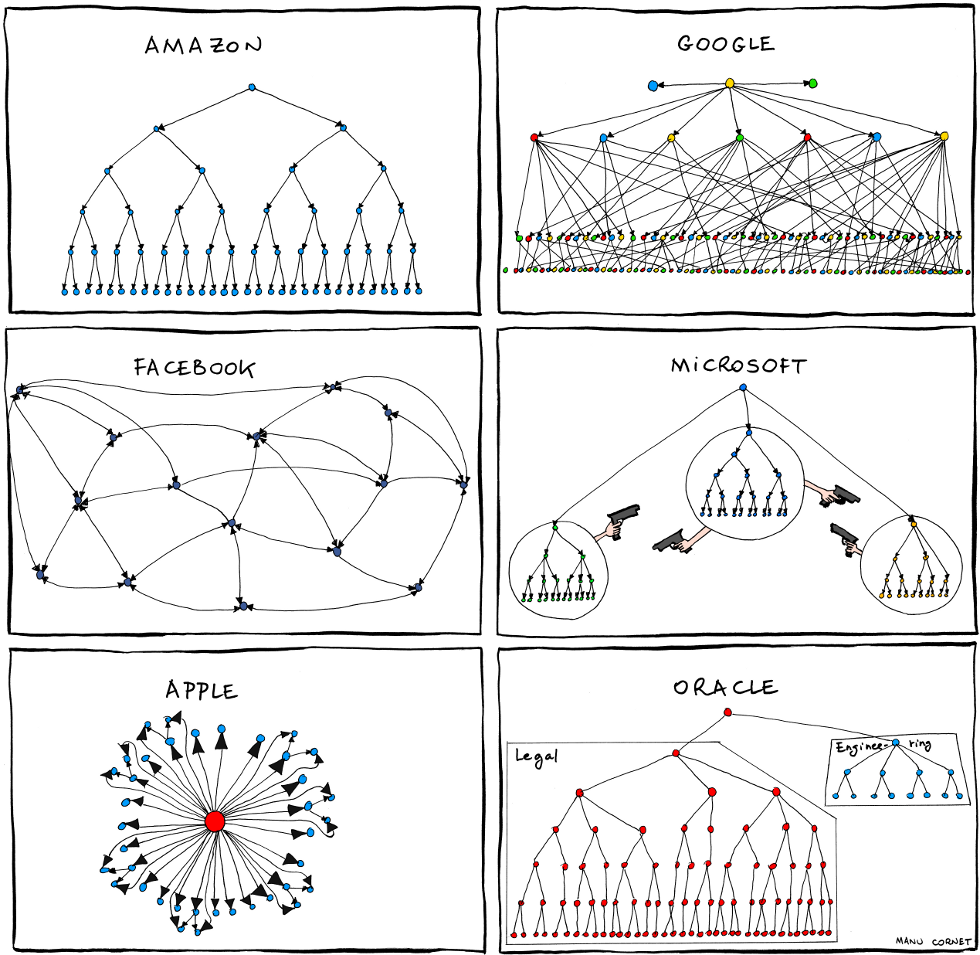
It was not just strategy but also culture. MSFT internal working dynamics used to be depicted as in the image [1]. This was also corroborated at that time by some of my friends working there.
Now the same friends admit that there is a lot improvement in this regard since Satya came on-board.
[1] https://images.squarespace-cdn.com/content/v1/500e2d14e4b042...
Re:Which jobs most often pair together among married couples
on Tuesday October 26, 2021 @11:05PM (#29009134)
Another data point from same website: Divorce Rate By Occupation
Re:Show HN: I built a fake VS Code to browse live cricket score in office
on Monday October 25, 2021 @06:53AM (#28986360)
This is mostly true for services companies (TCS, Infosys, etc). A lot of restrictions are there because clients demand it. It is borne out of fear of data breach. So these companies goes few steps ahead and impose blanket ban of lot of things e.g can't plug USB devices to company provided laptops, No permissions to install anything (except whitelisted software).
On the other hand, new age product companies/startups are similar to Silicon Valley.
Re:Google has a secret deal with FB called “Jedi Blue” that they knew ...
on Sunday October 24, 2021 @07:55AM (#28977090)
> When can we send the leadership to federal prison
Yeah, these companies make employees read & sign code-of-conduct, ethics etc. Hell, I was made to attend sessions explaining "values" of the company.
The sheer hypocrisy ... only if execs walk the talk, the world would be a better place