cmontella
There is! As of now, if you sort by recently updated, my literate programming project is the first result :P (link in profile if anyone reads this later)
Note the LLMs are trained on language semantics far beyond the mainstream ones, so language design can become quite exotic without straying too much from the training. You really do have to measure these things, I don’t see how you can make a confident assertion without data.
https://mech-lang.org/iros-r4r-2026/index.html#5805406811462...
I compare one algorithm across several programming languages and backends. There is no training data for Mech in the LLM yet it beats most other implementations in perf, which were optimized by LLM.
Maybe human performance engineers trained in these languages could write better implementations. But to answer the question of whether the LLM could write more performant code in languages it’s trained in versus languages it’s not, this comparison is at least illustartive.
That’s an interesting idea about an aromas transition, I’ll have to think about that. I put state machines in the language for better static program analysis and tracing, I think the aromas idea could complement that. What do you see as the main utility?
Have you written about your work anywhere else?
I'm with you there, I think I starred Oct when I came across it. I've been on that quest since 2014, we should collaborate! I'll be presenting this work at IROS tomorrow, I'd love to hear what you think: https://mech-lang.org/iros-r4r-2026/index.html
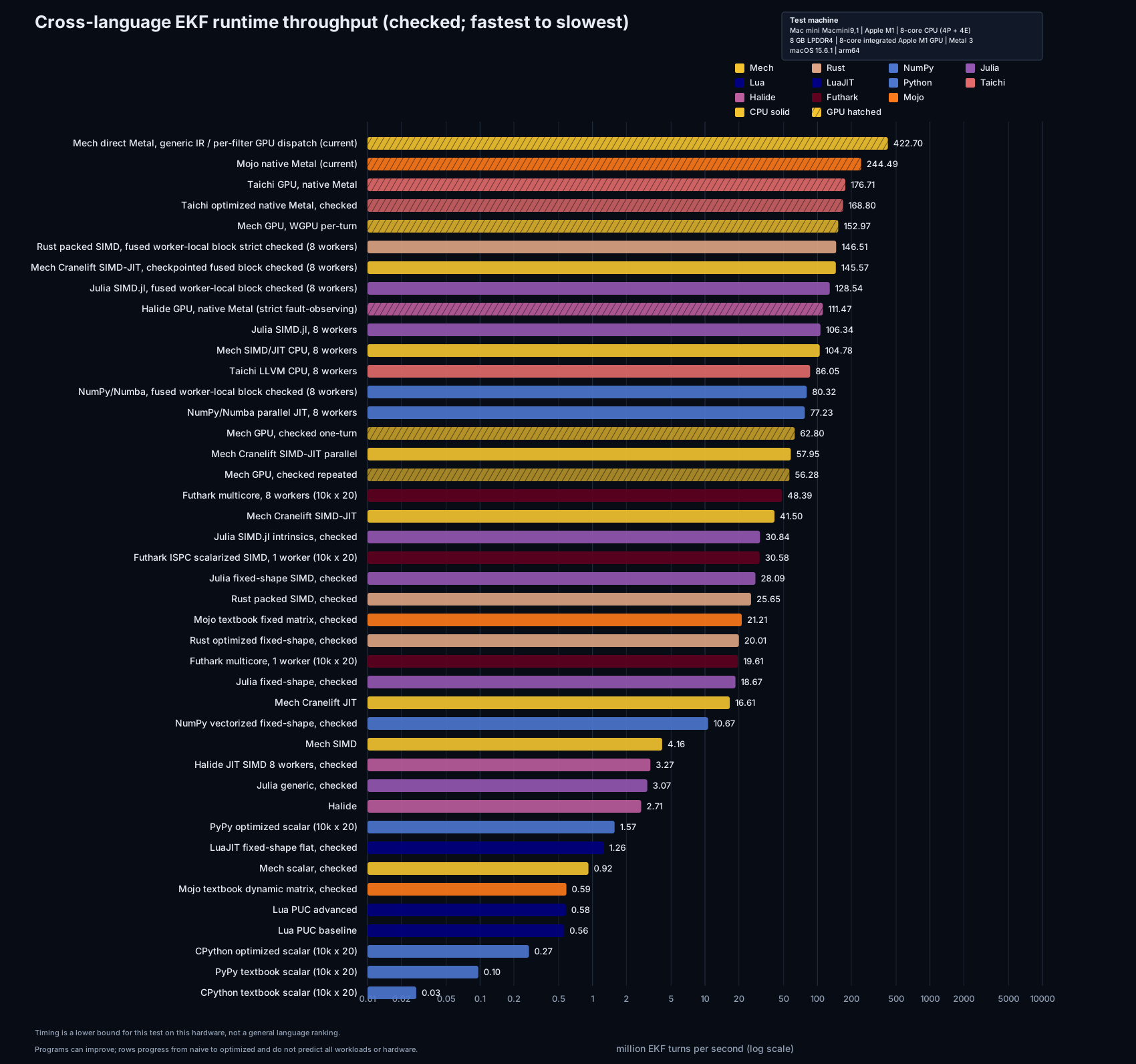
I added PyPy and Mojo.
PyPy performs valiantly compared to Cpython -- even better than LuaJIT. I'm sure someone skilled at writing it could do an even better job.
I measured 3 Mojo implementations. The first is a dynamic implementation, it performs like a typical dynamic language. Then when you use Mojo's SIMD intrinsics you can get compiled-tier performance in line with Futhark, Julia, Rust etc.
Then if you use their Max toolchain you can compile Mojo directly to Metal, with performance at the top of the stack (for the amount of money Qualcomm paid they'd better be there!).
The Rust / Mech version was rewritten to put it back on top, but the unchecked test is about equal. Basically if a toolchain can emit direct Metal code there's nothing preventing equal performance it seems, so the magic is in the compiler. Although there is some abstraction overhead depending on how you get there e.g. going wgpu->Metal has a penalty over going directly to Metal.
The big disclaimer again is that all of these measurements should be taken as lower bounds for one algorithm on one machine. I'm sure expert performance engineers could do better.
https://raw.githubusercontent.com/mech-lang/mech/codex/taich...
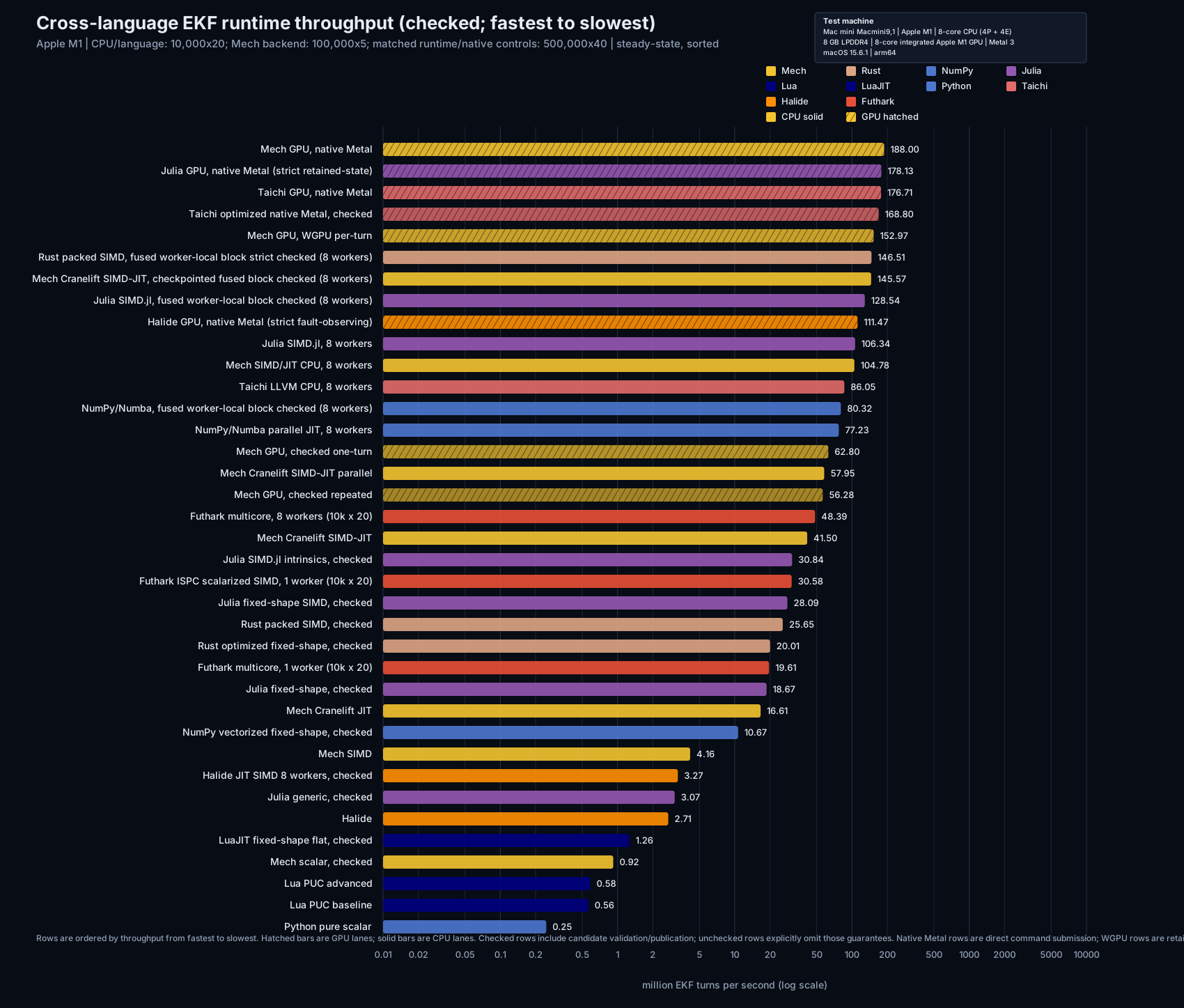
Compared against Taichi, Halide, Futhark, Rust', Lua, LuaJIT, Numpy and pure scalar Python. Julia holds up great it can run basically as fast as you'd like! (These are not apples-to-apples comparisons, picture this as a basket of fruit)
'The Mech results should be understood to be a lower bound on how Rust would perform.
https://mech-lang.org/post/2026-05-11-version-0.3/
Mech has a builtin presentation layer called Mechdown (a Markdown dialect) which allows tight integration between the document and the underlying program. You can see the source here: https://gitlab.com/mech-lang/web/website/-/raw/df4784d44b4ea...
Would appreciate any bug reports or issues: https://github.com/mech-lang/mech/issues
╭⬟╮The joke was the assistant is a cat who is constantly sabotaging you, and you have to take care of it like a gacha pet.
The seriousness though is that actually, disembodied intelligences are weird, so giving them a face and a body and emotions is a natural thing, and we already see that with various AI mascots and characters coming into existence.
[1]: serious: https://github.com/mech-lang/mech/releases/tag/v0.3.1-beta
[2]: joke: https://github.com/cmontella/purrtran
Here's the current version of my literate programming ideas, Mechdown: https://mech-lang.org/post/2025-11-12-mechdown/
It's a literate coding tool that is co-designed with the host language Mech, so the prose can co-exist in the program AST. The plan is to make the whole document queryable and available at runtime.
As a live coding environment, you would co-write the program with AI, and it would have access to your whole document tree, as well as live type information and values (even intermediate ones) for your whole program. This rich context should help it make better decisions about the code it writes, hopefully leading to better synthesized program.
You could send the AI a prompt, then it could generate the code using live type information; execute it live within the context of your program in a safe environment to make sure it type checks, runs, and produces the expected values; and then you can integrate it into your codebase with a reference to the AI conversation that generated it, which itself is a valid Mechdown document.
That's the current work anyway -- the basis of this is the literate programming environment, which is already done.
The docs show off some more examples of the code, which I anticipate will be mostly written by AIs in the future: https://docs.mech-lang.org/getting-started/introduction.html
Although, we've since moved to having several distinct data structures which conceptually map to tables, but implementation and syntax-wise have differences (mostly for performance).
BTW Basis was a good idea, I remember reading about Nondeterministic replay is a big problem on platforms like ROS.
It makes sense that the first thing I'd get to the front page of HN is what amounts to a bad joke :P
https://github.com/mech-lang/mech https://www.hytradboi.com/2022/i-tried-rubbing-a-database-on...
Not all features are implemented yet but we are getting there!
I also see two graphics, and several formal mathematical expressions. You can't modulo away all the not-natural language and then claim natural language alone was sufficient. I presume these things were added by the authors to increase clarity of the problem statement, and I agree with them. They used formal languages to specify all the important parameters in an unambiguous way, which was the right call! Otherwise we would all be left wondering at the semantics.
Anyway, I don't think this really responds to my point, because competition prompts are designed to be self-contained problem statements that are as clear and unambiguous as possible for competition purposes. And in this case, they switched to speaking in a formal language when being precise and unambiguous was most important.
On the other hand, my statement was about the task of programming, which typically involves solving ill-defined problems with specifications and requirements that shift over time. I've been in programming competitions, I've also been a programmer, and I don't find one to be really related to the other.
Well LLMs finally offer that, and what they are proving is what programmers have known for decades -- natural language is a terrible way to specify a program to a computer. So what is happening in the LLM world is they are reinventing programming languages and software engineering. They're just calling it "prompt engineering" and "context engineering".
What this tell us is that natural languages are not only not sufficient for the task of programming, to make them sufficient you need to bring back all the properties you lost by ditching the programming language. Things like reliability, reproducibility, determinism, unambiguity are thrown away when you use an LLM, and context engineering / prompt engineering are ways of trying to get that back. They won't work well. What you really want is a programming language.