abrenuntio
It ranges from simple stupidity and willfulness, "knuckleheaded" attempts to bring about God's promises on our own schedule using our own worldly means; to full-blown apostasy, idol worship and open rebellion; to the particularly sinister theme of a "counterfeit religion". All of it leads to bad outcomes, sometimes determining the rest of history, and none of it ever derails God's good promises coming to full fruition in their own time.
To answer your question: in my understanding, Scripture sees a good-natured, obedient kind of zealotry in a positive light. But this zealotry rarely makes the headlines.
My claim is that, by grace, both cults have successfully, over the course of many millennia, sniffed out loose but sound translations (even if they don't like the style or certain choices) from deliberately deviant translations.
Example: bringing the Law to the nations and bringing fear of the Lord to the nations refers to the exact same future, because fearing the Lord is a positive thing in Scripture. Israel itself was to be a spiritual sign of mankind fearing the Lord. And that future came to pass. God is bringing fear to the nations. Not the trembling fear for a dangerous oppressive army, but wholehearted conversion. By the time Messiah arrived, Jerusalem was already visited by eager "phoboumenoi": pagan "God-fearers" who had understood that the creator God of Israel was not like any of the pagan "gods".
An example of a translation truly deviating is for instance that made by Jehovah's Witnesses. An example: they translate ruach as "active force", not as a one-off choice because some human translator on some particular day in his own cultural context thought it just sounded better, but because JWs reject trinitarianism. You will not find a single actual Christian (or Jew!) accepting this as a (systematic) translation choice.
In fact, it's a testament to the divine inspiration of Scripture that Christians and Jews have never relied on an absolutely letter-for-letter standardized text to know the voice of their Shepherd.
Just yesterday I went to see a presentation of a priest appointed to a massive parish in the rural area of South Sudan, setting up schools and bringing in aid.
But I hope the Catholic Church of the future will take the defense of its flock more serious again. Many books (and movies and TV series...) out there contain downright evil ideas, sometimes presented in dishonest ways. Perhaps some organized, ecclesiastically sanctioned system of reviews to guide readers would be feasible?
Earth biomes will be kept intact with respect to their natural evolution. But human society will be treated as an amoral engineering problem seeking to optimize a few measurable parameters chosen up front. There is little sense in this proposal that human beings will bring along with them original sin or whatever you want to call it. But what allows human beings to flourish and keeps societies together, especially in conditions of scarcity (very much unlike the conditions of say the past half century), may not be obvious to the project planners.
In fact, much of what has been handed down to us in the legal and opaque cultural and religious traditions that have successfully survived such stresses in the past, is gleefully discarded.
The social engineering proposed is of the most dystopian and heavy-handed variety: it involves taking a group of volunteers to Antarctica to format them to a supposed sociocultural blank slate, followed by "characteristics monitoring". Despite the apparent care for superficial day-to-day happiness, human beings are to be indoctrinated to see themselves as discardable resources. They are not just governed with "mere" discipline, but with a program of violent population control (e.g. "maximum 2 childrens", "not necessarily with the same partner", "euthanasia", "not owned by the individual", ...).
So humans on Chrysalis will decide over every single aspect of life and death, not for themselves but for each other. But this time, unlike all earlier times, it will work because they're going to keep "governance architecture liquid, horizontal and inclusive" and "open source communities" and "not ethically compulsory" and based on "deep scenario exploration".
Will it ever be possible to prove that some future human theory of reality is complete?
But we don't do things to impress God. By supernatural grace we desire to become like God, from the inside out, in a way appropriate to our finite created nature. From grace comes our (sometimes clumsy...) imitation of Jesus and, why not, a desire for sacred art and beauty. By grace all of creation will be transformed.
Since you ask: what is elevated on the Catholic (and Orthodox) altars is the Son, the Lamb of God who takes away the sins of the world. It does not come from us, we did nothing to deserve it, and yet it was given to us so we can offer it to God. As the Lamb is elevated and we look up, we desire to add what little is in us. One expression of this desire is to have everything involved, from the building to the sacred vessels, express the sanctity of what is taking place. It may be clumsy, it may be mixed up with impure motives and false piety in some people. Who knows, it may really have been a bit much at times. But in itself, it is good and appropriate. It does not exclude other expressions of grace. In fact, to suppress it completely strikes me as joyless, misanthropic, deeply unbiblical and likewise potentially mixed up with impure motives and false piety.
What I think is wrong in your reply, is to confuse the art and golden vessels found in Catholic churches with privately owned wealth and a life dedicated to self-indulgence (like the rich man from Lazarus).
Finally, as a father I am always happy with the drawings of my kids, especially if I know that they really put effort in it. Would this same goodness also not exist in our Heavenly Father in a supereminent way?
https://www.newadvent.org/fathers/0714.htm
(E.g. when discussing the Eucharist.)
One of the most breathtaking pictures I've ever seen in this regard is of Mass in a German church completely destroyed during WW2.
https://www.churchpop.com/content/images/size/w1200/wordpres...
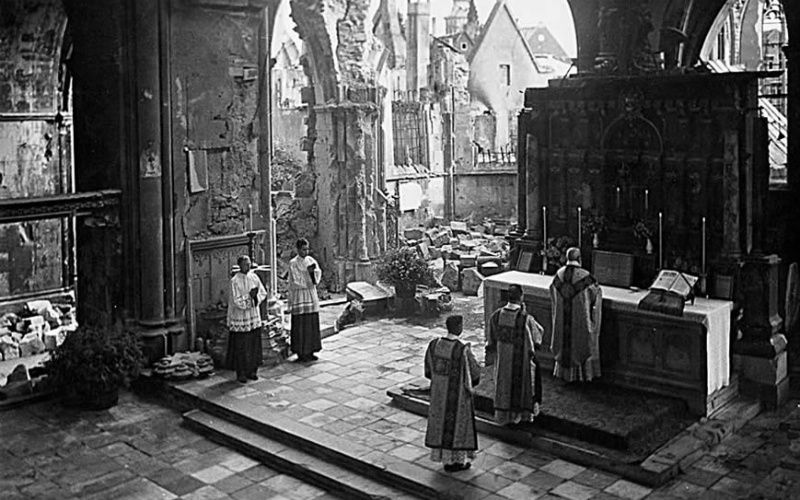
"Stat crux dum volvitur orbis"...
Sacred art exists to honor the Lord. We ourselves may remain poor and humble in the middle of all this beauty :-)
In the age of the Messiah the faithful are truly drawn “from every nation, from all tribes and peoples and languages”. If your wife would go to any (decent) Catholic or Orthodox church, and learns to "read" the building and the liturgy of Holy Mass, perhaps she could recognize the “pure” or “more Jewish" religion she is yearning for. She could go to modern or more traditional Latin/Greek/Ukrainian/Syriac/Ethiopian/... rites and in the plurality of all those different cultures and temperaments recognize over and over again the exact same elements and basic plan, organically evolved yet meticulously preserved in a chain of unbroken sacramental obedience.
Entering the church building she’d gradually walk from the holy water near the entrance, through the “outer courtyard” for the lay people, to the sanctuary with the sacrificial altar, golden vessels and incense, elevated and separated by altar rail or curtain. Behind is the tabernacle, the Holy of Holies containing the Real Presence, indicated by a lit candle.
And if she was to carefully analyse the words of the Eucharistic prayers in all these different rites and languages, she would find over and over again the same underlying structure, complete with the Haggadah. It is Christ Himself who preserved the liturgy of the ancient Passover meal, giving it its full and final meaning by substituting Himself for the symbolic lamb in the presence of the apostles.
The priest in this age is no longer a Levite. To properly offer sacrifice, he must now be sacramentally ordained by proper authorities “in the Order of Melchizedek”, reminiscent of the royal priesthood of David and the priesthood of Adam and the firstborns. If the priest obeys the liturgy that has been prescribed for his own rite and his own period, no amount of personal corruption can take away the sanctity of his work. This also means that there is no fundamental need for wars in the Holy Land or for "conquering" the Temple Mount by force. The third Temple is already being built. Every time the faithful, after having been sacramentally cleansed of mortal sin through baptism or confession, participate in the Lord’s sacrifice by eating the body and drinking the blood of the Lamb, they themselves will inevitably become more and more the dwelling place of the Lord within the material creation.
Bishop: "my colleagues have been trying for 1800 years and haven't succeeded."
Many flawed people belong to the Church. But the art of the Church does not belong to any individual. It exists to honor and glorify the Triune God from within material creation.
But late dating creates a host of disparate problems that must be explained. One problem coming to mind: Acts of the Apostles clearly ends with Paul still being alive.
If you simply don't share the assumption that prophecy is fundamentally impossible, then early dating for Mt, Mc and Lc becomes easy to accept on the basis of evidence.
In addition, the synoptic puzzle can be laid in a self-consistent and "path-of-least-resistance way" by looking at e.g. author motives: Matthew writing for the Jewish community in Jerusalem; Mark describing Peter's preaching in Rome; Luke writing as a Greek doctor for a gentile audience (and John writing much later, clarifying and responding to the first heresies that had popped up).
So the Q hypothesis, aside from being a theoretical construction based on internal evidence, is not necessary either.
See e.g. "Case Against Q: Studies in Markan Priority and the Synoptic Problem" by Goodacre.
I had the exact same reaction: "mind" as in "mind-body" for me refers to things such as reasoning, qualia, intentionality, the fact that neural patterns somehow receive "real meaning".
The mind may or may not be immaterial. This age-old question has not been resolved in any way, not even close.