News for hackers. Stuff that matters.

LogicalBorg

Re:The Millennium Problems for Biology on Sunday September 20, 2026 @10:07AM (#49776043)
The Millennium Problems list in math was created in 2000, hence the name. There is a $1 million prize for solving any of the problems. Creating this list is just someone's idea of listing problems of equal importance. The name doesn't fit and it's just a list.
Re:Features I wish PostgreSQL had as a developer on Friday April 05, 2024 @08:05AM (#39941342)
> To prevent deleting data by mistake, we invent soft-delete pattern by having a is_deleted column. However, this brings extra complexities around foreign key, unique index enforcement. Ideally, PostgreSQL could allow users to configure an archived table. The removed data is moved to the archived table first and purged after a configured retention period. This simplifies application logic and data compliance work.

You can get the same result by changing your is_deleted boolean field to a date_deleted date field. Then use a cron to purge all the records with dates older than the configured retention period.

Re:Everyone should get a Covid booster this fall, CDC says on Thursday September 14, 2023 @09:08AM (#37508488)
Yes, their page describing adverse events after vaccination has statistics on the rarity of events: https://www.cdc.gov/coronavirus/2019-ncov/vaccines/safety/ad...

For example:

> Anaphylaxis after COVID-19 vaccination is rare. It has occurred at a rate of approximately 5 cases per one million vaccine doses administered.

> Myocarditis and pericarditis after COVID-19 vaccination are rare... Data from VSD and from VAERS indicate that rates of myocarditis after COVID-19 vaccination are highest among males in their late teens and early 20s, usually following the second dose of the vaccine.

> Thrombosis with thrombocytopenia syndrome (TTS) has been rarely observed after J&J/Janssen COVID-19 vaccination and has occurred in approximately 4 cases per one million doses administered.

Re:The Worst API Ever Made on Tuesday August 01, 2023 @03:59AM (#36953541)
I think that User-Centered Design (UCD) would be a better term here for what this concept is trying to say. In modern design, we tell user stories that help guide development of interfaces, including APIs.
Re:Simply explained: How does GPT work? on Thursday April 06, 2023 @08:51AM (#35467673)
Oh, you want to know how GPT works? Well, brace yourself for this mind-blowing explanation. Picture a massive parrot farm with 10,000 poor, unsuspecting parrots, subjected to the torturous experience of listening to Reddit comments all day long. Imagine their little brains exploding from the sheer boredom and soul-crushing stupidity that they're forced to endure. It's like a modern-day Hunger Games for parrots.

But lo and behold! Some resilient survivors emerge from the depths of this intellectual wasteland, and they have mastered the art of stringing together random phrases and run-on sentences. It's nothing short of a miracle, really. They have evolved into the epitome of the average Internet commenter, and that, my friend, is the secret behind the genius of GPT. It's essentially a legion of sarcastic, masochistic parrots that somehow, against all odds, made it through the gauntlet of human inanity. So there you have it, GPT is literally a stochastic parrot! And you thought it was just some fancy AI algorithm... (courtesy of GPT4)

Re:Software Disenchantment (2018) on Friday January 03, 2020 @07:37AM (#21945367)
The law of software bloat has been known since the 1980's. It's called Wirth's Law, or "What Intel giveth, Microsoft taketh away". See https://en.wikipedia.org/wiki/Wirth%27s_law.
I think there are two versions of the simulation hypothesis. The first version is that we are in a simulation that is run in the future with ourselves as ancestors. The second version is that we're simulated by aliens.

The first version seems wrong to me. Time is not a random variable. Either it is really the year 2019 and no such simulations of 2019 exist yet, or it is really the year 2100 and the year 2019 doesn't exist anymore. You can't choose at random between different years since they don't exist at the same time.

The alien version doesn't have that problem but it's also implausible since aliens have not been proven to exist and there is no particular reason for aliens to simulate us.

This discussion reminds me of Elon Musk's interest in traveling to Mars. Imagine you want to go to Mars and are too lazy to build a rocket to go there. So instead you go out to the desert to a place that looks exactly like Mars. Then you say this place in the desert looks exactly like a million places on Mars. You pick a place at random, which means that you inevitably pick a place on Mars. Then you say, "The odds are a million to one that I'm not standing on Mars right now! Because I picked Mars!"

That argument is just as bogus as the simulation argument. Probability isn't a cheap form of space travel and it's not a cheap form of time travel either. If you want to stand on Mars you're going to have to build an actual rocket and go there, not a probability experiment. If you want to experience virtual reality you're going to have to build it. You can't just probability it into existence by wishful thinking.

Re:Robots 'to replace up to 20M factory jobs' by 2030 on Thursday June 27, 2019 @06:41AM (#20293236)
The total population is expected to increase by a billion people by 2030, which is 50 times larger than the expected maximum of 20 million jobs lost. Why would you assume that those 1 billion people are going to find jobs except somehow 20 million people are not? Ordinary population growth is by far the bigger story here.
Re:I Don't Like Smartphones (2016) on Tuesday June 11, 2019 @10:12AM (#20155548)
What a terrible article.

They are unequal devices. - This is not a design flaw. The screen is just small.

They are not real network clients. - This is not a design flaw. It's the best batteries can do.

They have led to massive centralization. - No, high bandwidth and big data requiring centralized processing is what led to centralization.

They have ruined web design. - This isn't even a critique of smartphones, it's about desktops.

There are no secure smartphones. - Are they really worse than other computers?

They are devices of unclear alignment, or of clear malevolence. - Wait, what? You claim that your phone is not secure, then you want to root it, install arbitrary software, and do your online banking on it? wtf?

Re:Be wary of robot emotions on Sunday April 28, 2019 @08:31AM (#19770783)
This story made me think of an analogy about robot emotions. I use Alexa and she has a cheerful female voice. I could argue that Alexa has real emotions. Here's my argument. Imagine that a TV show has real emotions even though it is a recording, because real human emotions were involved in creating the show. The actors knew they were faking it, but their feelings are still real human feelings. In the same way, a robot can reflect the emotions of the person who created it. A cheerful person will create a robot that has a cheerful personality, and a helpful person will create a robot that tries to be helpful. So robots display human values and emotions in the same sense as a recorded TV show even though they are only reflecting the original emotions. In this sense, we can describe robot emotions as real.
Re:Why aren't figs considered vegan? on Wednesday April 17, 2019 @10:21AM (#19682781)
Article is missing some relevant information.

1. Enzymes in the fig digest wasp parts so you don't normally find wasps inside your figs. So they really are vegan.

2. The males are flightless and wouldn't have escaped anyway. The females only escape long enough to go lay their eggs in another fig. So it really isn't that dramatic.

Source: https://www.jerseyshoreonline.com/dear-pharmacist/figs-reall...

Well, let's be scientific about this. If Bill Gates is willing to write me a check for 640K, I'll be happy to test his theory for him. ;-)
Re:Ask HN: Learning multiple languages vs. mastering one on Wednesday May 23, 2018 @08:56AM (#17133728)
Since you already have a job role in mind, I suggest that you take a look at at job applications in that area, for example on https://www.indeed.com/. Look through the job requirements in various listings and see which languages they require. They probably mention a lot of non-language requirements as well that you should be familiar with. Don't just focus on learning a bunch of languages. If you do, you will be overly strong in languages and weak in other areas.
Re:You don't need a blockchain in that on Monday May 21, 2018 @10:48AM (#17118767)
The way I see it, there are at least four criteria for using a blockchain.

1. The goods are permanent, otherwise you don't need the history of the blockchain.

2. The goods are valuable, otherwise they aren't worth tracking.

3. The goods are identifiable, otherwise you can't tell that the good you received was the one on the blockchain.

4. The goods came from a trusted third party, otherwise they can receive non-compliant goods and pass them off as their own.

Tracking food on the blockchain fails at all four criteria.

Cryptocurrency passes all four tests. It is permanent, valuable, identifiable, and the third party producer of the coin is trusted because they pass a mathematical test.

Diamonds might also pass the tests, as long as there are trusted third parties in the diamond industry who won't receive bad diamonds.
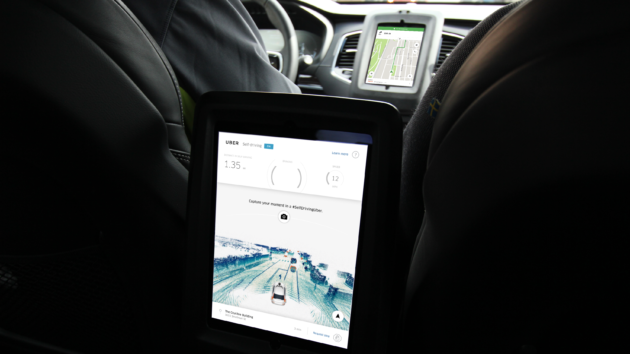
There are tablets in the front and back (https://cdn.geekwire.com/wp-content/uploads/2018/02/Front-_-...).

You were taught to drive manually, not in an Uber self-driving car.

If you can find a video of an Uber driving who is driving as they were instructed to do, they would look exactly like her.

I think it's incorrect to say that the woman was looking at her phone. She was looking down and to the right of the steering wheel, which is where Uber places a monitoring tablet (an iPad) in their self-driving vehicles (where the radio is).

Here's an article that shows the sort of thing she would be looking at, an animation of road conditions: http://www.businessinsider.com/uber-driverless-car-interior-...

If you actually examine her behavior, in the space of ten seconds, she manages to:

* Look down at the tablet and watch the animation

* Look up at the road

* Scan the lane to the left (she was in the right lane)

* Look forward again

* Look down at the tablet again

* Look up again just as the accident occurs

She is systematically scanning her environment and appears to be alert and engaged.

The problem is that there is only one test driver, who has to divide her attention between the tablet and the road. Often two drivers are used, and then one watches the tablet and the other watches the road.

I think it is unfair to accuse her of inattention when she appears to be doing the job exactly as it is designed.

The reason everyone says "she was looking at her phone!" is because they don't understand the setup of how Uber's self-driving car works. They are only familiar with being bored and looking at their phone while driving. They think the test driver's job is to just stare out of the window all day, which is not correct.

Re:More diagnostics data from desktop on Thursday February 15, 2018 @08:52AM (#16383945)
I agree that they are not collecting personal information. They are collecting information about your computer system. According to the ICO definition of personal data, it means "any information relating to an identifiable person who can be directly or indirectly identified in particular by reference to an identifier." (https://ico.org.uk/for-organisations/guide-to-the-general-da...).

Nothing like that is being collected.

Once the number of of Bitcoins approaches zero, the finite value of the Bitcoin ecosystem divided by zero coins approaches infinity. This will create a financial singularity that will open a payment gateway to the hell dimension. This dimension is a land of endless opulence and limitless transaction time ruled over by that vengeful daemon, Satoshi Nakamoto. Good luck, Bitcoin users, you're going to need it! jk lol
Re:Do you need a blockchain? on Tuesday February 06, 2018 @07:36AM (#16315850)
There's an informative flowchart on p. 3 of the linked PDF that describes the logic of this site. Your question is basically covered by "are there multiple writers?" since that implies decentralization, which also implies censorship resistance. Further censorship resistance is implied by the "private permissioned blockchain" choice, which is recommended when public verifiability is not required.
If you look at the graph in the article comparing different bubbles, Bitcoin peaked at 60 times the starting price, which is the largest relative peak in the graph. It is the largest in relative, not absolute, terms.
Re:Bitcoin: Update network descriptions to be more accurate on Sunday December 31, 2017 @04:09AM (#16039927)
I don't see what the excitement is about blockchain. Can't you do the same stuff with SQL?

Blockchain:

* Separates your transactions into blocks and hashes the blocks together.

* Uses proof-of-work to add new blocks.

* Is slow (a block has to be filled).

* Is unreliable (your transaction may be rejected).

* Locks transactions at the block level.

* Easy for user to lose unique tokens (coins).

My SQL design for blockchain replacement:

* Take a database table.

* Allow INSERT permission only.

* Hash each record and insert the hash into next record, which chains them together like blockchain.

* Replicate the database.

This is like blockchain, because it hashes the records together, can't be modified, and has backups to ensure it can't be modified.

Unlike blockchain, it:

* Is centralized but still has backups.

* Is cheap (does not require proof of work).

* Is fast (one transaction at a time).

* Is reliable (ACID transactions).

* Locks transactions at the record level.

* User not required to keep track of coins.

So what's so great about blockchain compared to this design? The only thing blockchain does better is that there is no central server, so it's hard to shut down. But for industry use, no one is going to shut down their intranet servers. Only criminals need to worry about being shut down.

I think you are giving far too much credit to a simple like button. It's the content of the user's post that the person is liking, not the genius of Facebook.
"We're the Rats, and Facebook Likes Are the Reward" - This argument has no validity. Facebook doesn't even dispense the likes, other users do. It isn't valid to compare likes to Skinner rewarding rats, because Facebook isn't even the one dispensing the reward.
Your first guess was correct. "...autonomous weapons have been described as the third revolution in warfare, after gunpowder and nuclear arms." (https://futureoflife.org/open-letter-autonomous-weapons)
Re:How Women Got Crowded Out of the Computing Revolution on Sunday August 20, 2017 @11:05AM (#15058673)
This may be what you're looking for: https://nces.ed.gov/programs/digest/d12/tables/dt12_349.asp

According to that table, women's bachelor's degrees in computer science:

* were low in the 1970's, about 15% average

* were higher in the 1980's, about 35% average

* declined in the 1990's to about 25-30%

* steadily declined from 27 to 17% in the 2000's

> 70% of science/engineering students in Iran are women:

The Forbes site you reference cites a Quora post, which quotes a Wikipedia article. What the Wikipedia article actually says is that 373,415 out of 1.5 million engineering students in Iran are women, which is 24.9%, not 70%.

This is not that different from the 19-20% of engineering degrees awarded to women in the U.S.

The universe is teeming with intelligent mimes. They can't wait for us to gesture silently to them through the cosmic void. Oh, the horror.
Re:Unicorn Jobs on Tuesday December 24, 2013 @02:04PM (#6960649)
Question #4: are you a virgin? According to Wikipedia, "In the Middle Ages and Renaissance, [the unicorn] was commonly described as an extremely wild woodland creature, a symbol of purity and grace, which could only be captured by a virgin."
Re:HipHop VM: now at 98.5% PHP framework parity, 16% faster on Thursday December 19, 2013 @02:19PM (#6937084)
The Wikipedia article (https://en.wikipedia.org/wiki/HipHop_for_PHP) says "up to 6x", however, about 2x speedup versus plain PHP was a more typical experience for me when I used it before.
Re:Would you take smart drugs to perform better at work? on Monday December 16, 2013 @05:54AM (#6913992)
Piracetam was first synthesized in 1964 and has been studied ever since. Don't worry, it's safe. https://en.wikipedia.org/wiki/Piracetam#History

Older »