Klapaucius
From an environmental perspective, CO2 sequestration for EOR (enhanced oil recovery) makes little sense, other than reducing the carbon footprint of production a bit, demonstrating the storage principle and further developing key technology.
What makes more sense is to use geological storage for CO2 captured from industrial processes other than power generation - production of cement, steel and chemicals, in other words processes that would release large amounts of CO2 even if switching 100% to renewable energy.
Also, we need some place to store all that CO2 that purportedly would be captured using DAC (direct air capture) in the future.
As I see it, Geological CO2 storage (CCS) may be the only large-scale practical way going forward, despite all the bad rap it gets due to its historical association with the fossile fuel industry. After all, the excess C in the system came from the ground, and the ground may be the only place able to re-absorb it without significant environmental consequences.
Also, keep in mind that CO2 is not stored as a gas, but in dense phase (liquid-like), due to the high pore pressures at the depths considered (> 3000 feet), well above the CO2 critical point.
At these depths, any leakage to the surface would be negligeable unless you make a really lousy job in choosing your reservoir.
I agree that we should aim to reduce energy usage, but I would argue we would need to both. As often said, there is no "silver bullet" to dealing with climate change, only the possibility of a "silver buckshot", where we'll have to do many large changes at once. Even if we could transit to 100% "green energy" overnight, that alone wouldn't take care of more than less than half of current emissions.
A third of emissions come from industrial processes, much of which entirely unrelated to the energy used. In a nutshell, these emissions can be reduced using CO2 capture/storage, or alternatively we could stop making things such as steel, cement or fertilizer.
Planting trees performs excellent on (1) but terribly on (2) and (3). According to Bill Gates' recent book on the topic (where he aims as best has he can to summarize the state of knowledge as per today), you'd basically have to make a big forest of the rest of the world just to offset US emissions.
In addition, it's not enough to plant trees, you have to plant trees where there wouldn't have grown any if you were not planting (i.e. making forest out of non-forest). This is going to put an additional huge strain on the need for land to feed more mouths, which is a problem that is only becoming more precarious.
To my understanding, the intermittency/baseload problem is a much larger problem than people give it credit for. And I don't think it is safe to assume that we will eventually "solve energy storage", any more than we can count on eventually developing commercially viable fusion or any other still-pie-in-the-sky technologies.
Perhaps we will, but dangerous to count on.
Cement is but one example of industrial processes that inherently release large amounts of CO2 even if we were to go 100% renewable energy-wise. Applying carbon-capture technology to cement plants would be a way to actually bring their emissions down to zero regardless. Capturing CO2 directly from such CO2-intensive processes would certainly give way more bang for the buck than trying to capture CO2 out of thin air, as many seems to be placing their hopes on these days.
And this is not theoretical. At least here in Norway, it is already being done at one cement plant: https://www.norcem.no/en/CCS
I agree that CCS shouldn't be used as an excuse to continue fossile fuel use. However, as long as there are fossile power plants in existence (and we are necessarily stuck with those for a very long time), it makes infintely more sense to capture emissions at the source (the power plant) rather than spending energy capturing CO2 out of "thin air" later.
Moreover, there are a host of industries (steel, cement, chemicals) that would continue emitting large amounts of CO2 even if they switched 100% to renewable energy). To cut these emissions, there is no alternative to capturing the CO2 and storing it.
Looking at the figures, I would dare to claim that people against the use of CCS are not really serious about tackling climate change. (And by the way, the reason large-scale CCS has not yet happened in Europe is to a large part public resistance - I would assume that's a big part of the reason for those power plants in Germany too).
Intersections are computed approximatively within some prescribed geometrical tolerance, and intersection curves are "marched out".
With emacs and vim around, I'd argue that text editors is a solved problem, if there ever was one. It is very hard to match emacs in terms of useful features or adaptability. Granted, the learning curve has a reputation for being steep, and elisp could need a facelift, but I think addressing these problems would provide much more value than reinventing the wheel with another shiny editor.
Oh yes, they are, and yes, they do.
But I am not sure whether this particular news item shows that anything has really changed in terms of policy. France has been bombing IS for quite some time already, as far as I understand.
According to those Western scholars who study IS ideology, it is clear that they adhere to an apocalyptic interpretation of islam where they envisage some kind of final battle against "the armies of Rome".
Whether the attack was intended to serve a strategic or ideologic purpose, or just to make a point, it is clear that the last thing they want is for it to change nothing.
So, in a purely rational world, the best reaction would be to change nothing. Not scale up military presence in Syria, certainly not scale it down, not change any policy, keep on carrying out business as usual, and on the emotional level, mourn, but not fear. Of course, we do not live in a purely rational world, so whether this route is even possible to follow, I don't know. But I really believe that if we were able to react (or rather non-react) in this way, it would be the very least the attackers wanted. It would reduce their "heroic deed" to just the meaningless slaugher that it was.
As a semi-analogy: After the right-wing extremist Anders Breivik killed some eighty people at a youth camp a few years ago, the Norwegian government more or less handled him as a regular criminal (albeit a high-profile one). Now he spends his day alone in a prison cell, occasionally whining in the media about not having the latest X-Box or something similar, pretty much revealing to everyone with a working brain what a small character he truly is. If he had been executed (not possible in Norway, I know....) he could surely have ended up being seen as a martyr by some.
And by the time the Dutch flee the Netherlands, it's too late to talk I'm afraid.
Therefore, we (me, you and the parent poster included) do need to rely on experts to get an impression of what is most likely to be true. If you imagine you can do this yourself to any significant degree, you are almost certainly deluding yourself.
That's why a figure such as 97% is so convincing, the remaining 3% (including Dr. Lindzen) nonwithstanding.
I didn't really expect an answer, so thank you for giving one anyway. From what you write, I get the impression that could be described as a "slippery slope" kind of situation, which I can understand. I don't know how I'd behave myself given those circumstances, although I'd of course like to think I'd resist somehow - but perhaps I'm fooling myself. And you are right that there are a lot of industries of questionable/negative moral worth out there (I listed a few of my picking in my previous comment, but you could add certain parts of banking/finance industry, tobacco industry and many others..)
I guess what amazes me is the number of people willing to sacrifice their limited time on this planet to actively work on stuff that is (if one is being honest with oneself) providing net negative value to society as a whole, making this world a shittier place for everyone. (Saying this as a relatively non-religious person).
The only permanent solution is sequestering the carbon deep underground (depleted oil/gas fields or saline aquifers). Most CO2 "utilization" cases (including production of biofuels) merely delay the inevitable release of the gas into the atmosphere.
Sequestering CO2 for the sake of sequestering it does not pay though. In order for this to make sense, a carbon tax would likely have to be imposed (it worked in Norway, where Statoil has stored excess CO2 geologically for almost two decades now at the Sleipner field).
But there are some encouraging news from Canada these days: http://blogs.scientificamerican.com/observations/2014/10/07/...
The point is that without some incredible advance in energy storage capability on a scale that is not on the radar today, we are stuck with an energy system where a significant component needs to be non-solar and non-wind. From a climate perspective, the best options would then be nuclear electricity or electricity from fossil fuel plans equipped with CCS technology (which is now belatedly emerging).
(Disclaimer: I work with CCS-related technology development).
[1] http://www.timera-energy.com/wp-content/uploads/2012/11/Hour...
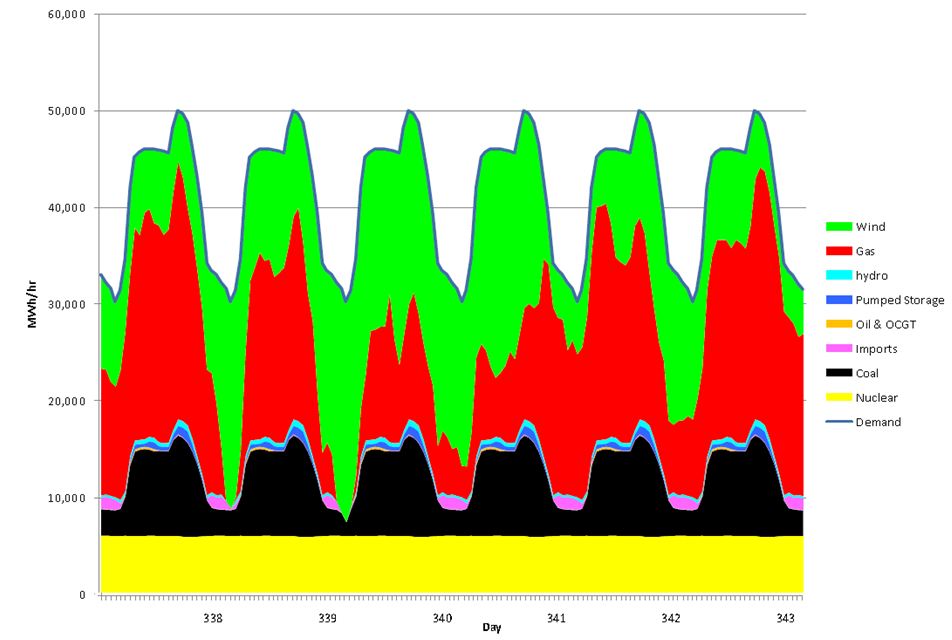
(link to page from which picture is taken: http://www.timera-energy.com/uk-power/getting-to-grips-with-...
How refreshening it was to return to my native high school after that year! Although it had is problem too, at least the norm among student was to be nice to each other. Being "cool" was certainly a thing, but students generally weren't obsessed about it. I am generally nostalgic about my high school days, except the year in the US.
This is just my personal anecdote, and is of course ludicrous to say that "bullying doesn't exist in Europe", but I cannot help but wondering whether my experience fit into a pattern. Watching American teenage dramas, it's just too uncannily like what I observed myself.
Also: https://www.asme.org/engineering-topics/articles/sustainabil...
I know too little of the subject myself to have a position on it, but it is an intriguing idea.