HermannSW
But 660fps is not the end for v1 camera, I added section "kFPS videos from kEPS multiple exposure frames" to my github "v1 camera global external shutter" repo: https://github.com/Hermann-SW/Raspberry_v1_camera_global_ext...
In that section a 3000fps and a 9000fps animation are shown (and the tools needed to create them)!
The repo introduction now contains comparison of 20$ diy highspeed flashlight with commercially available one (and with the very costly one you cannot produce kEPS multiple exposures and kFPS framerate videos): https://github.com/Hermann-SW/Raspberry_v1_camera_global_ext...
The MIT group used a flash with 0.5us exposure time. I asked for details without answer yet, but assume that it is costly (Vela One does cost 940£) and one-shot, no fast repeating flashes (Vela One has only 50Hz maximal continuous strobe frequency).
I used cheap 2$ 5000lm LEDs with 7$ led driver to convert mains to 38V/1.5A DC. I was able to do global external shutter captures with that led with 4us shutter time, did not try below yet. Most interestingly these LEDs allowed for 8.33us flashes at 9KHz frequency and used that to capture 109m/s flying airgun pellet 10 times in a single multiple exposure frame (9000eps, exposures per second). PI pwm should easily allow for 90,000eps frames for capturing 900m/s 0.50bmg bullets multiple times per frame in flight ...
You can do the same with 6$ Raspberry v1 camera clone (not with v2), bill of materials as well as global external shutter setup, software and example captured frames can be found here:
https://github.com/Hermann-SW/Raspberry_v1_camera_global_ext...
raspividyuv -md 7 -w 640 -h 480 -t 0 -fps 90 -o - | nc someIp somePort
and on someIp server service listeing on somePort just storing the data received. Because yuv has 12bits/pixel which is a bit more than the 10bit/pixel of raw Bayer, the command produces a 316Mbps stream of data for v1 camera (732Mbps for v2 camera when recording with "-fps 180"). For testing the service on someIp can be as easy as:
nc -l somePort > foobar
You can reduce the shutter time nearly arbitrarily, as long as you increase light intensity. I did place fast rotating propeller just above a 5000lm led, and did two 9us long flashes. See this image on how bright the two blades of propeller look, at both captured locations (the rest is dark, image was taken inside a closed cardbox, without flash everything was just black): https://raw.githubusercontent.com/Hermann-SW/Raspberry_v1_ca...
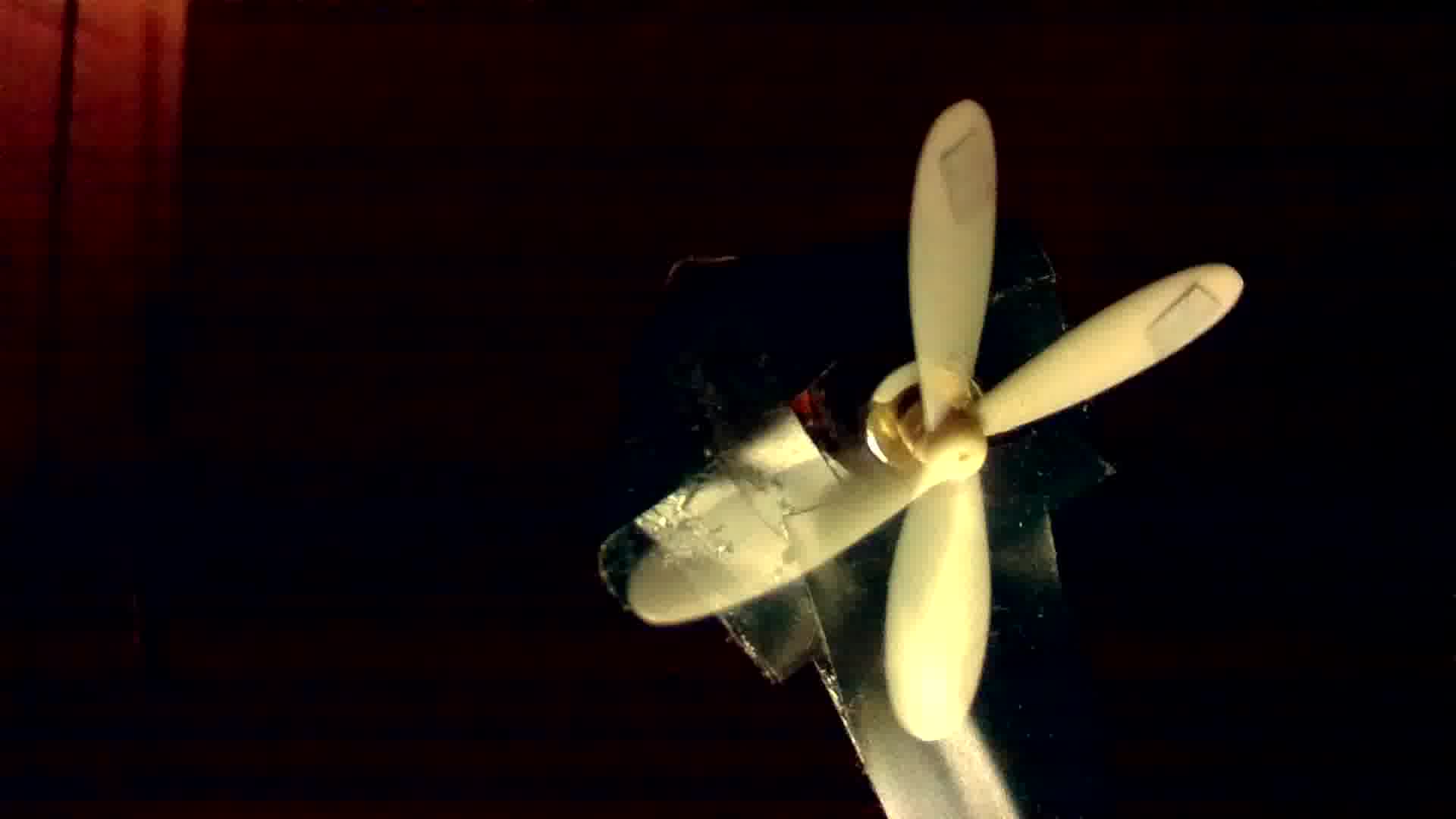
The idea is interesting, did some calculation. For v1 camera capturing 640xH frames can be done at framerate "42755/H+13". Lets forget about the 13. raspiraw transfers raw10 Bayer data, that is 640xHx1.25 bytes, with maximal framerate that gives 42755x640x1.25=34204000 bytes/s=261Mbit/s(!).
So you definitely need Gigabit ethernet of the Pi4, not sure whether Pi4 can actually stream out 261Mbit without losing stuff though ...
Just asked on Raspberry networking forum (261Mbps for v1, 464Mbps for v2): https://www.raspberrypi.org/forums/viewtopic.php?f=36&t=2482...
And you can hack the camera by injecting I2C commands to achieve effects impossible with the normal Raspbian camera software, like taking odd/even frames with different shutter speed: https://www.raspberrypi.org/forums/viewtopic.php?f=43&t=2126...
For reverse engineering camera I2C traffic, the v1 camera ov5647 datasheet is useful to have: https://cdn.sparkfun.com/datasheets/Dev/RaspberryPi/ov5647_f...
There was a MIT student project group that took 16 v1 cameras(!) global external shutter frames and created an animated .gif from that! "Ultra high-speed imaging, capturing matrix style bullet time" https://www.raspberrypi.org/forums/viewtopic.php?f=43&t=2404...
You can do the opposite and increase horizonatal resolution for line scanner type of application with still impressive framerates:
"v2 camera can do 3280x32@720fps and 3280x64@500fps with frame skip rate less than 1% (tools attached)."
https://www.raspberrypi.org/forums/viewtopic.php?f=43&t=1091...
You can do quite impressive gobal external shutter capturings (with v1 camera only!), eg. capturing a 109m/s airgun pellet in flight on a single multiple exposure frame 10x: https://github.com/Hermann-SW/Raspberry_v1_camera_global_ext...
And unlike v2 camera, the cheap v1 camera allows (besides high framerate capturing) for global external shutter capturing as well(!). I did capture an in flight 109m/s airgun pellet 10 times in a single multiple exposure frame! https://stamm-wilbrandt.de/en/Raspberry_camera.html#global_e...
Deal is basically "halve vertical resolution, and get roughly double framerate" (up to cap imit of around 665fps for v1 and exactly 1007fps for v2 camera).
In addition "tools/*_s" tools double vertical FOV while keeping the framerate.
In tools directory you can use *_s tools to get double FOV vertically while keeping the framerate. So you can get 640x128_s@665fps/640x256_s@667fps for v1/v2 camera.
There real limit for v2 camera is 1007fps, with can be achieved with 640x75 or 640x150_s tools. You can reduce vertical resolution below 75, but you will not get more than 1007fps (if you find out how to raise that limit, please shout! Deal for raspiraw high framerate capturing basically is "halve vertical resolution and get double framerate").